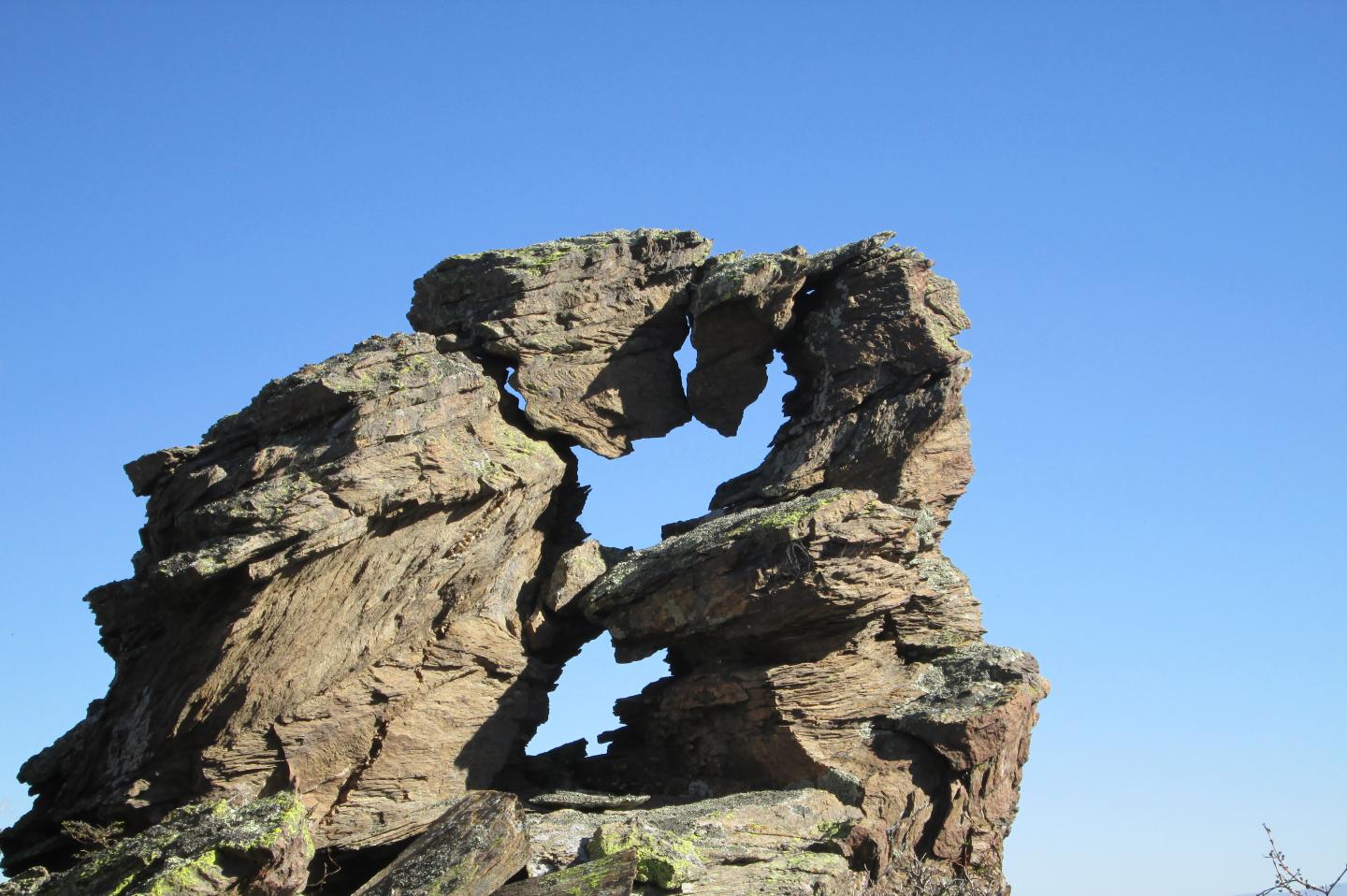
For the first time, researchers have used precariously-balanced rocks to set the formal design earthquake motions for a major existing engineered structure–the Clyde Dam, the largest concrete dam in New Zealand.
Mark Stirling of the University of Otago and colleagues identified and assessed the ages of these gravity-defying rock formations located about 2 kilometers from the dam site, using these data to determine the peak ground accelerations that the rocks could withstand before toppling.
This in turn was used to set the Safety Evaluation Earthquake (SEE) spectrum for the dam, or the expected peak earthquake ground motions occurring with a return period of 10,000 years that governs the safety assessment and seismic design of the structure.
As the researchers report in the Bulletin of the Seismological Society of America, the peak ground acceleration for the new SEE spectrum, developed from the rock data as well as an updated seismic hazard model for the region, is significantly reduced compared to their preliminary estimates developed in 2012.
However, the new design ground motion values are similar to those used–by chance–when the dam was built in the 1980s. “There is nothing that needs to be done in the way of dam strengthening,” said Stirling. “However, the study shows all the relevant authorities that the dam is compliant given the modern regulations.”
The study also “serves as an important proof-of-concept for future applications of fragile geologic features (FGFs) in engineering design,” Stirling and his colleagues write.
FGFs are especially useful in setting engineering design parameters in places where the period between relevant earthquakes is very long–10,000 years or more. In these cases, the geologic features can help test probabilistic seismic hazard estimates. While seismologists have explored the usefulness of these features for other engineering design projects, such as the canceled Yucca Mountain nuclear waste repository in Nevada and the Diablo Canyon power plant in California, the Clyde Dam is the first to use fragile features to set design ground motion.
The Clyde Dam is located in the Central Otago “Range and Basin” region of the southern part of New Zealand’s South Island. On a broad plateau located southwest of the dam called Cairnmuir flat, outcrops of schist rock that stick up above the landscape are carved by erosion into potentially unstable configurations.
In a painstaking effort, Stirling and colleagues identified these precariously-balanced rocks and took field measurements of their geometries to estimate their fragility. Then the researchers analyzed the formations using radionuclide data that estimate how long a rock surface has been exposed to the atmosphere. These data can show how long a rock has been balanced in a specific position.
“In terms of data collection, it was the FGF age estimation that was most challenging,” said Stirling. “It required specialist input, hard physical work, and there were usually large uncertainties in interpreting the dates to say how long the FGFs had been fragile.”
By combining these data with information on past earthquakes along the nearby Dunstan fault, Stirling and colleagues concluded that the rocks at Cairnmuir flat had been poised in their unstable positions since at least 24,000 years ago. This suggests that all of them have survived at least two Dunstan fault earthquakes.
The researchers then developed a fragility distribution of all precariously-balanced rocks in their study, based on peak ground acceleration, to determine the peak ground accelerations most likely to topple any random fragile rock structure with greater than 95% probability. This information was used to recommend a new SEE spectrum for the dam site.
Preliminary probabilistic seismic hazard calculations for the site suggested that “the FGFs in the area would be knocked down by these strong ground motions if they occurred–it’s easy to roughly estimate the fragility of the features by eye in the field,” Stirling explained. But since the features are still standing tall, it was then only a matter of time and research, he added, before the new Clyde Dam hazard estimates were revised.
###
Media Contact
Becky Ham
[email protected]
Related Journal Article
http://dx.