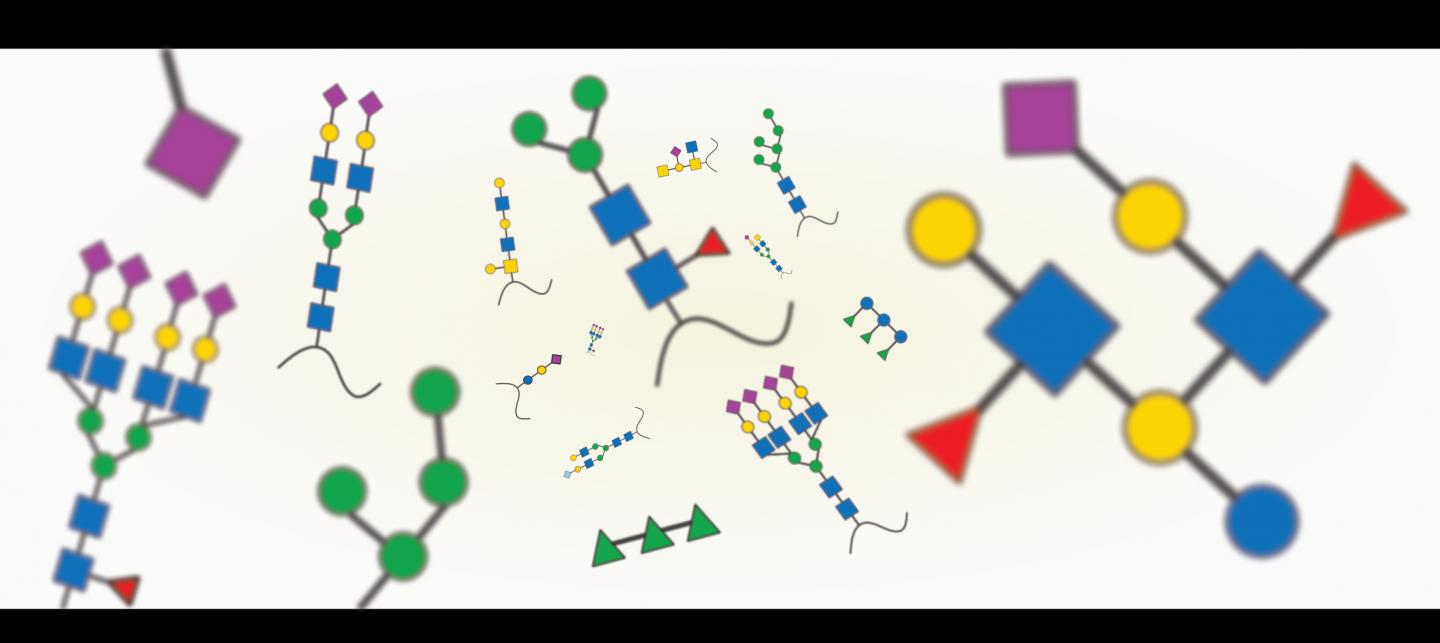
A new model that applies artificial intelligence to carbohydrates improves the understanding of the infection process and could help predict which viruses are likely to spread from animals to humans. This is reported in a recent study led by researchers at the University of Gothenburg.
Carbohydrates participate in nearly all biological processes – yet they are still not well understood. Referred to as glycans, these carbohydrates are crucial to making our body work the way it is supposed to. However, with a frightening frequency, they are also involved when our body does not work as intended. Nearly all viruses use glycans as their first contact with our cells in the process of infection, including our current menace SARS-CoV-2, causing the COVID-19 pandemic.
A research group led by Daniel Bojar, assistant professor at the University of Gothenburg, has now developed an artificial intelligence-based model to analyze glycans with an unprecedented level of accuracy. The model improves the understanding of the infection process by making it possible to predict new virus-glycan interactions, for example between glycans and influenza viruses or rotaviruses: a common cause for viral infections in infants.
As a result, the model can also lead to a better understanding of zoonotic diseases, where viruses spread from animals to humans.
“With the emergence of SARS-CoV-2, we have seen the potentially devastating consequences of viruses jumping from animals to humans. Our model can now be used to predict which viruses are particularly close to “jumping over”. We can analyze this by seeing how many mutations would be necessary for the viruses to recognize human glycans, which increases the risk of human infection. Also, the model helps us predict which parts of the human body are likely targeted by a potentially zoonotic virus, such as the respiratory system or the gastrointestinal tract”, says Daniel Bojar, who is the main author of the study.
In addition, the research group hopes to leverage the improved understanding of the infection process to prevent viral infection. The aim is to use the model to develop glycan-based antivirals, medicines that suppress the ability of viruses to replicate.
“Predicting virus-glycan interactions means we can now search for glycans that bind viruses better than our own glycans do, and use these “decoy” glycans as antivirals to prevent viral infection. However, further advances in glycan manufacturing are necessary, as potential antiviral glycans might include diverse sequences that are currently difficult to produce”, Daniel Bojar says.
He hopes the model will constitute a step towards including glycans in approaches to prevent and combat future pandemics, as they are currently neglected in favor of molecules that are simpler to analyze, such as DNA.
“The work of many groups in recent years has really revolutionized glycobiology and I think we are finally at the cusp of using these complex biomolecules for medical purposes. Exciting times are ahead,” says Daniel Bojar.
###
Title: Using Graph Convolutional Neural Networks to Learn a Representation for Glycans
Publication link: https://www.cell.com/cell-reports/fulltext/S2211-1247(21)00616-1
The researchers have developed graph neural networks for the analysis of glycans. This artificial intelligence technique views a glycan as a graph and learns sequence properties that can be used to predict glycan functions and interactions. The findings have been published in Cell Reports.
Contact:
Daniel Bojar, assistant professor at the Wallenberg Centre for Molecular and Translational Medicine and the Department of Chemistry and Molecular
Biology, University of Gothenburg.
Phone number: +46 (0)722-099822
Email address: [email protected]
Media Contact
Daniel Bojar
[email protected]
Original Source
https:/
Related Journal Article
http://dx.