High-speed internet access has gone from an amenity to a necessity for working and learning from home, and the COVID-19 pandemic has more clearly revealed the disadvantages for American households that lack a broadband connection.
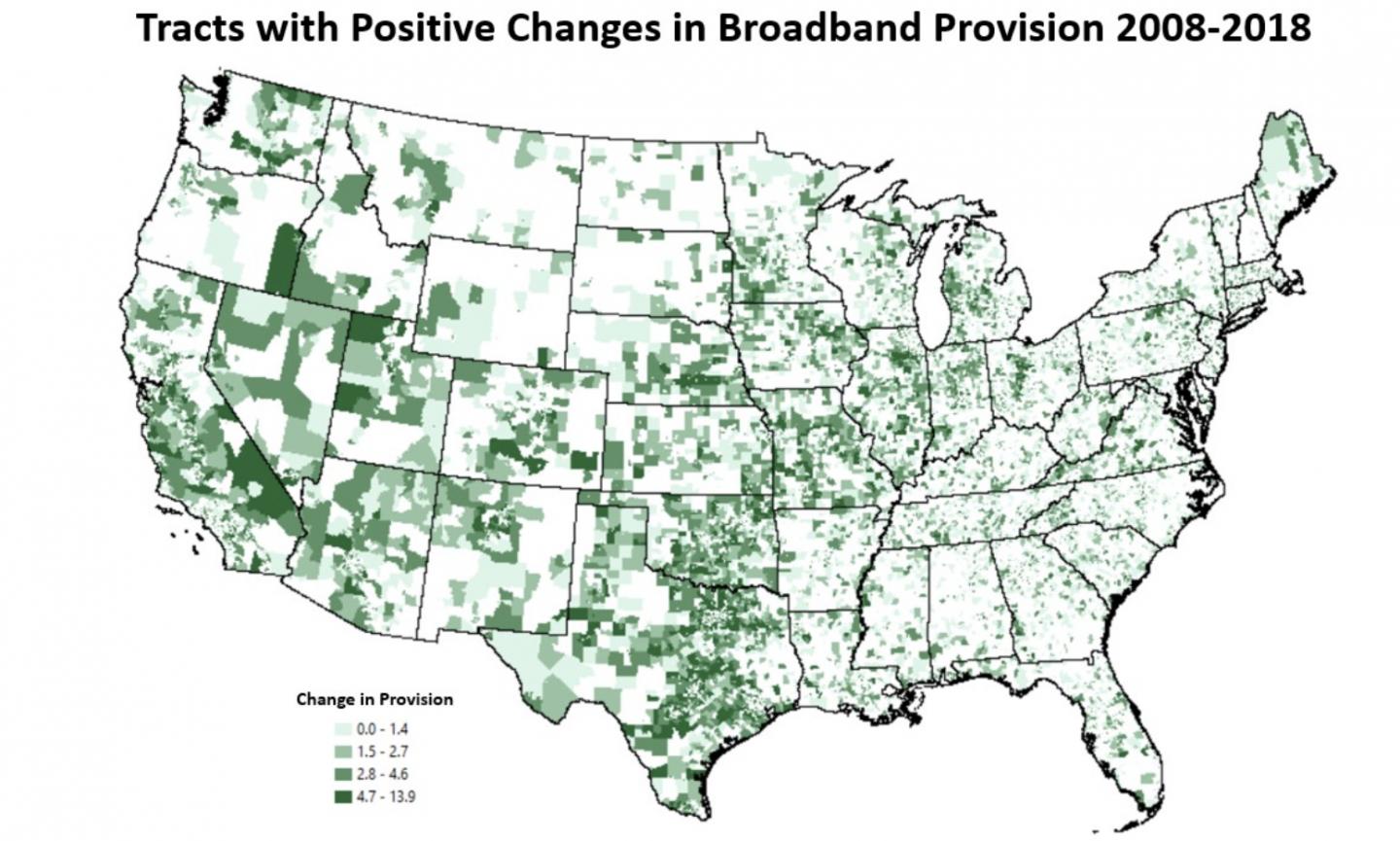
To tackle this problem, Michigan State University researchers have developed a new tool to smooth the collection of federal broadband access data that helps pinpoint coverage gaps across the U.S. The research was published May 26 In the journal PLOS ONE.
“Nearly 21% of students in urban areas are without at-home broadband, while 25% and 37% lack at-home broadband in suburban and rural areas,” said Elizabeth A. Mack, associate professor in the Department of Geography, Environment, and Spatial Sciences in the College of Social Science.
“As more of our day-to-day activities continue to move online, including education, commerce and health care, it’s essential that we understand where gaps in digital infrastructure exist. This is especially important if we want to address disparities in access related to demographics, socioeconomic status, and educational attainment,” she said.
When the U.S. Congress first passed the Telecommunications Act of 1996, the goal was to encourage competition in the telecommunications industry while improving the quality of service and lowering customer prices. To determine the act’s effectiveness, the Federal Communications Commission created a standardized form (Form 477) where twice a year, internet service providers are required to report where they provide service to residential and business customers.
“To date, Form 477 data remains the best publicly available data source regarding broadband deployment,” said Scott Loveridge, a professor in the Department of Agricultural, Food, and Resource Economics (AFRE). “Unfortunately, there are a lot of nuances to these data which to this point have prevented us from conducting useful analyses over time.”
One of these nuances is that the data collected from 2008 to 2018 spans the two census reporting periods of 2000 and 2010. This has made it difficult to look at the data overall and align it with the shifting census geographies, which do change each census year.
Loveridge, Mack and John Mann, an assistant professor with the Center for Economic Analysis, and several other researchers at the University of Texas and Arizona State University, worked together to produce a new dataset that resolves some of these issues by linking the breaks in the Form 477 data into a continuous timeline and aligning the data to the 2010 census.
“We developed a procedure for using the data to produce an integrated broadband time series,” Mann said. “The team has labeled the dataset BITS, which stands for a Broadband Integrated Time Series.”
“We hope these (BITS) data will be a tool to diagnosing gaps in broadband availability to help close the digital divide and enhance the participation of all people in online activities,” Mack said. “With shrinking public budgets and a need to pinpoint locations suffering from a chronic shortage of broadband, it is critical for policymakers to efficiently allocate the human, infrastructural and policy resources required to improve local conditions.”
###
This work was funded in part by a grant from the U.S. Department of Agriculture to examine broadband availability and its impact on business in rural and tribal areas.
Media Contact
Caroline Brooks
[email protected]
Original Source
https:/
Related Journal Article
http://dx.