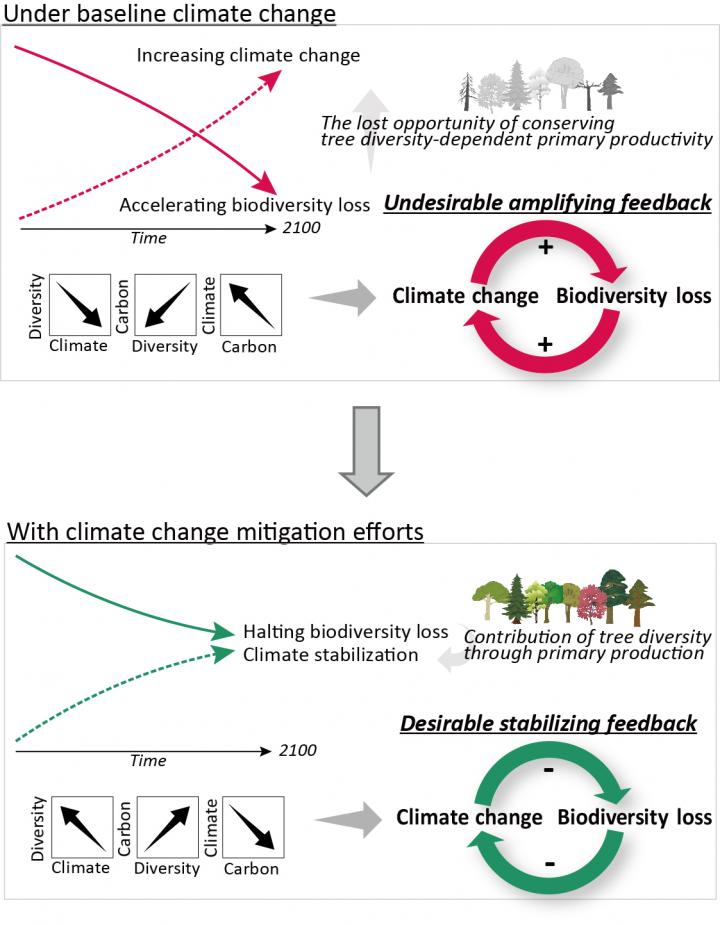
When it comes to climate change, policymakers may fail to see the trees for the forest. Turns out that the trees may be the answer after all, according to a study published by authors from more than seven countries on June 3rd in Nature Climate Change.
“Climate change and biodiversity loss are two major environmental challenges,” said paper author Akira S. Mori, professor at Yokohama National University. “But the vast majority of attention has been paid to one unidirectional relationship — climate change as a cause and biodiversity loss as a consequence.”
Mori and his co-authors argue that climate change and species diversity across ecosystems are mutually independent, and, while they can influence each other, they are not a direct cause and effect. The problem, Mori said, is that this perspective is largely lacking from both policy efforts and science so far.
“There is now recognition of the need for nature-based solutions, which involve working with nature to address society challenges, including carbon storage by restoring forests,” Mori said. “However, natural climate solutions are currently missing biodiversity as part of the equation: it is not yet widely appreciated as a powerful contributor to climate stabilization.”
To quantify how biodiversity, or the lack thereof, might influence climate change, the researchers used a multi-faceted modelling approach to assess how mitigation efforts impacted the diversity of woody plant species — namely, trees and shrubs — that can enable forests to store carbon. They divided the forested areas of Earth into 115 million grids, allowing them to analyze how shifts in species richness on the local level could change primary productivity — the ability to process carbon dioxide into other, benign and beneficial molecules, such as energy and oxygen. The researchers considered these changes and impacts against a baseline scenario in which global temperatures continue to rise and another scenario in which climate change is mitigated before reaching temperature increases of two degrees Celsius by the end of the 21st century.
“We found that greenhouse gas mitigation could help maintain tree diversity, and thereby avoid a nine to 39% reduction in terrestrial primary productivity across different biomes, which could otherwise occur over the next 50 years,” Mori said, noting that avoiding such a reduction could have significant social and economic benefits for communities.
The researchers scaled up the local estimates to understand how countries with varied biomes might fare in potential scenarios of reduced biodiversity and unabated climate change.
“We found that countries with the highest country-level social cost of carbon — the marginal damage expected to occur in a particular country as a consequence of additional carbon dioxide emissions produced anywhere in the world — have the greatest incentive to mitigate climate change to avoid its economic damages and also tend to be the countries where climate change mitigation could greatly help maintain primary productivity by safeguarding tree diversity, regardless of model or scenario,” Mori said.
For example, the United States and China, two of the biggest carbon producers, would likely experience the most significant economic damages due to global warming, which, Mori said, incentivize the countries to maintain tree diversity as part of their effort to mitigate emissions.
“Our results emphasize an opportunity for a triple win for climate, biodiversity and society, and highlight that these co-benefits should be the focus of reforestation programs,” Mori said.
The researchers are now preparing for two United Nations Framework Conventions: COP15, focused on biodiversity, in October and COP26, focused on climate, in November.
“We are aiming to provide strong implications for international policies since the interdependence of biodiversity and climate change are still not fully recognized by many governments,” Mori said.
###
Co-authors include Kei-ichi Okada, Faculty of Environment and Information Sciences, Yokohama National University, and Faculty of Bioindustry, Tokyo University of Agriculture; Laura E. Dee, Department of Ecology and Evolutionary Biology, University of Colorado; Andrew Gonzalez, Department of Biology, Quebec Centre for Biodiversity Science, McGill University; Haruka Ohashi, Department of Wildlife Biology, Forestry and Forest Products Research Institute, Forest Research and Management Organization; Jane Cowles and Forest Isbell, Department of Ecology, Evolution and Behavior, University of Minnesota; Alexandra J. Wright, California State University Los Angeles; Michel Loreau, Theoretical and Experimental Ecology Station, Centre national de la recherche scientifique; Yann Hautier, Ecology and Biodiversity Group, Department of Biology, Utrecht University; Tim Newbold, Centre for Biodiversity and Environment Research, Department of Genetics, Evolution and Environment, University College London; Peter B. Reich, Department of Forest Resources, University of Minnesota, and Hawkesbury Institute for the Environment, Western Sydney University; Tetsuya Matsui, Center for International Partnerships and Research on Climate Change, Forestry and Forest Products Research Institute, Forest Research and Management Organization; Wataru Takeuchi, Institute of Industrial Science, The University of Tokyo; and Rupert Seidl, School of Life Sciences, Technical University of Munich, and Berchtesgaden National Park.
The United States’ National Science Foundation, the Ichimura New Technology Foundation, Japan’s Environmental Restoration and Conservation Agency, Japan Society for the Promotion of Science, Liber Ero Chair in Biodiversity and the TULIP Laboratory of Excellence supported this work.
Yokohama National University (YNU or Yokokoku) is a Japanese national university founded in 1949. YNU provides students with a practical education utilizing the wide expertise of its faculty and facilitates engagement with the global community. YNU’s strength in the academic research of practical application sciences leads to high-impact publications and contributes to international scientific research and the global society. For more information, please see: https:/
Media Contact
Akiko Tsumura
[email protected]
Related Journal Article
http://dx.