• HOME
  • NEWS
  • EXPLORE
    • CAREER
      • Companies
      • Jobs
    • EVENTS
    • iGEM
      • News
      • Team
    • PHOTOS
    • VIDEO
    • WIKI
  • BLOG
  • COMMUNITY
    • FACEBOOK
    • INSTAGRAM
    • TWITTER
Saturday, February 7, 2026
BIOENGINEER.ORG
No Result
View All Result
  • Login
  • HOME
  • NEWS
  • EXPLORE
    • CAREER
      • Companies
      • Jobs
        • Lecturer
        • PhD Studentship
        • Postdoc
        • Research Assistant
    • EVENTS
    • iGEM
      • News
      • Team
    • PHOTOS
    • VIDEO
    • WIKI
  • BLOG
  • COMMUNITY
    • FACEBOOK
    • INSTAGRAM
    • TWITTER
  • HOME
  • NEWS
  • EXPLORE
    • CAREER
      • Companies
      • Jobs
        • Lecturer
        • PhD Studentship
        • Postdoc
        • Research Assistant
    • EVENTS
    • iGEM
      • News
      • Team
    • PHOTOS
    • VIDEO
    • WIKI
  • BLOG
  • COMMUNITY
    • FACEBOOK
    • INSTAGRAM
    • TWITTER
No Result
View All Result
Bioengineer.org
No Result
View All Result
Home NEWS Science News Chemistry

RUDN University chemists created cheap catalysts for ethanol conversion

Bioengineer by Bioengineer
September 6, 2025
in Chemistry
Reading Time: 2 mins read
0
IMAGE
Share on FacebookShare on TwitterShare on LinkedinShare on RedditShare on Telegram

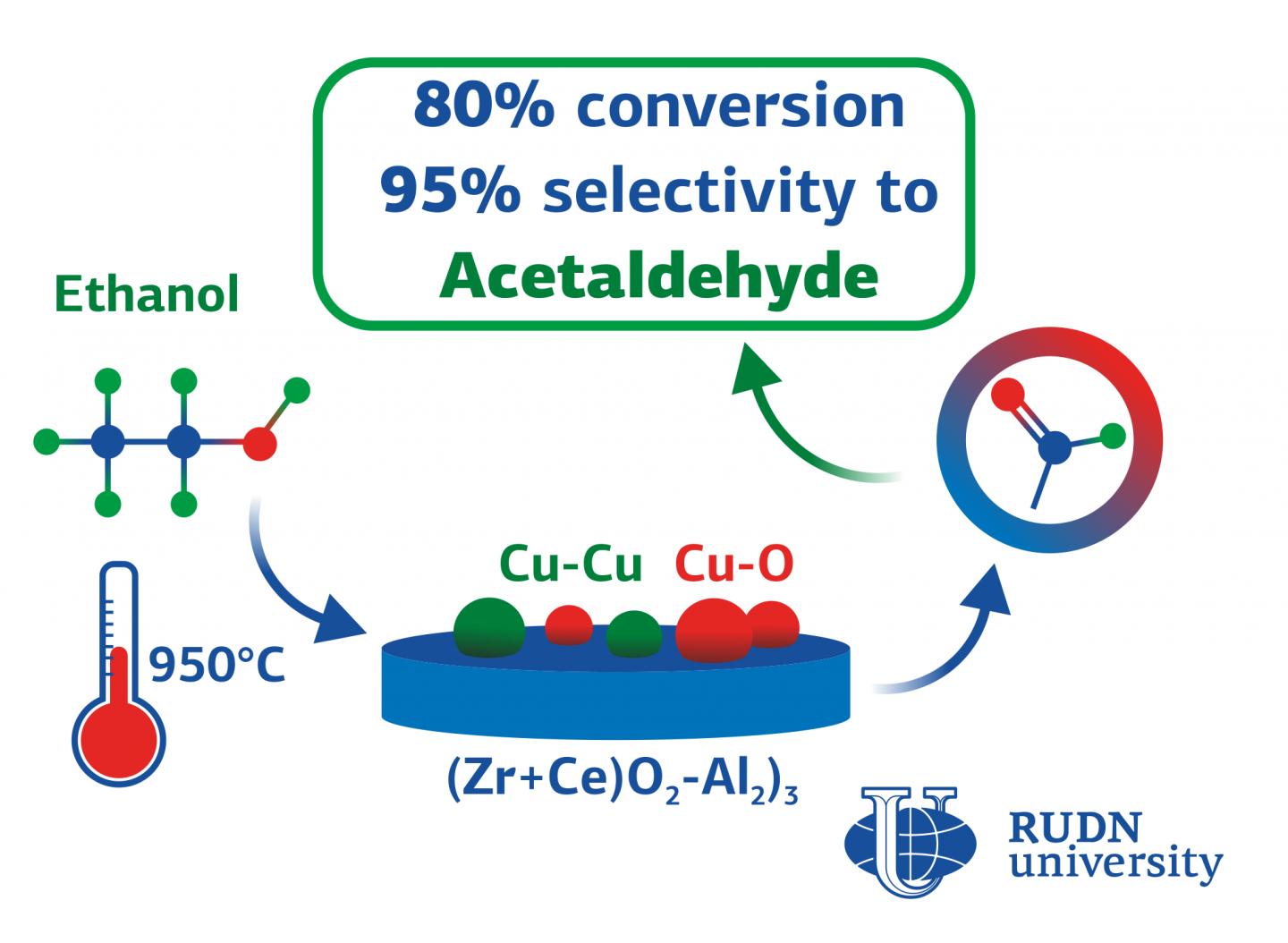
RUDN University chemists proposed a new way to synthesize catalysts for the conversion of ethyl alcohol. The obtained materials are promising catalysts for the selective conversion of ethanol, which is an important stage in the development of an alternative technology for obtaining valuable chemical synthesis products based on plant raw materials. The results of the study are published in Catalysis Today.

Ethanol fuel is ethyl alcohol, it is produced from plant material by fermentation of industrial or agricultural waste biomass. It is used as a more environmentally friendly fuel compared to gasoline. But this is not its sole use — ethanol can be converted into acetaldehyde, diethyl ether and other chemicals that are in demand in the industry. Highly efficient catalysts are required to trigger such chemical reactions. However, existing catalysts contain precious metals, and therefore they are too expensive to use. RUDN University chemists proposed new catalysts based on aluminium and zirconium, modified with copper.

“The best-known catalysts for ethanol conversion are based on oxides promoted by noble metals. However, they are quite expensive. A more affordable option is catalysts with copper as the active phase, but so far, the best option has not been found among them. Improvements are required to use these catalysts to ensure both high conversion and selectivity of the reaction — that is, to leave as little ethanol as possible unprocessed and at the same time to obtain the necessary substances, and not by-products”, Anna Zhukova, associated professor, PhD, from the Department of Physical and Colloidal Chemistry of RUDN University

RUDN chemists combined two approaches to improve the efficiency of catalysts for acetaldehyde synthesis. First, they combined oxides of several metals in nanocomposites: aluminium, cerium, and zirconium. The researchers synthesized five types of powders with different oxides ratios. Five of them was prepared at a relatively low temperature of 180°C, and another five was heated to 950°C. This made it possible to form different structures in the materials. The calcined samples had a large diameter and pore volume.

The second idea was to add copper. All the powders were soaked in an aqueous solution of copper nitrate, dried at room temperature, and exposed to a flow of hydrogen at 400°C. After that, the finished catalysts were tested in the ethanol vapor dehydrogenation reaction. Chemists placed them in a thin layer on a porous filter, and then fed alcohol vapors in the helium flow. The reaction was carried out at temperatures from 240°C to 360°C.

“All obtained systems demonstrated ? high alcohol conversion and selectivity to acetaldehyde. The copper containing catalysts with 5% aluminium oxide produced significant amounts of acetaldehyde with selectivity above 80 % at 3600C. We found that the mixed composition of the oxides creates conditions for the formation of active centres on the surface of the catalyst from copper ions with different charges. The best option is to use a mixture of oxides with a small content of aluminium in the synthesis of the catalyst and calcinate them at 950°C”, Anna Zhukova from RUDN University

###

Media Contact
Valeriya Antonova
[email protected]

Related Journal Article

http://dx.doi.org/10.1016/j.cattod.2021.02.015

Tags: Chemistry/Physics/Materials Sciences
Share12Tweet8Share2ShareShareShare2

Related Posts

blank

Breakthrough in Environmental Cleanup: Scientists Develop Solar-Activated Biochar for Faster Remediation

February 7, 2026
blank

Cutting Costs: Making Hydrogen Fuel Cells More Affordable

February 6, 2026

Scientists Develop Hand-Held “Levitating” Time Crystals

February 6, 2026

Observing a Key Green-Energy Catalyst Dissolve Atom by Atom

February 6, 2026
Please login to join discussion

POPULAR NEWS

  • Robotic Ureteral Reconstruction: A Novel Approach

    Robotic Ureteral Reconstruction: A Novel Approach

    82 shares
    Share 33 Tweet 21
  • Digital Privacy: Health Data Control in Incarceration

    63 shares
    Share 25 Tweet 16
  • Study Reveals Lipid Accumulation in ME/CFS Cells

    57 shares
    Share 23 Tweet 14
  • Breakthrough in RNA Research Accelerates Medical Innovations Timeline

    53 shares
    Share 21 Tweet 13

About

We bring you the latest biotechnology news from best research centers and universities around the world. Check our website.

Follow us

Recent News

Palmitoylation of Tfr1 Drives Platelet Ferroptosis and Exacerbates Liver Damage in Heat Stroke

Oxygen-Enhanced Dual-Section Microneedle Patch Improves Drug Delivery and Boosts Photodynamic and Anti-Inflammatory Treatment for Psoriasis

Scientists Identify SARS-CoV-2 PLpro and RIPK1 Inhibitors Showing Potent Synergistic Antiviral Effects in Mouse COVID-19 Model

Subscribe to Blog via Email

Enter your email address to subscribe to this blog and receive notifications of new posts by email.

Join 73 other subscribers
  • Contact Us

Bioengineer.org © Copyright 2023 All Rights Reserved.

Welcome Back!

Login to your account below

Forgotten Password?

Retrieve your password

Please enter your username or email address to reset your password.

Log In
No Result
View All Result
  • Homepages
    • Home Page 1
    • Home Page 2
  • News
  • National
  • Business
  • Health
  • Lifestyle
  • Science

Bioengineer.org © Copyright 2023 All Rights Reserved.