MUSC Hollings Cancer Center researcher awarded Young Investigator Award to study the function of protein CDK6 in T-cells for melanoma therapy
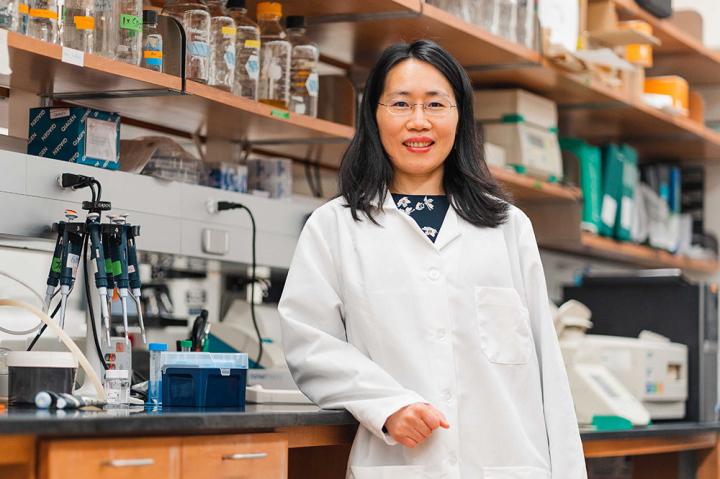
MUSC Hollings Cancer Center researcher Haizhen (Jen) Wang, Ph.D., recently was awarded a three-year $225,000 Young Investigator grant from the Melanoma Research Alliance.
MRA research awards support innovative ideas that offer the promise of rapidly improving outcomes for patients facing melanoma. Each award was selected during MRA’s grant review through a rigorous peer review process and was confirmed by the MRA Board of Directors. The alliance, the largest nonprofit funder of melanoma research, announced $8.1 million in funding for 34 new awards that support research at 27 institutions in seven countries.
MRA chief science officer Marc Hurlbert, Ph.D., said in the company’s press release that MRA grant awards support scientists who are pushing the envelope in order to address some of the biggest unanswered questions in melanoma. “These include researchers working on modulating the microbiome to improve patient outcomes and others exploring strategies to understand and overcome resistance to therapies,” he said.
Wang said she is appreciative of the funding support. “This will aid my investigation into the mechanisms of tumor progression to help to build the picture of how to turn on anti-cancer T-cells in melanoma patients,” she said. Tumor microenvironment cells play profound roles in cancer progression, and T-cells have become a central focus for engaging the immune system in the fight against cancer, including melanoma, she explained.
“If we can find a way to activate T-cells, this will lead to novel and promising strategies in this fight, such as cellular immunotherapies and checkpoint blockade. My research focuses on trying to figure out the mechanism to activate T-cells and preclinically test the effectiveness of this new therapeutic strategy on melanoma,” said Wang.
According to the Skin Cancer Foundation, 1 in 5 Americans will develop skin cancer by the age of 70. While more than two people die of skin cancer in the U.S. every hour, the five-year survival rate for melanoma is 99% when it is caught in the early stages. Data from the American Cancer Society shows that in the past decade (2011-2021), the number of new invasive melanoma cases diagnosed annually increased by 44%.
Hollings Cancer Center takes a multi-pronged approach to address skin cancer, including promoting routine skin cancer screenings and supporting collaborative research between clinicians and basic science researchers. Wang believes that the strong clinical research environment is one of Hollings’ top strengths, she said.
Wang, who also is an assistant professor in the Department of Cell and Molecular Pharmacology and Experimental Therapeutics, is tackling the challenge of immunotherapy resistance in melanoma. She was recruited to MUSC in 2018 after completing her postdoctoral work at Harvard Medical School’s Dana-Farber Cancer Institute.
“I became excited about cancer research when I became a Ph.D. student. I often think, ‘What if I discover something that makes a difference?’ My goal is to further our understanding of how the immune system works in cancer so we can help more patients,” she said.
Melanoma has been a primary research focus for Wang since her postdoctoral training. Her prior research, published in Nature, found that cyclin-dependent kinase (CDK6) is an important pro-survival protein that can be exploited as a cancer therapy. Now she is looking at the function of CDK6 in T-cells that migrate into the tumor microenvironment.
“The evidence that this is an appropriate pathway to tackle is quite strong. It is just a stepwise process. The funding from the Melanoma Research Alliance will help me to recruit skilled staff and collect more data from clinical samples.” By combining data from animal models and coordinating with clinicians to look at the T-cells in human melanoma, progress will be made toward combination therapies that are more effective for patients, she said.
###
About MUSC
Founded in 1824 in Charleston, MUSC is the oldest medical school in the South as well as the state’s only integrated academic health sciences center with a unique charge to serve the state through education, research and patient care. Each year, MUSC educates and trains more than 3,000 students and nearly 800 residents in six colleges: Dental Medicine, Graduate Studies, Health Professions, Medicine, Nursing and Pharmacy. The state’s leader in obtaining biomedical research funds, in fiscal year 2019, MUSC set a new high, bringing in more than $284 million. For information on academic programs, visit musc.edu.
As the clinical health system of the Medical University of South Carolina, MUSC Health is dedicated to delivering the highest quality patient care available while training generations of competent, compassionate health care providers to serve the people of South Carolina and beyond. Comprising some 1,600 beds, more than 100 outreach sites, the MUSC College of Medicine, the physicians’ practice plan and nearly 275 telehealth locations, MUSC Health owns and operates eight hospitals situated in Charleston, Chester, Florence, Lancaster and Marion counties. In 2020, for the sixth consecutive year, U.S. News & World Report named MUSC Health the No. 1 hospital in South Carolina. To learn more about clinical patient services, visit muschealth.org.
MUSC and its affiliates have collective annual budgets of $3.2 billion. The more than 17,000 MUSC team members include world-class faculty, physicians, specialty providers and scientists who deliver groundbreaking education, research, technology and patient care
About MUSC Hollings Cancer Center
MUSC Hollings Cancer Center is a National Cancer Institute-designated cancer center and the largest academic-based cancer research program in South Carolina. The cancer center comprises more than 100 faculty cancer scientists and 20 academic departments. It has an annual research funding portfolio of more than $44 million and a dedication to reducing the cancer burden in South Carolina. Hollings offers state-of-the-art diagnostic capabilities, therapies and surgical techniques within multidisciplinary clinics that include surgeons, medical oncologists, radiation therapists, radiologists, pathologists, psychologists and other specialists equipped for the full range of cancer care, including more than 200 clinical trials. For more information, visit hollingscancercenter.musc.edu.
Media Contact
Dawn Brazell
[email protected]
Original Source
https:/