Infrared thermal imaging as a novel non-invasive point-of-care tool to assess filarial lymphoedema
Credit: Louise Kelly-Hope
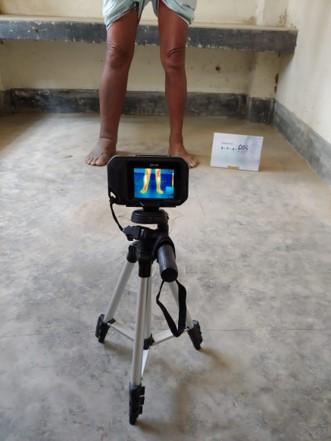
A paper published in the Journal of Clinical Medicine presents the results from a study which examined the use of an infrared thermal imaging camera as a novel non-invasive point-of-care tool for lymphatic filariasis lower-limb lymphoedema.
Thermal imaging has been used for several decades in a wide range of medical disciplines, but this is the first time it has been used for filariasis or any skin neglected tropical disease (NTD).
LSTM’s Dr Louise Kelly-Hope led the research. She said: “Infrared thermal imaging presents an innovative and objective method for quantifying clinical change in filarial lymphoedema status by using naturally emitting infrared radiation to capture skin surface temperatures. This tool will help to objectively monitor progression of disease or detect new and sub-clinical cases in the field.”
The LSTM team first trialled the use of the thermal imaging in Malawi in 2019 with the lymphatic filariasis elimination programme team using an FLIR iPhone thermal camera, which provided important insights into its utility as a non-invasive diagnostic.
This helped to design a multi-country prospective cohort study in Bangladesh, Ethiopia and Malawi using the robust compact FLIR C3 thermal camera, which is ongoing and includes ~750 people affected by lymphatic filariasis. The study aims to assess the impact of the enhanced self-care morbidity management protocol on lymphoedema patients with mild, moderate and severe conditions.
This paper present results from the first baseline survey conducted in Bangladesh in October 2020, which included 153 people affected by lymphoedema.
- The images show clear significant differences by the severity of lymphoedema – it helps to ‘see’ the ‘unseeable’ and highlights that the ‘affected legs’ are hotter, especially in people with more severe conditions, which is associated with inflammation, damage and disease progression.
- It also helps to show the extent to which limbs are affected – people with milder conditions tended to have high temperatures in selected areas of the limb, whereas people with severe conditions had high temperatures affecting most of their limb
- The temperature data indicated significantly higher limb temperatures in people who suffered from secondary bacterial infections know as ‘acute dermatolymphangioadenitis’ (ADLAs) or acute attacks
The team feel that this novel tool has great potential to be used by field researchers and local health workers to detect subclinical cases, predict progression of disease, and monitor pathological tissue changes and stage severity following enhanced care packages or other interventions in people affected by lymphoedema.
Professor Mark Taylor, Director of LSTM’s CNTD, said:”I believe Louise’s research has delivered an important new tool to improve the care for this devastating tropical disease. It will give local health care workers and researchers a new opportunity to improve the diagnosis and monitoring of filarial lymphoedema in an affordable and useable format. To be able to show the patients themselves, the improvements gained by enhanced care packages and other interventions will go a long way to relieve the physical and mental suffering of those affected by filarial lymphoedema.”
###
The study was funded by GlaxoSmithKline (GSK) as part of a grant to support operational research for the elimination of lymphatic filariasis as a public health problem.
Kelly-Hope, L.A.; Karim, M.J.; Sultan Mahmood, A.; Al Kawsar, A.; Khair, A.; Betts, H.; Douglass, J.; Forrer, A.; Taylor, M.J. Infrared Thermal Imaging as a Novel Non-Invasive Point-Of-Care Tool to Assess Filarial Lymphoedema. J. Clin. Med. 2021, 10, 2301. https:/
Media Contact
Clare Bebb
[email protected]
Original Source
https:/
Related Journal Article
http://dx.