• HOME
  • NEWS
  • EXPLORE
    • CAREER
      • Companies
      • Jobs
    • EVENTS
    • iGEM
      • News
      • Team
    • PHOTOS
    • VIDEO
    • WIKI
  • BLOG
  • COMMUNITY
    • FACEBOOK
    • INSTAGRAM
    • TWITTER
Wednesday, December 31, 2025
BIOENGINEER.ORG
No Result
View All Result
  • Login
  • HOME
  • NEWS
  • EXPLORE
    • CAREER
      • Companies
      • Jobs
        • Lecturer
        • PhD Studentship
        • Postdoc
        • Research Assistant
    • EVENTS
    • iGEM
      • News
      • Team
    • PHOTOS
    • VIDEO
    • WIKI
  • BLOG
  • COMMUNITY
    • FACEBOOK
    • INSTAGRAM
    • TWITTER
  • HOME
  • NEWS
  • EXPLORE
    • CAREER
      • Companies
      • Jobs
        • Lecturer
        • PhD Studentship
        • Postdoc
        • Research Assistant
    • EVENTS
    • iGEM
      • News
      • Team
    • PHOTOS
    • VIDEO
    • WIKI
  • BLOG
  • COMMUNITY
    • FACEBOOK
    • INSTAGRAM
    • TWITTER
No Result
View All Result
Bioengineer.org
No Result
View All Result
Home NEWS Science News

Candid cosmos: eROSITA cameras set benchmark for astronomical imaging

Bioengineer by Bioengineer
May 25, 2021
in Science News
Reading Time: 2 mins read
0
IMAGE
Share on FacebookShare on TwitterShare on LinkedinShare on RedditShare on Telegram

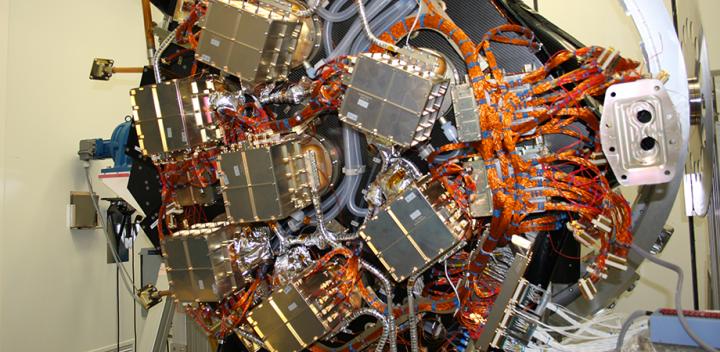
An overview and performance assessment of the seven cameras of eROSITA, a space x-ray telescope launched in 2019
IMAGE

Credit: P. Friedrich, doi 10.1117/1.JATIS.7.2.025004.

Recently, the eROSITA (extended Roentgen Survey with an Imaging Telescope Array) x-ray telescope, an instrument developed by a team of scientists at Max-Planck-Institut für Extraterrestrische Physik (MPE), has gained attention among astronomers. The instrument performs an all-sky survey in the x-ray energy band of 0.2-8 kilo electron volts aboard the Spectrum-Roentgen-Gamma (SRG) satellite that was launched in 2019 from the Baikonur cosmodrome in Kazakhstan.

“The eROSITA has been designed to study the large-scale structure of the universe and test cosmological models, including dark energy, by detecting galaxy clusters with redshifts greater than 1, corresponding to a cosmological expansion faster than the speed of light,” said Dr. Norbert Meidinger from MPE, a part of the team that developed the instrument. “We expect eROSITA to revolutionize our understanding of the evolution of supermassive black holes.” The details of the developmental work have been published in SPIE’s Journal of Astronomical Telescopes, Instruments, and Systems (JATIS).

eROSITA is not one telescope, but an array of seven identical, co-aligned telescopes, with each one composed of a mirror system and a focal-plane camera. The camera assembly, in turn, consists of the camera head, camera electronics, and filter wheel. The camera head is made up of the detector and its housing, a proton shield, and a heat pipe for detector cooling. The camera electronics include supply, control, and data acquisition electronics for detector operation. The filter wheel is mounted above the camera head and has four positions including an optical and UV blocking filter to reduce signal noise, a radioactive x-ray source for calibration, and a closed position that allows instrumental background measurements.

“It’s exciting to read about these x-ray cameras that are in orbit and enabling a broad set of scientific investigations on a major astrophysics mission,” says Megan Eckart of Lawrence Livermore National Laboratory, USA, who is the deputy editor of JATIS. “Dr. Meidinger and his team provide a clear description of the hardware development and ground testing, and wrap up the paper with a treat: first-light images from eROSITA and an assessment of onboard performance. Astrophysicists around the world will analyze data from these cameras for years to come.”

The eROSITA telescope is well on its way to becoming a game changer for x-ray astronomy.

###

Read the open-access article by Norbert Meidinger et al., “eROSITA camera array on the SRG satellite,” J. Astron. Telesc. Instrum. Syst. 7(2), 025004 (2021). doi 10.1117/1.JATIS.7.2.025004

Media Contact
Daneet Steffens
[email protected]

Original Source

https://spie.org/news/candid-cosmos-erosita-cameras-set-a-benchmark-for-astronomical-imaging?SSO=1

Related Journal Article

http://dx.doi.org/10.1117/1.JATIS.7.2.025004

Tags: AstronomyAstrophysicsExperiments in SpaceOpticsResearch/DevelopmentSpace/Planetary ScienceTechnology/Engineering/Computer Science
Share12Tweet8Share2ShareShareShare2

Related Posts

Study Explores Medi-Cal Transition for Older Latinos

December 31, 2025
blank

Maximizing T Count in Quantum Circuits with AlphaTensor

December 31, 2025

Creating Digital Twins for Robotic Chemistry Automation

December 31, 2025

SARCDNet: Advancing Change Detection in SAR Imagery

December 31, 2025
Please login to join discussion

POPULAR NEWS

  • blank

    PTSD, Depression, Anxiety in Childhood Cancer Survivors, Parents

    100 shares
    Share 40 Tweet 25
  • NSF funds machine-learning research at UNO and UNL to study energy requirements of walking in older adults

    71 shares
    Share 28 Tweet 18
  • Exploring Audiology Accessibility in Johannesburg, South Africa

    52 shares
    Share 21 Tweet 13
  • Nurses’ Views on Online Learning: Effects on Performance

    71 shares
    Share 28 Tweet 18

About

We bring you the latest biotechnology news from best research centers and universities around the world. Check our website.

Follow us

Recent News

Study Explores Medi-Cal Transition for Older Latinos

Maximizing T Count in Quantum Circuits with AlphaTensor

Creating Digital Twins for Robotic Chemistry Automation

Subscribe to Blog via Email

Enter your email address to subscribe to this blog and receive notifications of new posts by email.

Join 71 other subscribers
  • Contact Us

Bioengineer.org © Copyright 2023 All Rights Reserved.

Welcome Back!

Login to your account below

Forgotten Password?

Retrieve your password

Please enter your username or email address to reset your password.

Log In
No Result
View All Result
  • Homepages
    • Home Page 1
    • Home Page 2
  • News
  • National
  • Business
  • Health
  • Lifestyle
  • Science

Bioengineer.org © Copyright 2023 All Rights Reserved.