Research co-led by Newcastle University has shed new light on important microscopic scale interactions between algae and bacteria predicated on the mutually beneficial exchange of nutrients.
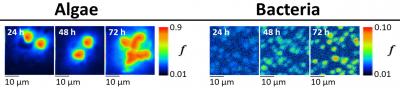
Credit: The authors
Research co-led by Newcastle University has shed new light on important microscopic scale interactions between algae and bacteria predicated on the mutually beneficial exchange of nutrients.
The research was carried out at the University of Cambridge and the Nordsim laboratory at the Swedish Museum of Natural History in Stockholm by Dr Hannah Laeverenz Schlogelhofer, now at the University of Exeter, and a team led by Dr Ottavio Croze, of Newcastle University’s School of Mathematics, Statistics and Physics.
They have used an advanced high-spatial resolution isotope mapping technique called ‘SIMS’ (secondary ion mass spectrometry) to chart for the first time how long it takes for labelled carbon produced by microalgae to be transferred to the bacteria they are growing with.
The study reveals the details of important nutrient exchanges between algae and bacteria. Such exchanges determine the functioning of microbial communities in the environment, relevant to climate change cycles and agricultural productivity. Microbial interactions within microbial communities are important on many levels, ranging from the ecology of aquatic and terrestrial food webs, to wastewater treatment. A key characteristic of the interactions within these communities is the exchange of nutrients between species.
Publishing their findings in the journal PLOS ONE, the research team, involving also scientists from Stockholm University, Sweden, also used a mathematical model to predict how the concentrations of nutrients exchanged between the microbes change with time, including vitamin B12, which occurs in very low concentrations and is not easily trackable.
Many species of algae and bacteria share mutually beneficial resources. In this study, the algae depend on bacteria as a source of vitamin B12, as they can’t make it themselves. On the other hand, bacteria rely on carbon produced by algae for their growth. The research combines SIMS and mathematical modelling to show what happens when microbial partners able to exchange nutrients are initially brought together.
Principal investigator of the study, Dr Croze said: “The paper concerns the onset of the mutualistic interaction between microalgae and bacteria, that is microbes that need each other to grow and survive, and the transfer of nutrients between them.
“Our results allow establishing when the microbial partners first form a ‘relationship’ by growing exclusively on the nutrients they respectively produce. The method we have developed is widely applicable to other microbial systems, and we hope it will contribute to furthering a mechanistic understanding of interactions within microbial communities in the environment and biotechnological applications.”
Dr Laeverenz Schlogelhofer added: “It is the interdisciplinary nature of our approach to studying microbial interactions that I think will have broad applications. While the single-cell technique SIMS allowed us to visualise and measure the carbon exchange between algae and bacteria, mathematical modelling provided a link between the experimental observations and our understanding of the underlying nutrient kinetics.”
Co-author Dr Rachel Foster, from Stockholm University, said: “I appreciate most that the work takes highly resolved single cell measurements and directly applies them for predicting nutrient acquisitions between cells. Hence we can use calculated rate measurements based on the SIMS measures instead of assuming an activity rate, and this approach should be far-reaching and applicable to many other microbial populations-free and/or symbiotic.”
###
Media Contact
Ivan Lazarov
[email protected]
Related Journal Article
http://dx.