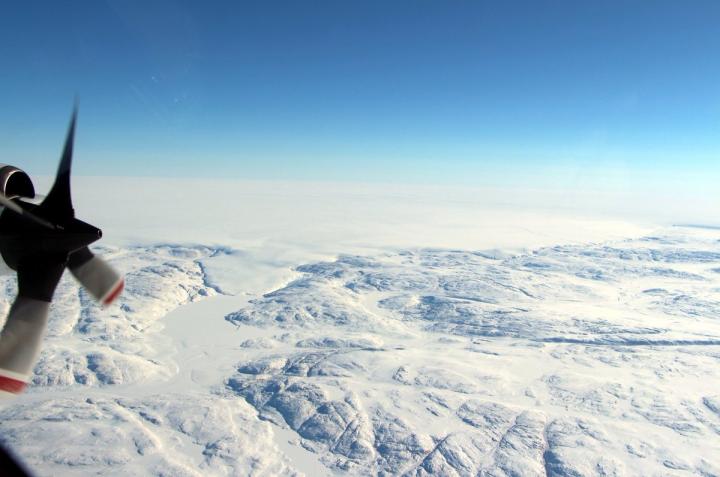
Credit: NASA, Public domain, via Wikimedia Commons
Melting glaciers and polar ice sheets are among the dominant sources of sea-level rise, yet until now, the water beneath them has remained hidden from airborne ice-penetrating radar.
With the detection of groundwater beneath Hiawatha Glacier in Greenland, researchers have opened the possibility that water can be identified under other glaciers from the air at a continental scale and help improve sea-level rise projections. The presence of water beneath ice sheets is a critical component currently missing from glacial melt scenarios that may greatly impact how quickly seas rise – for example, by enabling big chunks of ice to calve from glaciers vs. stay intact and slowly melt. The findings, published in Geophysical Research Letters May 20, could drastically increase the magnitude and quality of information on groundwater flowing through the Earth’s poles, which had historically been limited to ground-based surveys over small distances.
“If we could potentially map water underneath the ice of other glaciers using radar from the air, that’s a game-changer,” said senior study author Dustin Schroeder, an assistant professor of geophysics at Stanford’s School of Earth, Energy & Environmental Sciences (Stanford Earth).
The data was collected in 2016 as part of NASA’s Operation IceBridge using a wide-bandwidth radar system, a newer technique that has only started being used in surveys in the last few years. Increasing the range of radio frequencies used for detection allowed the study authors to separate two radar echoes – from the bottom of the ice sheet and the water table – that would have been blurred together by other systems. While the team suspected groundwater existed beneath the glacier, it was still surprising to see their hunch confirmed in the analyses.
“When you see these anomalies, most of the time they don’t pan out,” said lead study author Jonathan Bessette, a graduate student at the Massachusetts Institute of Technology who conducted the research as a SUNY Buffalo undergraduate through the Stanford Summer Undergraduate Research in Geoscience and Engineering Program (SURGE).
Based on the radar signal, the study team constructed two possible models to describe Hiawatha Glacier’s geology: Frozen land with thawed ice below it or porous rock that enables drainage, like when water flows to the bottom of a vase filled with marbles. These hypotheses have different implications for how Hiawatha Glacier may respond to a warming climate.
Groundwater systems may play a more significant role than what researchers currently model in ice sheets for sea-level-rise projections, according to Schroeder. The researchers hope their findings will prompt further investigation of the possibility for additional groundwater detection using airborne radar, which could potentially be deployed on a grand scale to collect hundreds of miles of data per day.
“What society wants from us are predictions of sea level – not only now, but in futures with different greenhouse gas emission scenarios and different warming scenarios – and it is not practical to survey an entire continent with small ground crews,” Schroeder said. “Groundwater is an important player, and we need to survey at the continental scale so that we can make continental-scale projections.”
###
Schroeder is also an assistant professor, by courtesy, of electrical engineering and a center fellow, by courtesy, at the Stanford Woods Institute for the Environment. Study co-authors include Thomas Jordan, who conducted research as a Stanford postdoctoral researcher on a Marie Curie fellowship from the University of Bristol, and Joseph MacGregor of the NASA Goddard Space Flight Center in Maryland.
The research was supported by an NSF CAREER award and NASA.
Media Contact
Danielle T. Tucker
[email protected]
Original Source
https:/
Related Journal Article
http://dx.