Credit: American Chemical Society
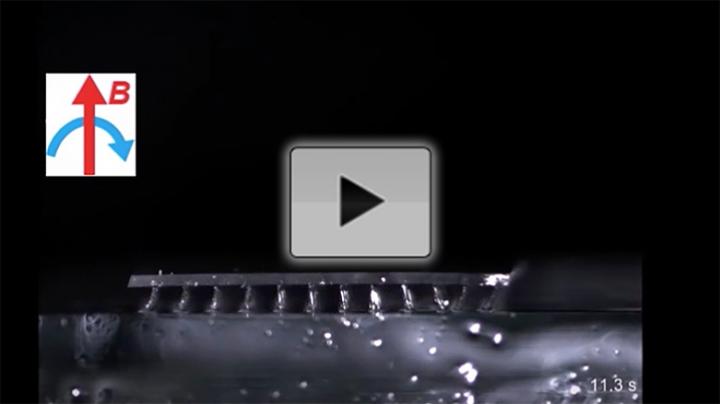
The rhythmic motions of hair-like cilia move liquids around cells or propel the cells themselves. In nature, cilia flap independently, and mimicking these movements with artificial materials requires complex mechanisms. Now, researchers reporting in ACS Applied Materials & Interfaces have made artificial cilia that move in a wave-like fashion when a rotating magnetic field is applied, making them suitable for versatile, climbing soft robots and microfluidic devices. Watch a video of the artificial cilia here.
Replicating movements found in nature — for example, the small, whip-like movements of cilia — could help researchers create better robots or microscopic devices. As cilia vibrate sequentially, they produce a traveling wave that moves water more efficiently and with a better pumping speed than when the cilia move at the same time. Previous researchers have recreated these wave-like movements, but the artificial cilia were expensive, needed sophisticated moving parts and were too large to be used for micro-scale devices. So, Shuaizhong Zhang, Jaap den Toonder and colleagues wanted to create microscale cilia that would move in a wave when a magnetic field was applied, pumping water quickly over them or acting as a soft robot that can crawl and climb.
The researchers infused a polymer with carbonyl iron powder particles and poured the mixture into a series of identical 50 μm-wide cylindrical holes. While the polymer cured, the team placed magnets underneath the mold, slightly altering the particles’ alignments and magnetic properties in adjacent cilia. To test the artificial cilia’s ability to move in water and glycerol, the researchers applied a rotating magnetic field. As magnets moved around the array, the cilia whipped back and forth, and flow was generated at a rate better than for most artificial cilia. Finally, the researchers flipped the array over, and it scuttled across a flat surface, reaching a maximum speed proportional to a human’s running speed, and the robot reversed when the magnetic field flipped directions. The soft robot crawled up and down a 45-degree incline, climbed vertical surfaces, walked upside down and carried an object 10 times heavier than its own weight. The researchers say that because these artificial cilia are magnetically propelled and unconnected to any other device, they could be used to produce microfluidic pumps and agile soft robots for biomedical applications.
The authors acknowledge funding from a European Research Council (ERC) Advanced Grant and the China Scholarship Council.
This paper is freely available as an ACS AuthorChoice article here.
The American Chemical Society (ACS) is a nonprofit organization chartered by the U.S. Congress. ACS’ mission is to advance the broader chemistry enterprise and its practitioners for the benefit of Earth and all its people. The Society is a global leader in promoting excellence in science education and providing access to chemistry-related information and research through its multiple research solutions, peer-reviewed journals, scientific conferences, eBooks and weekly news periodical Chemical & Engineering News. ACS journals are among the most cited, most trusted and most read within the scientific literature; however, ACS itself does not conduct chemical research. As a leader in scientific information solutions, its CAS division partners with global innovators to accelerate breakthroughs by curating, connecting and analyzing the world’s scientific knowledge. ACS’ main offices are in Washington, D.C., and Columbus, Ohio.
To automatically receive news releases from the American Chemical Society, contact [email protected].
Follow us: Twitter | Facebook
###
Media Contact
Katie Cottingham
[email protected]