Credit: by Fabian Duerr and Hugo Thienpont
Optical imaging systems have been playing an essential role in scientific discovery and societal progress for several centuries. For more than 150 years scientists and engineers have used aberration theory to describe and quantify the deviation of light rays from ideal focusing in an imaging system. Until recently most of these imaging systems included spherical and aspherical refractive lenses or reflective mirrors or a combination of both. With the introduction of new ultra-precision manufacturing methods, it has become possible to fabricate lenses and mirrors that lack the common translational or rotational symmetry about a plane or an axis. Such optical components are called freeform optical elements and they can be used to greatly extend the functionalities, improve performance, and reduce volume and weight of optical imaging systems. Today, the design of optical systems largely relies on efficient raytracing and optimization algorithms. A successful and widely used optimization-based optical design strategy therefore consists of choosing a well-known optical system as a starting point and steadily achieving incremental improvements. Such a “step-and-repeat” approach to optical design, however, requires considerable experience, intuition, and guesswork, which is why it is sometimes referred to as “art and science”. This applies especially to freeform optical systems.
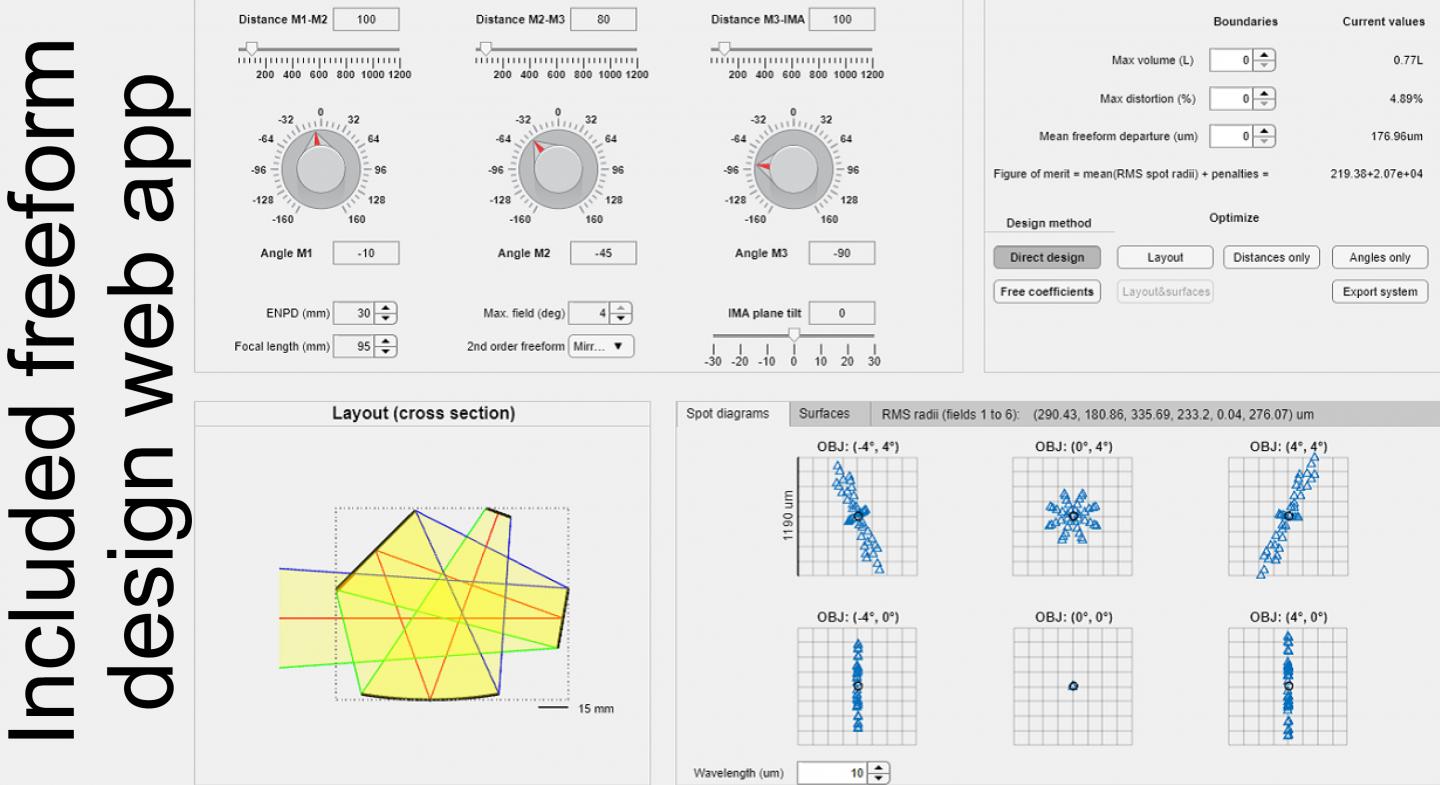
In a newly published paper in Light Science & Applications – Nature, researchers at Brussels Photonics (B-PHOT), Vrije Universiteit Brussel, Belgium have developed a deterministic direct optical design method for freeform imaging systems based on differential equations derived from Fermat’s principle and solved using power series. The method allows calculating the optical surface coefficients that ensure minimal image blurring for each individual order of aberrations. They demonstrate the systematic, deterministic, scalable, and holistic character of their method for mirror- and lens-based design examples. The reported approach provides a disruptive methodology to design optical imaging systems from scratch, while largely reducing the ‘trial and error’ approach in present-day optical design.
The scientists summarize the operational principle of their method:
“We only need to specify the layout, the number and types of surfaces to be designed and the location of the stop. The established differential equations and solution scheme requires only two further steps: (1) solve the non-linear first order case using a standard non-linear solver; (2) solve the linear systems of equations in ascending order by setting unwanted aberrations to zero or by minimizing a combination thereof as required by the targeted specifications of the imaging freeform system. Most importantly, these two steps are identical for all (freeform) optical designs”
“The presented method allows a highly systematic generation and evaluation of directly calculated freeform design solutions that can be readily used as an excellent starting point for further and final optimization. As such, it allows the straightforward generation of ‘first time right’ initial designs that enable a rigorous, extensive and real-time evaluation in solution space when combined with available local or global optimization algorithms.”
###
Media Contact
Fabian Duerr
[email protected]
Related Journal Article
http://dx.