Credit: UniSA
World-first nanotechnology developed by the University of South Australia could change the lives of thousands of people living with cystic fibrosis (CF) as groundbreaking research shows it can improve the effectiveness of the CF antibiotic Tobramycin, increasing its efficacy by up to 100,000-fold.
The new technology uses a biomimetic nanostructured material to augment Tobramycin – the antibiotic prescribed to treat chronic Pseudomonas aeruginosa lung infections in severe cases of CF – eradicating the infection in as little as two doses.
In Australia, cystic fibrosis (CF) affects one in 2500 babies – or one baby born every four days – causing severe impairments to a person’s lungs, airways and digestive system, trapping bacteria and leading to recurrent infections. Lung failure is the major cause of death for people with CF.
The UniSA research team, which includes Professor Clive Prestidge, Dr Nicky Thomas, and PhD candidate, Chelsea Thorn, says the discovery could transform the lives of people living with CF.
“CF is a progressive, genetic disease that causes persistent, chronic lung infections and limits a person’s ability to breathe,” Thorn says.
“The disease causes thick, sticky mucus to clog a person’s airways, attracting germs and bacteria, such as Pseudomonas aeruginosa, which leads to recurring infections and blockages.
“Tobramycin is commonly used to treat these infections but increasingly antibiotics are failing to make any significant difference to lung infections, leaving sufferers requiring life-long antibiotic therapy administered every month.
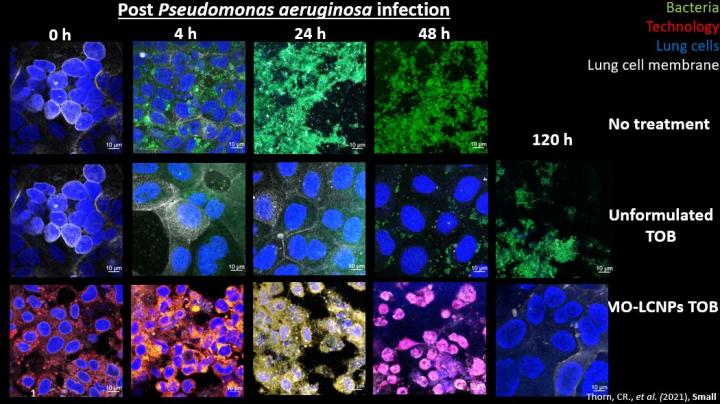
“Our research successfully treats advanced human cell culture lung infections using nano-enhanced Tobramycin and shows how it can eradicate serious and persistent infections after only two doses.
“This could be a real game-changer for people living with CF.”
Researchers enhanced the Tobramycin with a biometric, nanostructured, lipid liquid crystal nanoparticle (LCNP)-based material, testing it on a new lung infection model to showcase its unique ability to penetrate the dense surface of the bacteria and kill the infection.
Dr Nicky Thomas, says the discovery continues the global battle to eradicate and prevent Pseudomonas aeruginosa.
Tobramycin works by inhibiting the synthesis of bacteria and causing cell membrane damage. Yet, as it’s a concentration-dependent antibiotic, achieving a sufficiently high concentration is critical,” Dr Thomas says.
“Our technology improves the performance of Tobramycin without increasing the toxicity of the drug, so what we’re doing is a far more effective and efficient treatment for chronic lung infections.”
The technology is currently entering pre-clinical trials and hopes to be on the market in the next five years.
###
Notes to editors:
The research group for this study includes the University of South Australia; the Basil Hetzel Institute for Translational Health and Research; the ARC Centre for Excellence in Bio-Nano Science and Technology; the Biofilm Test facility at UniSA’s Cancer Research Institute; the Helmholtz Institute for Pharmaceutical Research Saarland; and Saarland University.
The research directly relates to these papers:
* Thorn, C. R., Carvalho-Wodarz, C. D., Horstmann, J. C., Lehr, C-M., Prestidge, C. A., Thomas, N., “Tobramycin liquid crystal nanoparticles eradicate cystic fibrosis-related Pseudomonas aeruginosa biofilms”. Small: 2021. https:/
* Thorn, C. R., Raju, D., Lacdao, I., Gilbert, S., Sivarajah, P., Howell, P. L., Prestidge, C., Thomas, N., “Protective liquid crystal nanoparticles for targeted delivery of PslG – a biofilm dispersing enzyme”. ACS Infectious Diseases: 2021. Online ahead of print: https:/
Media contact: Annabel Mansfield T: +61 8 8302 0351 M: +61 417 717 504
E: [email protected]
Researcher: Chelsea Thorn T: +61 439 703 006 E: [email protected]
Dr Nicky Thomas T: +61 8302 0125 E: [email protected]
Professor Clive Prestidge T: +61 8 8302 2438 E: [email protected]
Media Contact
Annabel Mansfield
[email protected]
Related Journal Article
http://dx.