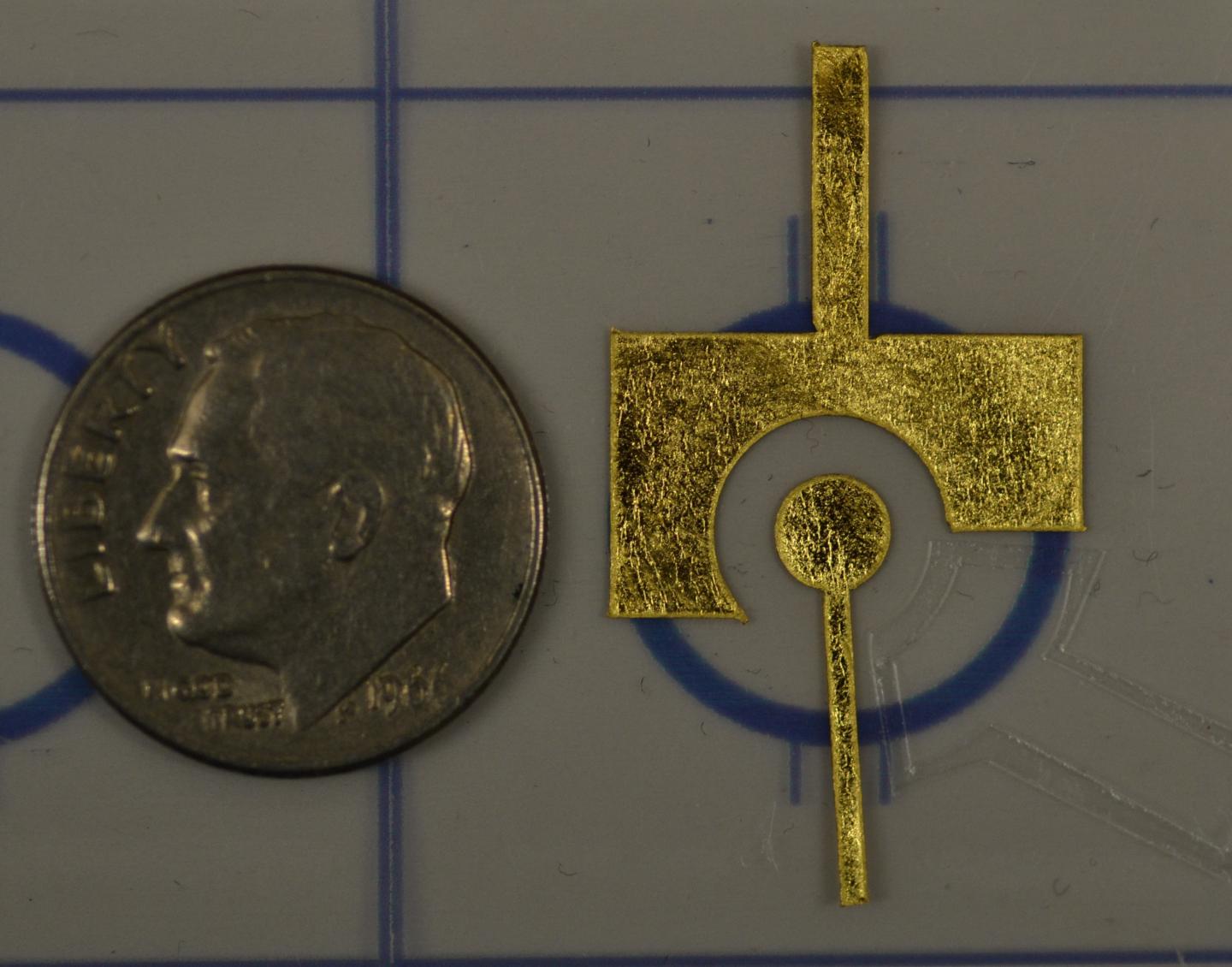
Credit: Adapted from ACS Central Science 2021, DOI: 10.1021/acscentsci.1c00186
Gold leaf — gold metal hammered into thin sheets — is used by artists and crafters to gild picture frames, artwork and clothing. Despite its luxurious appearance, the material is affordable and available at most craft stores. Now, researchers reporting in ACS Central Science have developed gold leaf electrodes that, in combination with a CRISPR-based assay, could sensitively detect human papillomavirus (HPV) DNA in human samples. The method also could be modified to diagnose other viral infections.
Previous research indicates that about 80% of new cases of sexually transmitted infections, such as HPV and human immunodeficiency virus (known as HIV), take place in low-resource settings. In addition, over 90% of cervical cancer deaths, which are caused mainly by HPV, occur in these regions, according to the World Health Organization. But people in low-resource settings lack the facilities, trained personnel and money to conduct common diagnostic tests, including polymerase chain reaction (PCR) or antibody detection. Therefore, Ariel Furst, Catherine Klapperich and colleagues wanted to develop a simple, affordable point-of-care test.
Using a sheet of 24K gold leaf, an adhesive, a stencil and a razor blade, the researchers made a three-electrode system that provided a readout in the presence of HPV DNA. On the surface of the electrodes, they attached DNA strands tagged with a dye. Then, they amplified DNA from cervical swab samples with a technique called loop-mediated isothermal amplification, which doesn’t require expensive PCR machines. They added the amplified DNA, along with a CRISPR Cas12a enzyme engineered to recognize an HPV sequence, to the surface of the electrode. In the presence of HPV DNA, Cas12a became activated, causing the enzyme to cut the dye-tagged DNA sequence, which changed the electrochemical signal. The assay, which costs only about $2.30 total per test (compared with $30-75 for existing tests), accurately detected HPV in cervical swabs from patients. The technology could be adapted to detect any viral infection, including SARS-CoV-2, the researchers say.
The authors acknowledge funding from the Dorf-Ebner Distinguished Faculty Fellow Award, the Boston University Precision Diagnostics Center, the Defense Advanced Research Projects Agency and the National Science Foundation.
The paper with be freely available as an ACS AuthorChoice article on May 12 at 8 a.m. Eastern time here: http://pubs.
The American Chemical Society (ACS) is a nonprofit organization chartered by the U.S. Congress. ACS’ mission is to advance the broader chemistry enterprise and its practitioners for the benefit of Earth and all its people. The Society is a global leader in promoting excellence in science education and providing access to chemistry-related information and research through its multiple research solutions, peer-reviewed journals, scientific conferences, eBooks and weekly news periodical Chemical & Engineering News. ACS journals are among the most cited, most trusted and most read within the scientific literature; however, ACS itself does not conduct chemical research. As a leader in scientific information solutions, its CAS division partners with global innovators to accelerate breakthroughs by curating, connecting and analyzing the world’s scientific knowledge. ACS’ main offices are in Washington, D.C., and Columbus, Ohio.
To automatically receive news releases from the American Chemical Society, contact [email protected].
Follow us: Twitter | Facebook
###
Media Contact
Katie Cottingham
[email protected]