• HOME
  • NEWS
  • EXPLORE
    • CAREER
      • Companies
      • Jobs
    • EVENTS
    • iGEM
      • News
      • Team
    • PHOTOS
    • VIDEO
    • WIKI
  • BLOG
  • COMMUNITY
    • FACEBOOK
    • INSTAGRAM
    • TWITTER
Sunday, November 15, 2026
BIOENGINEER.ORG
No Result
View All Result
  • Login
  • HOME
  • NEWS
  • EXPLORE
    • CAREER
      • Companies
      • Jobs
        • Lecturer
        • PhD Studentship
        • Postdoc
        • Research Assistant
    • EVENTS
    • iGEM
      • News
      • Team
    • PHOTOS
    • VIDEO
    • WIKI
  • BLOG
  • COMMUNITY
    • FACEBOOK
    • INSTAGRAM
    • TWITTER
No Result
View All Result
Bioengineer.org
No Result
View All Result
Home NEWS Science News

‘Flipping’ optical wavefront eliminates distortions in multimode fibers

Bioengineer by Bioengineer
May 10, 2021
in Science News
Reading Time: 3 mins read
0
IMAGE
Share on FacebookShare on TwitterShare on LinkedinShare on RedditShare on Telegram

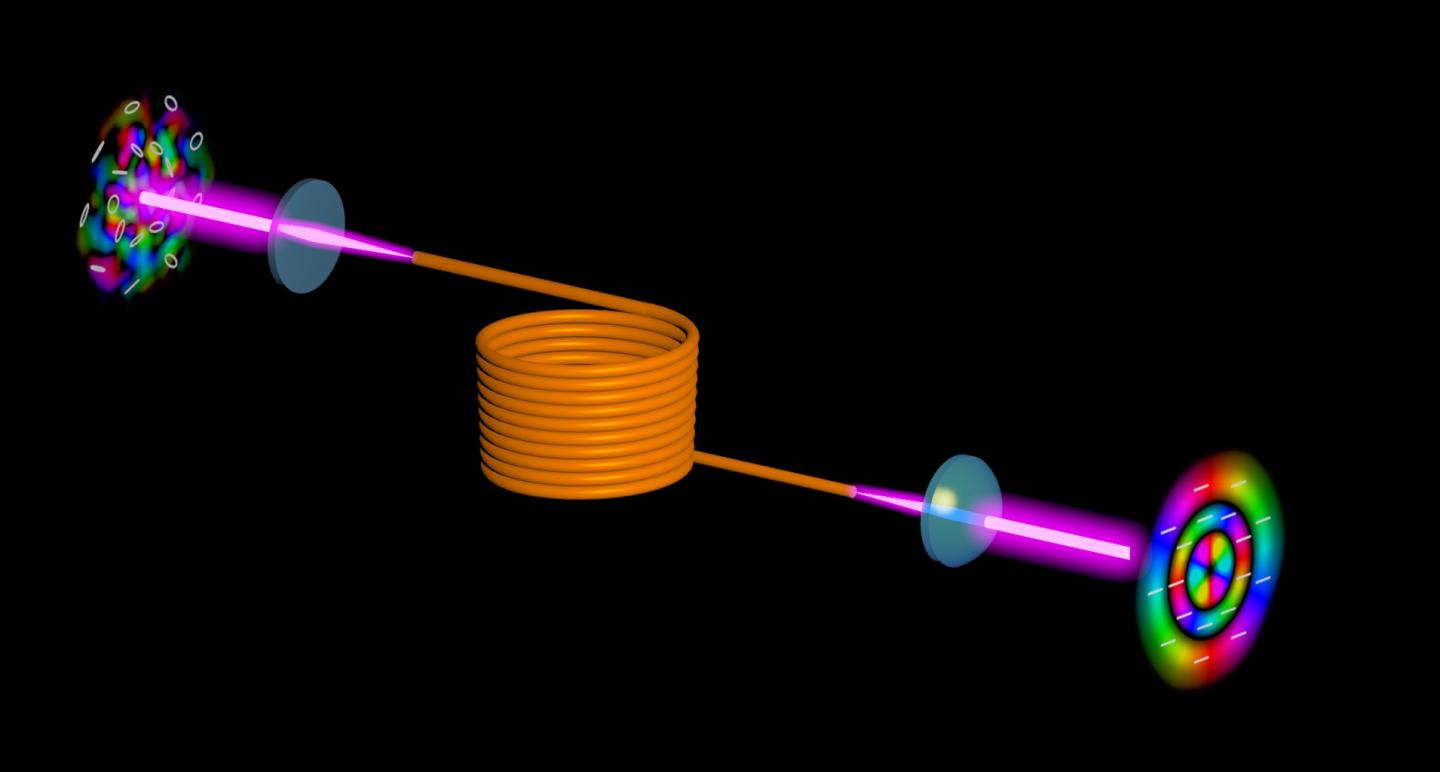
University of Rochester researchers use vectorial time reversal to demonstrate enhanced channel capacity in a 1-km-long multimode fiber
IMAGE

Credit: Illustration by Yiyu Zhou

The use of multimode optical fibers to boost the information capacity of the Internet is severely hampered by distortions that occur during the transmission of images because of a phenomenon called modal crosstalk.

However, University of Rochester researchers at the Institute of Optics have devised a novel technique, described in a paper in Nature Communications, to “flip” the optical wavefront of an image for both polarizations simultaneously, so that it can be transmitted through a multimode fiber without distortion. Researchers at the University of South Florida and at the University of Southern California collaborated on the project.

Lead author Yiyu Zhou, a PhD candidate in the Rochester lab of Robert Boyd, professor of optics, draws an analogy to a multilane highway in describing the challenge the researchers confronted.

“Obviously, a multiple lane highway is faster than a single lane,” Zhou says. “But if a courier is forced to change from lane A to lane B, the package will be delivered to the wrong destination. When this happens in a multimode fiber–when one spatial mode is coupled to another during the propagation through the fiber–it’s what we call modal crosstalk. And we want to suppress that.”

The solution the researchers devised involves digitally pre-shaping the wavefront and polarization of a forward-propagating signal beam to be the phase conjugate of an auxiliary, backward-propagating probe beam–in an experimental realization of vectorial time reversal.

“When an optical beam with perfect wavefronts passes through the multimode fiber, it comes out badly distorted,” explains Boyd, who is also the Canada Excellence Research Chair in Quantum Nonlinear Optics at the University of Ottawa.

“If we use a mirror to send the wavefront back, it will become even more distorted. But if we instead reflect it off a mirror, and also flip the wavefront from front to back, the distortion becomes undone as the waves go back through that distorting medium. In particular, we need perform this procedure for both polarizations simultaneously when the distorting medium is a long multimode fiber.”

The researchers demonstrate that this technology can enhance the channel capacity in a 1-km-long multimode fiber

“Our technique can be used to realize mode-division multiplexing over long, standard multimode fibers to significantly enhance the channel capacity of optical communication links,” Zhou says. “It can potentially be used to increase the Internet speed by one or two orders of magnitude.”

The technique could also be potentially used to improve endoscopy imaging of the brain and other biological tissues, Zhou says.

###

Other coauthors are Jiapeng Zhao of Boyd’s Rochester lab; Boris Braverman of Boyd’s Ottawa lab; Alexander Fyffe and Zhimin Shi of the University of South Florida, and Runzhou Zhang and Alan Willner of the University of Southern California, Los Angeles.

The research was supported with funding from the U.S. Office of Naval Research; a Banting Postdoctoral Fellowship; the Natural Sciences and Engineering Research Council of Canada; the Canada Research Chairs program; the Canada First Research Excellence Fund; a Vannevar Bush Faculty Fellowship sponsored by the Basic Research Office of the Assistant Secretary of Defense for Research and Engineering; and a Qualcomm Innovation Fellowship.

Media Contact
Bob Marcotte
bmarcotte@ur.rochester.edu

Original Source

http://www.hajim.rochester.edu/news/2021/2021-05-09-boyd.html

Related Journal Article

http://dx.doi.org/10.1038/s41467-021-22071-w

Tags: OpticsTechnology/Engineering/Computer ScienceTelecommunications
Share12Tweet8Share2ShareShareShare2

Related Posts

Decision Framework Evaluates Six Building Nanotechnologies for Egypt's Hot Arid Architecture

Decision Framework Evaluates Six Building Nanotechnologies for Egypt’s Hot Arid Architecture

November 15, 2026
Interactive Web Tool Calculates Precise Pediatric Body Mass Index Scores in Italy

Interactive Web Tool Calculates Precise Pediatric Body Mass Index Scores in Italy

November 15, 2026

Split-Parameter Federated Learning Detects Cyber Threats Across Incompatible Network Infrastructures

November 15, 2026

Family History and Reproductive Timing Linked to Cervical Cancer in Weighting Analysis

November 15, 2026
Please login to join discussion

POPULAR NEWS

  • Self-Supervised Vision Model Estimates Live Pig Weight Within Three Kilograms

    Self-Supervised Vision Model Estimates Live Pig Weight Within Three Kilograms

    29 shares
    Share 12 Tweet 7
  • Custom YOLO26 Architecture Improves Grapevine Disease Detection on Embedded Devices

    29 shares
    Share 12 Tweet 7
  • Survey Synthesizes Remote Sensing and Edge Computing Pathways for Rice Monitoring

    29 shares
    Share 12 Tweet 7
  • Urine FujiLAM II Test Shows High Specificity but Limited Tuberculosis Sensitivity in Vietnam

    29 shares
    Share 12 Tweet 7

About

We bring you the latest biotechnology news from best research centers and universities around the world. Check our website.

Follow us

Recent News

Decision Framework Evaluates Six Building Nanotechnologies for Egypt’s Hot Arid Architecture

Interactive Web Tool Calculates Precise Pediatric Body Mass Index Scores in Italy

Split-Parameter Federated Learning Detects Cyber Threats Across Incompatible Network Infrastructures

Subscribe to Blog via Email

Enter your email address to subscribe to this blog and receive notifications of new posts by email.

Join 87 other subscribers
  • Contact Us

Bioengineer.org © Copyright 2023 All Rights Reserved.

Welcome Back!

Login to your account below

Forgotten Password?

Retrieve your password

Please enter your username or email address to reset your password.

Log In
No Result
View All Result
  • Homepages
    • Home Page 1
    • Home Page 2
  • News
  • National
  • Business
  • Health
  • Lifestyle
  • Science

Bioengineer.org © Copyright 2023 All Rights Reserved.