Credit: NASA, ESA, STScI, K. Sandstrom (University of California, San Diego), and the SMIDGE team.
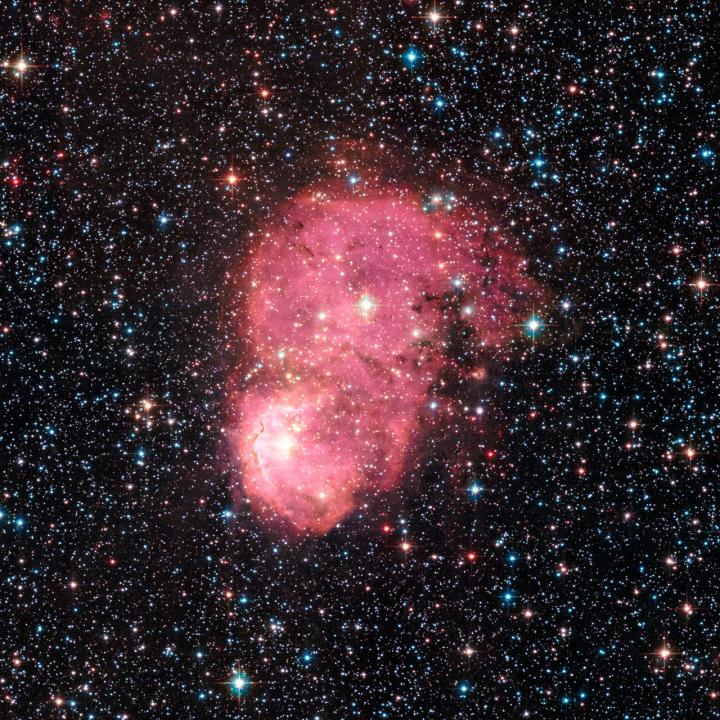
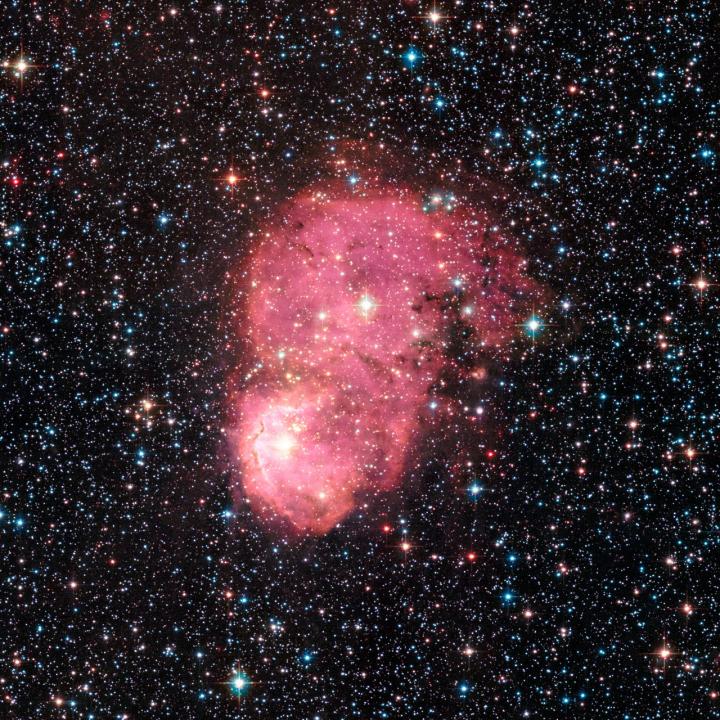
The sheer observing power of the NASA/ESA Hubble Space Telescope is rarely better illustrated than in an image such as this. This glowing pink nebula, named NGC 248, is located in the Small Magellanic Cloud, just under 200 000 light-years away and yet can still be seen in great detail.
Our home galaxy, the Milky Way, is part of a collection of galaxies known as the Local Group. Along with the Andromeda Galaxy , the Milky Way is one of the Group's most massive members, around which many smaller satellite galaxies orbit. The Magellanic Clouds are famous examples, which can easily be seen with the naked eye from the southern hemisphere.
Within the smaller of these satellite galaxies, the Small Magellanic Cloud, the NASA/ESA Hubble Space Telescope captured two festive-looking emission nebulae, conjoined so they appear as one. Intense radiation from the brilliant central stars is causing hydrogen in the nebulae to glow pink.
Together the nebulae are called NGC 248. They were discovered in 1834 by the astronomer Sir John Herschel. NGC 248 is about 60 light-years long and 20 light-years wide. It is among a number of glowing hydrogen nebulae in the Small Magellanic Cloud, which lies in the southern constellation of Tucana(The Toucan), about 200 000 light-years away.
The nebula was observed as part of a Hubble survey, the Small Magellanic cloud Investigation of Dust and Gas Evolution (SMIDGE). In this survey astronomers are using Hubble to probe the Small Magellanic Cloud to understand how its dust — an important component of many galaxies and related to star formation — is different from the dust in the Milky Way.
Thanks to its relative proximity, the Small Magellanic Cloud is a valuable target. It also turns out to have only between a fifth and a tenth of the amount of heavy elements that the Milky Way has, making the dust similar to what we expect to see in galaxies in the earlier Universe.
This allows astronomers to use it as a cosmic laboratory to study the history of the Universe in our cosmic backyard. These observations also help us to understand the history of our own galaxy as most of the star formation happened earlier in the Universe, at a time when the percentage of heavy elements in the Milky Way was much lower than it is now.
The data used in this image were taken with Hubble's Advanced Camera for Surveys in September 2015.
###
More information
The Hubble Space Telescope is a project of international cooperation between ESA and NASA.
Image credit: NASA, ESA, STScI, K. Sandstrom (University of California, San Diego), and the SMIDGE team.
Links
- Images of Hubble – http://www.spacetelescope.org/images/archive/category/spacecraft/
- Link to hubblesite release – http://hubblesite.org/news/2016/42
Contacts
Karin Sandstrom
University of California
San Diego, USA
Tel: +1 858-246-0552
Email: [email protected]
Mathias Jäger
ESA/Hubble, Public Information Officer
Garching bei München, Germany
Tel: +49 176 62397500
Email: [email protected]
Media Contact
Mathias Jäger, ESA/Hubble, Public Information Officer
[email protected]
49-176-623-97500
@Hubble_space
http://www.spacetelescope.org
############
Story Source: Materials provided by Scienmag