• HOME
  • NEWS
  • EXPLORE
    • CAREER
      • Companies
      • Jobs
    • EVENTS
    • iGEM
      • News
      • Team
    • PHOTOS
    • VIDEO
    • WIKI
  • BLOG
  • COMMUNITY
    • FACEBOOK
    • INSTAGRAM
    • TWITTER
Thursday, September 24, 2026
BIOENGINEER.ORG
No Result
View All Result
  • Login
  • HOME
  • NEWS
  • EXPLORE
    • CAREER
      • Companies
      • Jobs
        • Lecturer
        • PhD Studentship
        • Postdoc
        • Research Assistant
    • EVENTS
    • iGEM
      • News
      • Team
    • PHOTOS
    • VIDEO
    • WIKI
  • BLOG
  • COMMUNITY
    • FACEBOOK
    • INSTAGRAM
    • TWITTER
  • HOME
  • NEWS
  • EXPLORE
    • CAREER
      • Companies
      • Jobs
        • Lecturer
        • PhD Studentship
        • Postdoc
        • Research Assistant
    • EVENTS
    • iGEM
      • News
      • Team
    • PHOTOS
    • VIDEO
    • WIKI
  • BLOG
  • COMMUNITY
    • FACEBOOK
    • INSTAGRAM
    • TWITTER
No Result
View All Result
Bioengineer.org
No Result
View All Result
Home NEWS Science News Chemistry

Light meets superconducting circuits

Bioengineer by Bioengineer
May 10, 2021
in Chemistry
Reading Time: 2 mins read
0
IMAGE
Share on FacebookShare on TwitterShare on LinkedinShare on RedditShare on Telegram

IMAGE

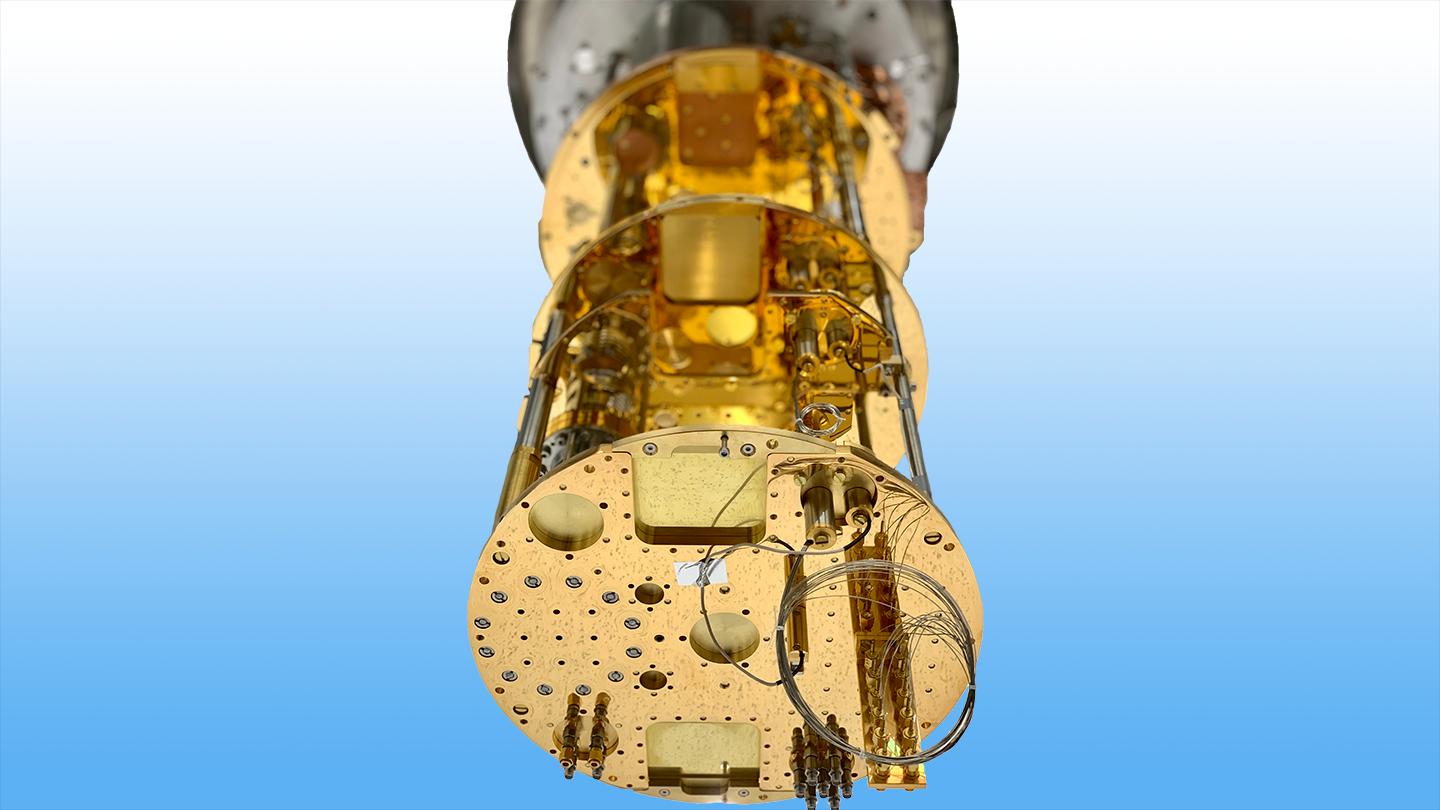
Credit: Andrea Bancora, Amir Youssefi (EPFL)

In the last few years, several technology companies including Google, Microsoft, and IBM, have massively invested in quantum computing systems based on microwave superconducting circuit platforms in an effort to scale them up from small research-oriented systems to commercialized computing platforms. But fulfilling the potential of quantum computers requires a significant increase in the number of qubits, the building blocks of quantum computers, which can store and manipulate quantum information.

But quantum signals can be contaminated by thermal noise generated by the movement of electrons. To prevent this, superconducting quantum systems must operate at ultra-low temperatures – less than 20 milli-Kelvin – which can be achieved with cryogenic helium-dilution refrigerators.

The output microwave signals from such systems are amplified by low-noise high-electron mobility transistors (HEMTs) at low temperatures. Signals are then routed outside the refrigerator by microwave coaxial cables, which are the easiest solutions to control and read superconducting devices but are poor heat isolators, and take up a lot of space; this becomes a problem when we need to scale up qubits in the thousands.

Researchers in the group of Professor Tobias J. Kippenberg at EPFL’s School of Basic Sciences have now developed a novel approach that uses light to read out superconducting circuits, thus overcoming the scaling challenges of quantum systems. The work is published in Nature Electronics.

The scientists replaced HEMT amplifiers and coaxial cables with a lithium niobate electro-optical phase modulator and optical fibers respectively. Microwave signals from superconducting circuits modulate a laser carrier and encode information on the output light at cryogenic temperatures. Optical fibers are about 100 times better heat isolators than coaxial cables and are 100 times more compact. This enables the engineering of large-scale quantum systems without requiring enormous cryogenic cooling power. In addition, the direct conversion of microwave signals to the optical domain facilitates long-range transfer and networking between quantum systems.

“We demonstrate a proof-of-principle experiment using a novel optical readout protocol to optically measure a superconducting device at cryogenic temperatures,” says Amir Youssefi, a PhD student working on the project. “It opens up a new avenue to scale future quantum systems.” To verify this approach, the team performed conventional coherent and incoherent spectroscopic measurements on a superconducting electromechanical circuit, which showed perfect agreement between optical and traditional HEMT measurements.

Although this project used a commercial electro-optical phase modulator, the researchers are currently developing advanced electro-optical devices based on integrated lithium niobate technology to significantly enhance their method’s conversion efficiency and lower noise.

###

Reference

Youssefi, Amir, Itay Shomroni, Yash J. Joshi, Nathan Bernier, Anton Lukashchuk, Philipp Uhrich, Liu Qiu, Tobias J. Kippenberg. A cryogenic electro-optic interconnect for superconducting devices. Nature Electronics 10 May 2021. DOI: 10.1038/s41928-021-00570-4

Media Contact
Nik Papageorgiou
[email protected]

Related Journal Article

http://dx.doi.org/10.1038/s41928-021-00570-4

Tags: Chemistry/Physics/Materials SciencesElectrical Engineering/ElectronicsElectromagneticsSuperconductors/SemiconductorsTelecommunications
Share12Tweet8Share2ShareShareShare2

Related Posts

Nanoparticle-Coated Fabrics Promise Antibacterial, Self-Cleaning and Conductive Clothing

Nanoparticle-Coated Fabrics Promise Antibacterial, Self-Cleaning and Conductive Clothing

September 24, 2026
Bismuth Tungstate Wrapped in Conductive Polymer Yields Supercapacitor Electrode That Barely Fades Over 1,000 Cycles

Bismuth Tungstate Wrapped in Conductive Polymer Yields Supercapacitor Electrode That Barely Fades Over 1,000 Cycles

September 24, 2026

New Sum-Connectivity Descriptors Give Molecular Graphs a Sharper Predictive Edge

September 24, 2026

Ball-Milled and CVD Silicon Anodes Face Off in All-Solid-State Batteries

September 24, 2026
Please login to join discussion

POPULAR NEWS

  • Staphylococcal Protein Reprograms Liver Tumor Macrophages to Boost Immunotherapy

    29 shares
    Share 12 Tweet 7
  • Hidden Microbes Inside Mung Bean Show Striking Stress Tolerance and Fungal-Fighting Power

    29 shares
    Share 12 Tweet 7
  • Noisy Gates Put Gate Teleportation to the Test

    29 shares
    Share 12 Tweet 7
  • Prenatal BPA Exposure Rewires the Cerebellum Differently in Male and Female Rat Offspring

    29 shares
    Share 12 Tweet 7

About

BIOENGINEER.ORG

We bring you the latest biotechnology news from best research centers and universities around the world. Check our website.

Follow us

Recent News

Staphylococcal Protein Reprograms Liver Tumor Macrophages to Boost Immunotherapy

Hidden Microbes Inside Mung Bean Show Striking Stress Tolerance and Fungal-Fighting Power

Noisy Gates Put Gate Teleportation to the Test

Subscribe to Blog via Email

Enter your email address to subscribe to this blog and receive notifications of new posts by email.

Join 85 other subscribers
  • Contact Us

Bioengineer.org © Copyright 2023 All Rights Reserved.

Welcome Back!

Login to your account below

Forgotten Password?

Retrieve your password

Please enter your username or email address to reset your password.

Log In
No Result
View All Result
  • Homepages
    • Home Page 1
    • Home Page 2
  • News
  • National
  • Business
  • Health
  • Lifestyle
  • Science

Bioengineer.org © Copyright 2023 All Rights Reserved.