Credit: Dani Machlis/BGU
BEER-SHEVA, Israel May 10, 2021 – Researchers from Ben-Gurion University (BGU), together with American and German colleagues, have developed new “molecular tweezers” to combat antibiotic-resistant bacteria. Their recently announced findings were published in Cell Chemical Biology.
For years, medical professionals have struggled with bacterial infections becoming increasingly resistant to antibiotics. These molecular tweezers may be the key to battling one of greatest public health issues of the 21st century.
“Our discovery prevents infection without building up antibiotic resistance, and it might even be preferable to develop treatments based on molecular tweezers rather than antibiotics,” said BGU Department of Chemistry Prof. Raz Jelinek.
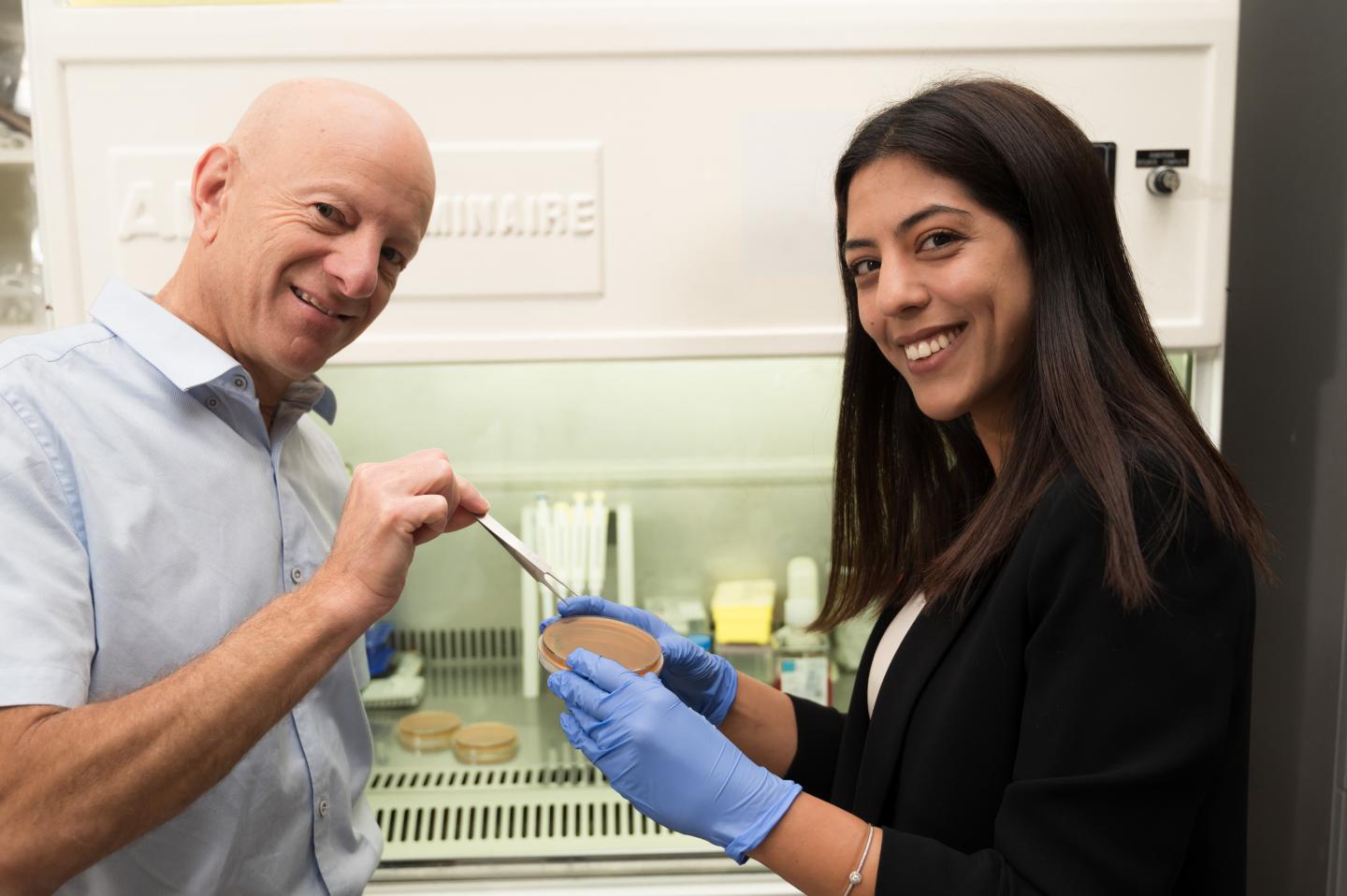
The research team, led by Prof. Jelinek and his Ph.D. student Ravit Malishev, tested their molecular tweezers on the Staphylococcus aureus (Staph) bacteria. In the U.S. staph infections have an estimated mortality rate of over 25%, and 40% for drug-resistant strains.
The tweezers target biofilm, a thin layer of fibers that protects the bacteria. By gripping the fibers and destroying the protective layer, the tweezers impair the bacteria without directly attacking it, which prevents resistance from occurring.
Prof. Jelinek, who is also BGUs vice president of Research & Development and a member of the Ilse Katz Institute for Nanoscale Science and Technology explained, “The tweezers are just like your home tweezers but a million times smaller, and instead of plucking hairs they attack fibers of the bacteria’s biofilm.” By doing that they break the biofilm, making it more vulnerable to human immune defenses and external substances that are used against bacteria like antibiotics.”
“The success of the study indicates an innovative direction of antibiotic treatments against pathogenic bacteria. We found that binding the tweezers to the biofilm disrupts its protective capabilities. Consequently, the bacterial pathogens become, less virulent to the human body, and, more vulnerable to elimination by the immune system. This breakthrough may open up new ways to fight antibiotic-resistant bacteria.” Prof. Jelinex hopes that following further testing, a pill containing millions of “swallowable tweezers” could identify biofilms in the body and break them apart.
###
Additional researchers include:
Orit Malka of BGU’s Department of Chemistry; Dr. Sofiya Kolusheva of the BGU Ilse Katz Institute for Nanoscale Science and Technology; Nir Salinas and Prof. Meytal Landau of the Department of Biology, Technion-Israel Institute of Technology. Landau is also a member of the European Molecular Biology Laboratory (EMBL), in Hamburg, Germany. U.S. researchers include James Gibson, Angela Bailey Eden, and Prof. Chunyu Wang of the Center for Biotechnology and Interdisciplinary Studies, Department of Biological Sciences, Rensselaer Polytechnic Institute, Troy, New York; Gal Bitan of the David Geffen School of Medicine, Brain Research Institute, and Molecular Biology Institute, University of California, Los Angeles. Partners at the University of Duisburg-Essen in Essen include Ger Joel Mieres-Perez, Yasser B. Ruiz-Blanco, and Prof. Elsa Sanchez-Garcia of the Department of Computational Biochemistry; Prof. Frank-Gerrit Klärner and Prof. Thomas Schrader of the Faculty of Chemistry.
This research was supported by the German Research Foundation, the Boehringer Ingelheim Foundation, and NIH/NIA grants R01AG050721 and RF1AG054000.
About Americans for Ben-Gurion University
Americans for Ben-Gurion University plays a vital role in maintaining David Ben-Gurion’s vision of an “Oxford in the Negev.” By supporting a world-class academic institution that not only nurtures the Negev, but also shares its expertise locally and globally, Americans for Ben-Gurion University engages a community of Americans who are committed to improving the world. The Americans for Ben-Gurion University movement supports a 21st century unifying vision for Israel by rallying around BGU’s remarkable work and role as an apolitical beacon of light in the Negev desert.
For more information visit http://www.
Media Contact
Andrew Lavin
[email protected]
Related Journal Article
http://dx.