Credit: Chemistry of Materials
Narrow-gap semiconductors with the ability to use visible light have garnered significant interest thanks to their versatility. Now, scientists in Japan have developed and characterized a new semiconductor material for application in process components stimulated by light. The findings have, for the first time, suggested a new way to reduce the band gap in cheaper and non-toxic tin-based oxide semiconductors for efficient light-based applications.
Semiconductors that can exploit the omnipresent visible spectrum of light for different technological applications would serve as a boon to the material world. However, such semiconductors often do not come cheap and can often be toxic. Now, a group of material scientists from Tokyo Institute of Technology and Kyushu University have collaborated to develop a cheaper and non-toxic narrow-gap semiconductor material with potential ‘light-based’ or photofunctional applications, according to a recent study published in Chemistry of Materials.
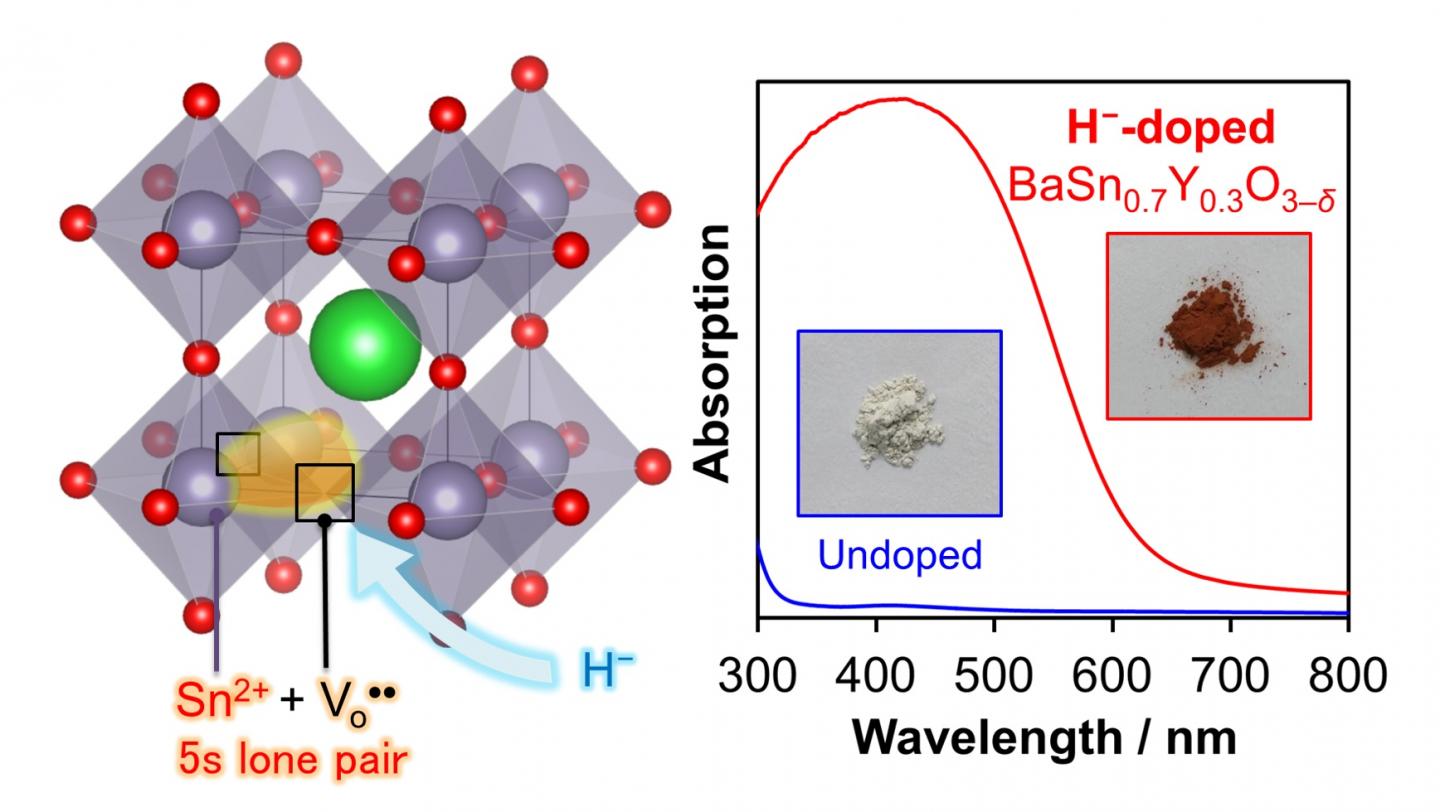
Tin-containing oxide semiconductors are cheaper than most semiconductor materials, but their photofunctional applications are constrained by a wide optical band gap. The aforementioned team of scientists, led by Dr. Kazuhiko Maeda, Associate Professor at the Department of Chemistry, Tokyo Institute of Technology, developed a perovskite-based semiconductor material that is free of toxic lead and can absorb a wide range of visible light (Figure 1). The team “doped,” or intentionally introduced, hydride ions into the tin-containing semiconductor material. In doing so, they successfully reduced the band gap from 4 eV to 2 eV, due to the chemical reduction of the tin component that accompanied the hydride ion doping.
The scientists were also able to pinpoint a crucial tin reduction reaction in the semiconductor material through physicochemical measurements. This reduction leads to the generation of a “tin lone electron pair,” whose different electronic states notably contribute to the visible light absorption of the material. They also attribute this desired property to the prior introduction of oxygen defects into the material. Highlighting the importance of the oxygen defects, Dr. Maeda, who is also a corresponding author of the study, explains, “The prior introduction of oxygen defects into BaSnO3 by Y3+ substitution for Sn4+ is also indispensable to realize a significant reduction of the band gap.”
To confirm that the developed semiconductor material is indeed photofunctional, the scientists tested the applicability of the semiconductor material in a photoelectrode. They observed that the developed material gave a clear anodic photoresponse up to the expected 600 nm.
Speaking about the impact of the study, Dr. Katsuro Hayashi, Professor of the Faculty of Engineering, Kyushu University, and the other corresponding author of the study, says, “Overall, the study has enabled a giant leap in the development of a cheaper, non-toxic, narrow optical band gap, tin-containing semiconductor material for practical applications in solar cells, photocatalysis and pigments.”
Thanks to the efforts of the researchers, we can expect significant advancements in the development of several more novel lead-free visible-light absorbing materials with myriad applications.
###
About Tokyo Institute of Technology
Tokyo Tech stands at the forefront of research and higher education as the leading university for science and technology in Japan. Tokyo Tech researchers excel in fields ranging from materials science to biology, computer science, and physics. Founded in 1881, Tokyo Tech hosts over 10,000 undergraduate and graduate students per year, who develop into scientific leaders and some of the most sought-after engineers in industry. Embodying the Japanese philosophy of “monotsukuri,” meaning “technical ingenuity and innovation,” the Tokyo Tech community strives to contribute to society through high-impact research.
https:/
About Kyushu University
Kyushu U is one of Japan’s leading research-oriented institutes of higher education since its foundation in 1911. Home to around 19,000 students and 8,000 faculty and staff, Kyushu U is making advances in medicine, sustainable energy technologies, materials, and more from its highly accessible location on the southwestern Japanese island of Kyushu in Fukuoka City, a coastal metropolis frequently ranked among the world’s most livable cities and historically known as a gateway to Asia.
https:/
About Dr. Kazuhiko Maeda
Dr. Kazuhiko Maeda is an Associate Professor at Associate Professor at Department of Chemistry, School of Science, Tokyo Institute of Technology. Dr. Maeda’s focus areas of research include heterogeneous photocatalysis, solar energy conversion, photoelectrode, layered compounds, water splitting, hydrogen production, and CO2 reduction. He is a member of esteemed academic institutions like The Chemical Society of Japan, Catalysis Society of Japan, and The Japanese Photochemistry Association. He has over 250 publication as journal and conference papers, and books, among others. He is the recipient of several prestigious awards and prizes, like Highly Cited Researchers 2018-2020, from Clarivate Analytics.
Media Contact
Emiko Kawaguchi
[email protected]
Related Journal Article
http://dx.