• HOME
  • NEWS
  • EXPLORE
    • CAREER
      • Companies
      • Jobs
    • EVENTS
    • iGEM
      • News
      • Team
    • PHOTOS
    • VIDEO
    • WIKI
  • BLOG
  • COMMUNITY
    • FACEBOOK
    • INSTAGRAM
    • TWITTER
Sunday, December 21, 2025
BIOENGINEER.ORG
No Result
View All Result
  • Login
  • HOME
  • NEWS
  • EXPLORE
    • CAREER
      • Companies
      • Jobs
        • Lecturer
        • PhD Studentship
        • Postdoc
        • Research Assistant
    • EVENTS
    • iGEM
      • News
      • Team
    • PHOTOS
    • VIDEO
    • WIKI
  • BLOG
  • COMMUNITY
    • FACEBOOK
    • INSTAGRAM
    • TWITTER
  • HOME
  • NEWS
  • EXPLORE
    • CAREER
      • Companies
      • Jobs
        • Lecturer
        • PhD Studentship
        • Postdoc
        • Research Assistant
    • EVENTS
    • iGEM
      • News
      • Team
    • PHOTOS
    • VIDEO
    • WIKI
  • BLOG
  • COMMUNITY
    • FACEBOOK
    • INSTAGRAM
    • TWITTER
No Result
View All Result
Bioengineer.org
No Result
View All Result
Home NEWS Science News Chemistry

The first hydroxide conductivity in anion conducting polymer thin films

Bioengineer by Bioengineer
May 7, 2021
in Chemistry
Reading Time: 2 mins read
0
IMAGE
Share on FacebookShare on TwitterShare on LinkedinShare on RedditShare on Telegram

Researchers from Japan Advanced Institute of Science and Technology (JAIST) have successfully established a new humidity in situ measurements for anion conducting polymer thin films
IMAGE

Credit: Yuki Nagao from JAIST

Ishikawa, Japan – As decarbonization progresses rapidly in the world, fuel cells offer potentially higher electrical efficiency than conventional power-generating systems. Anion exchange membrane fuel cells offer advantages of using non-precious metal catalysts than proton exchange membrane fuel cells. One of the challenges of this next-generation fuel cell is to clarify the hydroxide ion conductivity in the ion conductive polymer around the electrode catalyst. The difficulty of studying the hydroxide ion conductivity at the electrode interface is that the hydroxide ion, which is a carrier, easily reacts with carbon dioxide in the air. To solve this problem, all evaluation devices were improved so that the sample did not come into contacting with air.

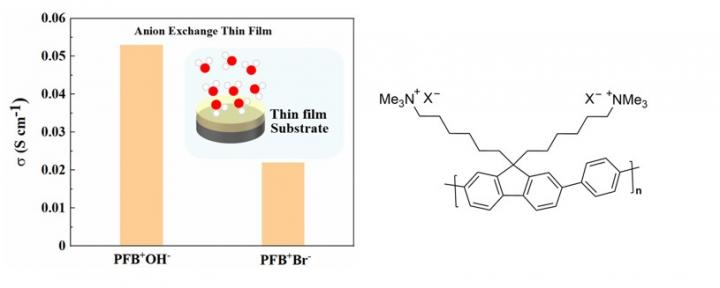
In a new study published in ChemSusChem (Accepted Article), researchers from Japan Advanced Institute of Science and Technology (JAIST), namely Associate Professor Yuki Nagao and Ph.D. students Fangfang Wang and Dongjin Wang, succeeded in precisely identifying the hydroxide ion conductivity and the water amount contained in the sample without exposing the thin film sample to air. Fluorene-based cationic polymers were synthesized, and Br– and OH– samples as counter anions were prepared for comparison. It was revealed that the 270-nm-thick thin film containing hydroxide ions exhibits a high hydroxide ion conductivity of 0.05 S cm-1. This ionic conductivity was more than twice as high as the value of the thin film containing Br– ions as shown in Figure 1.

Surprisingly, it was also revealed that the hydroxide ion conductivity of the thin film form containing hydroxide ions was comparable to that of the thick membrane form. This tendency seems to be different from the results reported in proton conductive polymers.

“Developing a better understanding of these properties and their impacts on hydroxide ion conduction will be important for both clarifying hydroxide ion conduction mechanisms and improving fuel cell performance,” explains Associate Professor Yuki Nagao from JAIST. New findings seem to be a solid step toward a hydrogen society.

###

Funding information

This study was funded by Grant-in-Aid for KAKENHI grants (JP18K05257 and JP21H01997), a Grant-in-Aid for Scientific Research on Innovative Areas “hydrogenomics “project (JP21H00020) from Japan Society for the Promotion of Science (JSPS).

Media Contact
Yuki Nagao
[email protected]

Related Journal Article

http://dx.doi.org/10.1002/cssc.202100711

Tags: Chemistry/Physics/Materials SciencesEnergy/Fuel (non-petroleum)Polymer Chemistry
Share12Tweet8Share2ShareShareShare2

Related Posts

Cutting Electrolyte Reduction Boosts High-Energy Battery Performance

Cutting Electrolyte Reduction Boosts High-Energy Battery Performance

December 19, 2025
Microenvironment Shapes Gold-Catalysed CO2 Electroreduction

Microenvironment Shapes Gold-Catalysed CO2 Electroreduction

December 11, 2025

Photoswitchable Olefins Enable Controlled Polymerization

December 11, 2025

Cation Hydration Entropy Controls Chloride Ion Diffusion

December 10, 2025
Please login to join discussion

POPULAR NEWS

  • Nurses’ Views on Online Learning: Effects on Performance

    Nurses’ Views on Online Learning: Effects on Performance

    70 shares
    Share 28 Tweet 18
  • NSF funds machine-learning research at UNO and UNL to study energy requirements of walking in older adults

    71 shares
    Share 28 Tweet 18
  • Unraveling Levofloxacin’s Impact on Brain Function

    53 shares
    Share 21 Tweet 13
  • Exploring Audiology Accessibility in Johannesburg, South Africa

    51 shares
    Share 20 Tweet 13

About

We bring you the latest biotechnology news from best research centers and universities around the world. Check our website.

Follow us

Recent News

TMEM120A Regulates Fat Lipids via ER CoA Channel

Hidden Deforestation from Global Mining in 21st Century

Empowerment Model Boosts COPD Patients via Telenursing

Subscribe to Blog via Email

Success! An email was just sent to confirm your subscription. Please find the email now and click 'Confirm' to start subscribing.

Join 70 other subscribers
  • Contact Us

Bioengineer.org © Copyright 2023 All Rights Reserved.

Welcome Back!

Login to your account below

Forgotten Password?

Retrieve your password

Please enter your username or email address to reset your password.

Log In
No Result
View All Result
  • Homepages
    • Home Page 1
    • Home Page 2
  • News
  • National
  • Business
  • Health
  • Lifestyle
  • Science

Bioengineer.org © Copyright 2023 All Rights Reserved.