• HOME
  • NEWS
  • EXPLORE
    • CAREER
      • Companies
      • Jobs
    • EVENTS
    • iGEM
      • News
      • Team
    • PHOTOS
    • VIDEO
    • WIKI
  • BLOG
  • COMMUNITY
    • FACEBOOK
    • INSTAGRAM
    • TWITTER
Monday, November 16, 2026
BIOENGINEER.ORG
No Result
View All Result
  • Login
  • HOME
  • NEWS
  • EXPLORE
    • CAREER
      • Companies
      • Jobs
        • Lecturer
        • PhD Studentship
        • Postdoc
        • Research Assistant
    • EVENTS
    • iGEM
      • News
      • Team
    • PHOTOS
    • VIDEO
    • WIKI
  • BLOG
  • COMMUNITY
    • FACEBOOK
    • INSTAGRAM
    • TWITTER
No Result
View All Result
Bioengineer.org
No Result
View All Result
Home NEWS Science News Biology

Many consumers misinterpret food date labels, yet use them with confidence

Bioengineer by Bioengineer
May 6, 2021
in Biology
Reading Time: 2 mins read
0
IMAGE
Share on FacebookShare on TwitterShare on LinkedinShare on RedditShare on Telegram

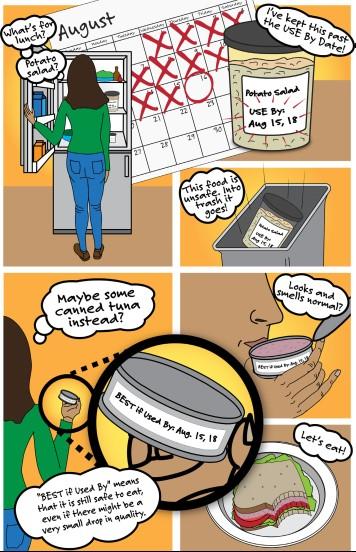
Consumer education is needed to increase understanding of food date labels according to a new study in the Journal of Nutrition Education and Behavior
IMAGE

Credit: Journal of Nutrition Education and Behavior

Philadelphia, May 6, 2021 – Misunderstanding food date labeling is common and educational communications are needed to improve consumer understanding, according to a new study in the Journal of Nutrition Education and Behavior, published by Elsevier.

Does it mean “spoiled – throw it out,” or “might not taste as good as it could anymore?” Food date labels (e.g., “USE By August 16”) can play an important role in helping consumers make informed decisions about food, and ultimately prevent unsafe consumption and waste of food. Researchers surveyed 2,607 adults in the United States to assess consumer understanding of the streamlined 2-date labeling system and explore the relative effectiveness of educational messages in increasing understanding.

“Our study showed that an overwhelming majority of consumers say that they use food date labels to make decisions about food and say they know what the labels mean,” said Catherine Turvey, MPH, Department of Exercise and Nutrition Sciences, Milken Institute School of Public Health, The George Washington University, Washington, DC, USA. “Despite confidently using date labels, many consumers misinterpreted the labels and continued to misunderstand even after reading educational messaging that explained the labels’ meaning.”

Less than half (46 percent) of study respondents knew that the “BEST If Used By” label specifically indicates that food quality may deteriorate after the date on the label. Less than one-quarter (24 percent) of study respondents knew that the “USE By” label means that food is not safe to eat after the date on the label.

Researchers explored if framing the messages with values like saving money or avoiding waste, would impact the effectiveness of messages at increasing consumer understanding. None of the seven value frames tested was significantly more effective at increasing understanding than another, but all messages significantly increased consumer’s general understanding of the labels.

After viewing educational messages, 37 percent of consumers still did not understand the specific meaning of the “BEST If Used By” label and 48 percent did not understand the specific meaning of the “USE By” label.

“Responses to the survey suggest that date labels are so familiar that some consumers believe they are boring, self-explanatory, or common sense despite misunderstanding the labels,” said Ms. Turvey. “Unwarranted confidence and the familiarity of date labels may make consumers less attentive to educational messaging that explains the food industry’s labeling system.”

Future communication campaigns will have to capture the attention of people who think they already know what date labels mean, find the information tedious, or are satisfied with a rough understanding of labels. Educating consumers about the meaning of the labels has growing implications for food waste and food safety as the 2-date labeling system becomes more widely adopted and gains support from non-profits and government institutions.

###

Media Contact
Eileen Leahy
jnebmedia@elsevier.com

Related Journal Article

http://dx.doi.org/10.1016/j.jneb.2021.03.007

Tags: BehaviorMedicine/HealthNutrition/NutrientsPublic Health
Share12Tweet8Share2ShareShareShare2

Related Posts

Yeast Evolution Reveals Fitness Trade-Offs Across Early and Late Stationary Phases

Yeast Evolution Reveals Fitness Trade-Offs Across Early and Late Stationary Phases

November 16, 2026
Fungal Genomic and Phenotypic Plasticity Enables Rapid Adaptation and Survival

Fungal Genomic and Phenotypic Plasticity Enables Rapid Adaptation and Survival

November 16, 2026

Artificial Intelligence Framework Integrates Multi-Omics Data to Target Cardiac Regeneration Barriers

November 16, 2026

New Hangingfly Species Discovered in Mozambique Features Rare Hind Leg Structure

November 16, 2026
Please login to join discussion

POPULAR NEWS

  • New Hangingfly Species Discovered in Mozambique Features Rare Hind Leg Structure

    New Hangingfly Species Discovered in Mozambique Features Rare Hind Leg Structure

    29 shares
    Share 12 Tweet 7
  • Psychiatric Diagnosis Faces New Risks in the Age of AI

    29 shares
    Share 12 Tweet 7
  • Fig Leaf Silver Nanoparticles Eliminate Cattle Ticks in Laboratory Bioassays

    29 shares
    Share 12 Tweet 7
  • South Korean Whipworms Lack Classic Resistance Mutations in Full-Length Genetic Study

    29 shares
    Share 12 Tweet 7

About

We bring you the latest biotechnology news from best research centers and universities around the world. Check our website.

Follow us

Recent News

Yeast Evolution Reveals Fitness Trade-Offs Across Early and Late Stationary Phases

Advanced Electrochemical Sensors Enable Rapid On-Site Detection of Toxic Environmental Pollutants

Ubiquitin Signaling Networks Reshape Tumor Macrophages and Highlight New Cancer Targets

Subscribe to Blog via Email

Enter your email address to subscribe to this blog and receive notifications of new posts by email.

Join 87 other subscribers
  • Contact Us

Bioengineer.org © Copyright 2023 All Rights Reserved.

Welcome Back!

Login to your account below

Forgotten Password?

Retrieve your password

Please enter your username or email address to reset your password.

Log In
No Result
View All Result
  • Homepages
    • Home Page 1
    • Home Page 2
  • News
  • National
  • Business
  • Health
  • Lifestyle
  • Science

Bioengineer.org © Copyright 2023 All Rights Reserved.