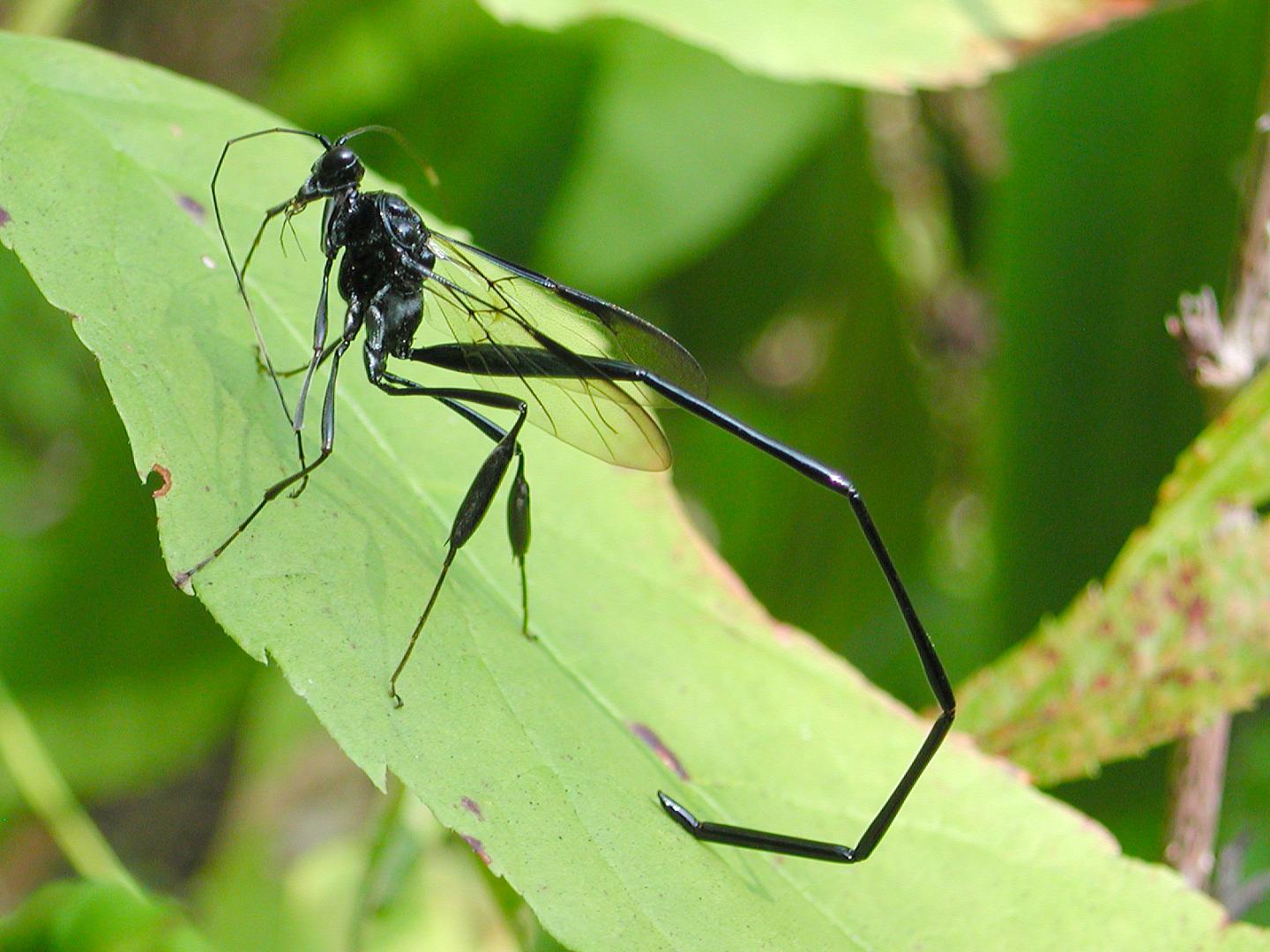
Credit: Henri Goulet
Knowing what species live in which parts of the world is critical to many fields of study, such as conservation biology and environmental monitoring. This is also how we can identify present or potential invasive and non-native pest species. Furthermore, summarizing what species are known to inhabit a given area is essential for the discovery of new species that have not yet been known to science.
For less well-studied groups and regions, distributional species checklists are often not available. Therefore, a series of such checklists is being published in the open-access, peer-reviewed Journal of Hymenoptera Research, in order to address the issue for a group of organisms that, despite its size and diversity, is still poorly known: the insect order Hymenoptera, which includes ants, bees and wasps. The surveyed area spreads across northern North America, which comprises Canada, Alaska (U.S.) and Greenland (Denmark), and occupies about 9.3% of the world’s total land mass.
The last distributional survey of Hymenoptera in North America was published in 1979, where about 6000 described species were recorded from Canada and 600 from Alaska. The current survey lists 8933 species in Canada and 1513 in Alaska, marking an increase of 49% and 152%, respectively. A total of 9250 described species are recorded from northern North America. Considering that there are approximately 154,000 described species of Hymenoptera, northern North America has about 6% of the current world total.
Highlights of the series will include updated distributions of over 900 species of bees, which will provide valuable insight into native pollinators at a time when honey bees are in decline. Nearly 230 species of ants and over 100 species of vespid wasps (hornets and yellow jackets) are recorded, including pest species such as the widespread pharaoh ant and the newly invasive Asian giant hornet in British Columbia.
By far, the majority of species of Hymenoptera found in northern North America and the world are parasitoids, which develop on or in other invertebrate hosts and are therefore of great interest to the biological control of pests. Of the 9250 species recorded, more than three-quarters (over 7150 species) are parasitoids. These distributional lists provide essential baseline information required prior to undertaking studies to introduce biological control agents of invasive pests that may have escaped their native, natural enemies when they arrived in North America.
The topical collection “Checklists of the Hymenoptera of Canada, Alaska and Greenland” is to contain a total of eleven papers, where the introduction and the first two checklists: of sawflies (758 species) and one of the groups of “microhymenoptera” (the chalcidoid parasitic wasps) (1246 species) have just been published.The other checklists are to follow over the next several years. The associated data are also being uploaded to the Global Biodiversity Information Facility (GBIF), allowing for periodic updates over time.
When complete, this will be the largest species checklist for any group of organisms in northern North America. Considering that it is estimated that we currently have documented less than half of the species of Hymenoptera present in northern North America, there is still a great amount of work to do on this fascinating group of insects.
###
Original sources:
Bennett AMR (2021a) Checklists of the Hymenoptera of Canada, Alaska and Greenland – Introduction. Journal of Hymenoptera Research 82: 1-19. https:/
Bennett AMR (2021b) Checklist of the Hymenoptera of Canada, Alaska and Greenland. Agriculture and Agri-Food Canada. Checklist dataset https:/
Goulet H, Bennett AMR (2021) Checklist of the sawflies (Hymenoptera) of Canada, Alaska and Greenland. Journal of Hymenoptera Research 82: 21-67. https:/
Huber JT, Bennett AMR, Gibson GAP, Zhang YM, Darling DC (2021) Checklist of Chalcidoidea and Mymarommatoidea (Hymenoptera) of Canada, Alaska and Greenland. Journal of Hymenoptera Research 82: 69-138. https:/
Media Contact
Dr Andrew MR Bennett
[email protected]
Related Journal Article
http://dx.