The UPV/EHU-University of the Basque country is exploring the effects of graphene oxide alone and in combination with certain organic compounds on zebra fish
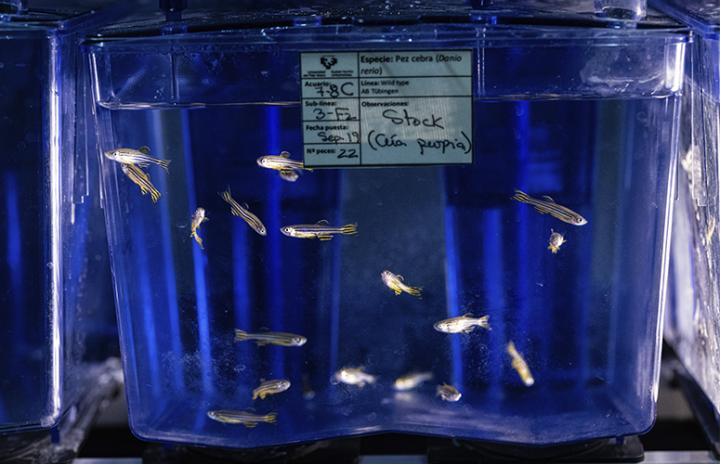
Credit: Egoi Markaida. UPV/EHU
Graphene is a two-dimensional nanomaterial composed of carbon and formed by a single layer of densely packed carbon atoms. The high mechanical strength and significant electrical and thermal properties of graphene mean that it is highly suited to many new applications in the fields of electronics, biological, chemical and magnetic sensors, photodetectors and energy storage and generation. Due to its potential applications, graphene production is expected to increase significantly in the coming years, but given its low market uptake and the limitations in analysing its effects, little information on the concentrations of graphene nanomaterials in ecosystems is currently available.
As a result of the surface characteristics of graphene, once in the aquatic environment, graphene could act as a carrier of organic pollutants, such as polycyclic aromatic hydrocarbons, to aquatic organisms. Accordingly, the CBET (Cell Biology in Environmental Toxicology) research group has evaluated not only the capacity of graphene oxide to sorb polycyclic aromatic hydrocarbons, but also the toxicity of graphene oxide alone and in combination with certain polycyclic aromatic hydrocarbons in embryo and adult zebrafish. The research was conducted in collaboration with the University of Bordeaux.
Embryonic malformations and neurotoxicity
“The results reveal that graphene oxide can carry polycyclic aromatic hydrocarbons into the zebrafish (via a kind of Trojan horse effect) and exert sublethal effects. Under the conditions we adopted, the toxic effects have not been huge, no fish or embryos have died, but in some biomarkers we have detected effects that have put us on the alert,” said Amaia Orbea, a PhD-holder in the CBET group at the UPV/EHU.
Firstly, they detected that at high concentrations malformations may occur in embryos, “which means that in longer exposures and at higher concentrations non-viable animals may be born”, explained Orbea. Secondly, this research has confirmed that “in the long term, during a three-week exposure period, the enzyme acetylcholinesterase, which slows down nervous stimuli, was inhibited in all the fish treated, so despite not using very high concentrations, we saw that as the exposure time increases, neurotoxic effects begin to appear”, said the researcher.
“We used specific concentrations and time periods, but we don’t know how these concentrations will evolve from now on in nature or what their possible influence may be in relation to other pollutants. The results have shown us that the concentrations that may exist in the environment at the moment are not very dangerous, but we have to be careful: we don’t know what effects these low concentrations may have during longer exposures. The results obtained are related to the conditions applied in our experiments. We don’t normally come across graphene alone in the environment; along with graphene there are many other pollutants that also affect animals… We need to consider them all at the same time,” she concluded.
###
Additional information
This study is part of the international co-supervised thesis by PhD student Ignacio Martínez-Álvarez. The research was funded by the UPV/EHU; Amaia Orbea is the thesis supervisor at the UPV/EHU, and Hélène Budzinski is the thesis supervisor at the University of Bordeaux. The research was carried out in the Department of Zoology and Animal Cell Biology and at the Experimental Marine Biology and Biotechnology Research Centre (Plentzia Marine Station), in collaboration with Polymat.
Media Contact
Matxalen Sotillo
[email protected]
Original Source
https:/
Related Journal Article
http://dx.