• HOME
  • NEWS
  • EXPLORE
    • CAREER
      • Companies
      • Jobs
    • EVENTS
    • iGEM
      • News
      • Team
    • PHOTOS
    • VIDEO
    • WIKI
  • BLOG
  • COMMUNITY
    • FACEBOOK
    • INSTAGRAM
    • TWITTER
Friday, January 2, 2026
BIOENGINEER.ORG
No Result
View All Result
  • Login
  • HOME
  • NEWS
  • EXPLORE
    • CAREER
      • Companies
      • Jobs
        • Lecturer
        • PhD Studentship
        • Postdoc
        • Research Assistant
    • EVENTS
    • iGEM
      • News
      • Team
    • PHOTOS
    • VIDEO
    • WIKI
  • BLOG
  • COMMUNITY
    • FACEBOOK
    • INSTAGRAM
    • TWITTER
  • HOME
  • NEWS
  • EXPLORE
    • CAREER
      • Companies
      • Jobs
        • Lecturer
        • PhD Studentship
        • Postdoc
        • Research Assistant
    • EVENTS
    • iGEM
      • News
      • Team
    • PHOTOS
    • VIDEO
    • WIKI
  • BLOG
  • COMMUNITY
    • FACEBOOK
    • INSTAGRAM
    • TWITTER
No Result
View All Result
Bioengineer.org
No Result
View All Result
Home NEWS Science News Chemistry

New look at a bright stellar nursery

Bioengineer by Bioengineer
May 4, 2021
in Chemistry
Reading Time: 2 mins read
0
IMAGE
Share on FacebookShare on TwitterShare on LinkedinShare on RedditShare on Telegram

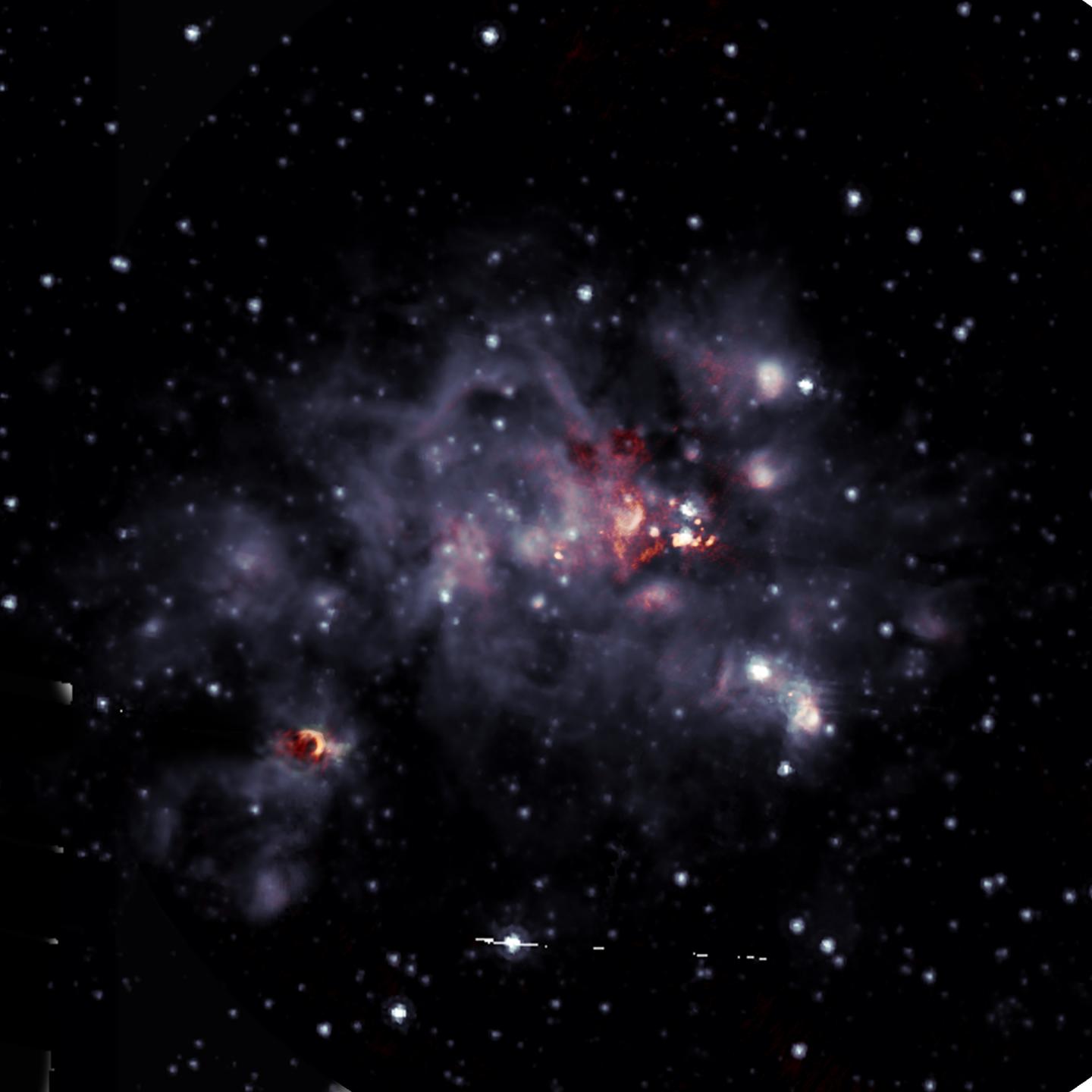
VLA observations reveal changes over time
IMAGE

Credit: CREDIT: DePree, et al.; Sophia Dagnello, NRAO/AUI/NSF; Spitzer/NASA.

This overlay shows radio (orange) and infrared images of a giant molecular cloud called W49A, where new stars are being formed. A team of astronomers led by Chris DePree of Agnes Scott College used the National Science Foundation’s Karl G. Jansky Very Large Array (VLA) to make new, high-resolution radio images of this cluster of still-forming, massive stars. W49A, 36,000 light-years from Earth, has been studied for many decades, and the new radio images revealed some tantalizing changes that have occurred since an earlier set of VLA observations in 1994 and 1995.

The VLA radio images show the shape and movement of giant clouds of ionized hydrogen gas formed by the intense ultraviolet radiation from young stars. Comparing old and new VLA images of these ionized regions has shown changes indicating new activity in some of the regions. This new activity includes a narrow, fast-moving jet in one region, supersonic gas motions in three others, and an unexpected reduction in the radio brightness in another.

The astronomers, who reported their findings in the Astronomical Journal, plan to continue observing this region regularly to track changes that will reveal new details about the complex processes of star formation and interactions of the outflows from young stars.

###

The National Radio Astronomy Observatory is a facility of the National Science Foundation, operated under cooperative agreement by Associated Universities, Inc.

CREDIT: DePree, et al.; Sophia Dagnello, NRAO/AUI/NSF; Spitzer/NASA.

Media Contact
Dave Finley
[email protected]

Original Source

https://public.nrao.edu/news/new-look-bright-stellar-nursery/

Tags: AstronomyAstrophysicsChemistry/Physics/Materials SciencesSpace/Planetary ScienceStars/The Sun
Share12Tweet8Share2ShareShareShare2

Related Posts

Cutting Electrolyte Reduction Boosts High-Energy Battery Performance

Cutting Electrolyte Reduction Boosts High-Energy Battery Performance

December 19, 2025
Microenvironment Shapes Gold-Catalysed CO2 Electroreduction

Microenvironment Shapes Gold-Catalysed CO2 Electroreduction

December 11, 2025

Photoswitchable Olefins Enable Controlled Polymerization

December 11, 2025

Cation Hydration Entropy Controls Chloride Ion Diffusion

December 10, 2025
Please login to join discussion

POPULAR NEWS

  • blank

    PTSD, Depression, Anxiety in Childhood Cancer Survivors, Parents

    113 shares
    Share 45 Tweet 28
  • NSF funds machine-learning research at UNO and UNL to study energy requirements of walking in older adults

    71 shares
    Share 28 Tweet 18
  • Exploring Audiology Accessibility in Johannesburg, South Africa

    52 shares
    Share 21 Tweet 13
  • SARS-CoV-2 Subvariants Affect Outcomes in Elderly Hip Fractures

    44 shares
    Share 18 Tweet 11

About

We bring you the latest biotechnology news from best research centers and universities around the world. Check our website.

Follow us

Recent News

Laser-Printed Metasurfaces Enable Advanced Light Conversion, Detection

Reprogrammable Nonlinear Optics with Ferroelectric Liquid Crystals

Advancements in Droplet Microfluidics for Biomaterials

Subscribe to Blog via Email

Enter your email address to subscribe to this blog and receive notifications of new posts by email.

Join 71 other subscribers
  • Contact Us

Bioengineer.org © Copyright 2023 All Rights Reserved.

Welcome Back!

Login to your account below

Forgotten Password?

Retrieve your password

Please enter your username or email address to reset your password.

Log In
No Result
View All Result
  • Homepages
    • Home Page 1
    • Home Page 2
  • News
  • National
  • Business
  • Health
  • Lifestyle
  • Science

Bioengineer.org © Copyright 2023 All Rights Reserved.