• HOME
  • NEWS
  • EXPLORE
    • CAREER
      • Companies
      • Jobs
    • EVENTS
    • iGEM
      • News
      • Team
    • PHOTOS
    • VIDEO
    • WIKI
  • BLOG
  • COMMUNITY
    • FACEBOOK
    • INSTAGRAM
    • TWITTER
Tuesday, November 17, 2026
BIOENGINEER.ORG
No Result
View All Result
  • Login
  • HOME
  • NEWS
  • EXPLORE
    • CAREER
      • Companies
      • Jobs
        • Lecturer
        • PhD Studentship
        • Postdoc
        • Research Assistant
    • EVENTS
    • iGEM
      • News
      • Team
    • PHOTOS
    • VIDEO
    • WIKI
  • BLOG
  • COMMUNITY
    • FACEBOOK
    • INSTAGRAM
    • TWITTER
No Result
View All Result
Bioengineer.org
No Result
View All Result
Home NEWS Science News Biology

The first comprehensive single-cell atlas of human teeth

Bioengineer by Bioengineer
April 27, 2021
in Biology
Reading Time: 2 mins read
0
IMAGE
Share on FacebookShare on TwitterShare on LinkedinShare on RedditShare on Telegram

IMAGE

Credit: ZZM/UZH

During the last 30 years, medical and dental research has attracted a large number of scientists and practitioners working on aspects of high medical relevance that involve a combination of genetic and tissue regeneration approaches. These developments in stem cell and tissue engineering have provided medical and dental researchers with new insights and given rise to new ideas as to how everyday clinical practice can be improved. Many research groups are dealing with questions like: How can we help injured tissues and organs heal? Can lost tissue be regenerated? How can we create solid protocols that apply across all stem cell therapies?

Advanced single-cell sequencing technology used

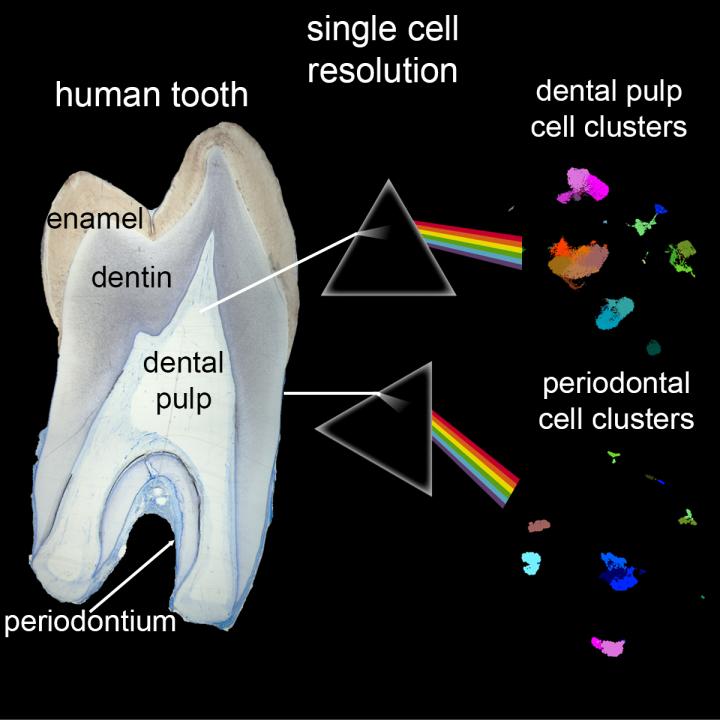
A team of researchers led by Thimios Mitsiadis, professor at the Institute of Oral Biology at the University of Zurich, and Dr. Andreas Moor, professor at the Department of Biosystems Science and Engineering at ETH Zurich, has now created the first-ever single cells atlas of the human teeth. By using advanced single-cell sequencing technology, they were able to distinguish every single cell that is part of the dental pulp and the periodontium. “Our study provides an unprecedented understanding of the composition of these two tissues, which are subject to tooth-specific and bacterially-linked pathologies such as caries and periodontitis. Both the dental pulp and the periodontium contain stem cells that possess a great regenerative potential,” states first co-author Pierfrancesco Pagella, senior researcher in Mitsiadis’ team.

The study identified great cellular heterogeneity in the dental pulp and the periodontium. Unexpectedly, the team found that the molecular signatures of the stem cell populations were very similar. “We think their different behavior is possibly brought about by their distinctive microenvironment,” says Pagella. The findings suggest that the microenvironmental specificity is the potential source of the major functional differences of the stem cells located in the various tooth compartments.

New cell-based dental therapies possible

The study demonstrates the complexity of dental tissues and represents a major contribution to a better understanding of the cellular and molecular identity of human dental tissues. “Single-cell approaches can help us understand the interactions of dental pulp and periodontal cells involved in immune responses upon bacterial insults. Therefore, single-cell analysis could be useful for diagnostic purposes to support the early detection of dental diseases,” last author Thimios Mitsiadis explains. The findings thus open up new avenues for cell-based dental therapeutic approaches.

According to Mitsiadis, these advances in dental research can lead to more appropriate therapies, successful regeneration of damaged parts of the teeth, and even more precise diagnostic tools in case of dental pathologies. “These innovations are the consequence of the fusion between bioinformatics and modern dentistry,” he concludes.

###

Media Contact
Prof. Dr. Thimios A. Mitsiadis
thimios.mitsiadis@zzm.uzh.ch

Original Source

https://www.media.uzh.ch/en/Press-Releases/2021/Tooth-Altlas.html

Related Journal Article

http://dx.doi.org/10.1016/j.isci.2021.102405

Tags: Cell BiologyDentistry/Periodontal DiseaseDiagnosticsGeneticsHealth ProfessionalsMedicine/HealthPublic Health
Share12Tweet8Share2ShareShareShare2

Related Posts

Aspergillus tubingensis Yields Bioactive Antioxidant Pyrones Amid Melanin Extraction Challenges

Aspergillus tubingensis Yields Bioactive Antioxidant Pyrones Amid Melanin Extraction Challenges

November 17, 2026
South Korean Cattle Study Identifies Common Cryptosporidium and Eimeria Parasite Subtypes

South Korean Cattle Study Identifies Common Cryptosporidium and Eimeria Parasite Subtypes

November 17, 2026

Simmental Bull Semen Preservation at Zero Degrees Celsius Optimised by One-to-Five Dilution

November 17, 2026

USP2 Stabilizes c-Fos to Drive AP-1 Transcription in Breast Cancer

November 17, 2026
Please login to join discussion

POPULAR NEWS

  • Four Key Clinical Factors Associated With Heart Injury in Gastrointestinal Bleeding

    Four Key Clinical Factors Associated With Heart Injury in Gastrointestinal Bleeding

    29 shares
    Share 12 Tweet 7
  • Nanjing Hospital Study Finds 19.2 Percent HPV Positivity Among 39,335 Women

    29 shares
    Share 12 Tweet 7
  • Specialized EBI3-High Dendritic Cell Subset Identified in Rheumatoid Arthritis Synovial Fluid

    29 shares
    Share 12 Tweet 7
  • Early Tildrakizumab Treatment Predicts Complete Psoriasis Clearance in Five-Year Italian Study

    29 shares
    Share 12 Tweet 7

About

We bring you the latest biotechnology news from best research centers and universities around the world. Check our website.

Follow us

Recent News

Poor Oral Health Tied to Accelerated Epigenetic Aging and Higher Mortality

Adding Butorphanol to Post-Surgery PCA Increases Dizziness Without Improving Pain Control

Review Outlines Deep Phenotyping Frameworks to Advance Precision Medical Genetics

Subscribe to Blog via Email

Enter your email address to subscribe to this blog and receive notifications of new posts by email.

Join 88 other subscribers
  • Contact Us

Bioengineer.org © Copyright 2023 All Rights Reserved.

Welcome Back!

Login to your account below

Forgotten Password?

Retrieve your password

Please enter your username or email address to reset your password.

Log In
No Result
View All Result
  • Homepages
    • Home Page 1
    • Home Page 2
  • News
  • National
  • Business
  • Health
  • Lifestyle
  • Science

Bioengineer.org © Copyright 2023 All Rights Reserved.