• HOME
  • NEWS
  • EXPLORE
    • CAREER
      • Companies
      • Jobs
    • EVENTS
    • iGEM
      • News
      • Team
    • PHOTOS
    • VIDEO
    • WIKI
  • BLOG
  • COMMUNITY
    • FACEBOOK
    • INSTAGRAM
    • TWITTER
Friday, June 26, 2026
BIOENGINEER.ORG
No Result
View All Result
  • Login
  • HOME
  • NEWS
  • EXPLORE
    • CAREER
      • Companies
      • Jobs
        • Lecturer
        • PhD Studentship
        • Postdoc
        • Research Assistant
    • EVENTS
    • iGEM
      • News
      • Team
    • PHOTOS
    • VIDEO
    • WIKI
  • BLOG
  • COMMUNITY
    • FACEBOOK
    • INSTAGRAM
    • TWITTER
  • HOME
  • NEWS
  • EXPLORE
    • CAREER
      • Companies
      • Jobs
        • Lecturer
        • PhD Studentship
        • Postdoc
        • Research Assistant
    • EVENTS
    • iGEM
      • News
      • Team
    • PHOTOS
    • VIDEO
    • WIKI
  • BLOG
  • COMMUNITY
    • FACEBOOK
    • INSTAGRAM
    • TWITTER
No Result
View All Result
Bioengineer.org
No Result
View All Result
Home NEWS Science News Biology

SARS-CoV-2 curtails immune response in the gut

Bioengineer by Bioengineer
April 27, 2021
in Biology
Reading Time: 3 mins read
0
IMAGE
Share on FacebookShare on TwitterShare on LinkedinShare on RedditShare on Telegram

Scientists transform human intestinal cells into ‘mini guts’ to follow infection process
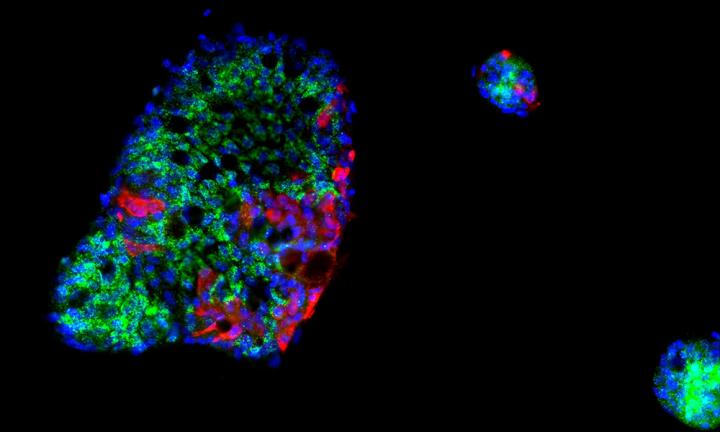
IMAGE

Credit: Mohammed Shahraz, Sergio Triana/EMBL; Camila Metz-Zumaran/Heidelberg University

In an effort to determine the potential for COVID-19 to begin in a person’s gut, and to better understand how human cells respond to SARS-CoV-2, the scientists used human intestinal cells to create organoids – 3D tissue cultures derived from human cells, which mimic the tissue or organ from which the cells originate. Their conclusions, published in the journal Molecular Systems Biology, indicate the potential for infection to be harboured in a host’s intestines and reveal intricacies in the immune response to SARS-CoV-2.

“Previous research had shown that SARS-CoV-2 can infect the gut,” says Theodore Alexandrov, who leads one of the two EMBL groups involved. “However, it remained unclear how intestinal cells mount their immune response to the infection.”

In fact, the researchers were able to determine the cell type most severely infected by the virus, how infected cells trigger an immune response, and – most interestingly – that SARS-CoV-2 silences the immune response in infected cells. These findings may shed light on the pathogenesis of SARS-CoV-2 infection in the gut, and indicate why the gut should be considered to fully understand how COVID-19 develops and spreads.

According to Sergio Triana, lead author and a doctoral candidate in EMBL’s Alexandrov team, the researchers observed how infected cells seem to start a cascade of events that produce a signalling molecule called interferon.

“Interestingly, although most cells in our mini guts had a strong immune response triggered by interferon, SARS-CoV-2-infected cells did not react in the same way and instead presented a strong pro-inflammatory response,” Sergio says. “This suggests that SARS-CoV-2 interferes with the host signalling to disrupt an immune response at the cellular level.”

Coronaviruses, including SARS-CoV-2, cause infection by latching on to specific protein receptors found on the surface of certain cell types. Among these receptors is the protein ACE2. Interestingly, the researchers showed that the infection is not explained solely by the presence of ACE2 on the surface of the cells, highlighting our still limited knowledge about COVID-19, even after a year of tremendous research efforts worldwide.

As the disease progressed in the organoids, the researchers used single-cell RNA sequencing, which involves several techniques to amplify and detect RNA. Among these single-cell technologies, Targeted Perturb-seq (TAP-seq) provided sensitive detection of SARS-CoV-2 in infected organoids. Lars Steinmetz’s research group at EMBL recently developed TAP-seq, which the researchers combined with powerful computational tools, enabling them to detect, quantify, and compare expression of thousands of genes in single cells within the organoids.

“This finding could offer insights into how SARS-CoV-2 protects itself from the immune system and offer alternative ways to treat it,” Lars says. “Further study can help us understand how the virus grows and the various ways it impacts the human immune system.”

###

Media Contact
Mathias Jäger
[email protected]

Original Source

https://www.embl.org/news/science/sars-cov-2-curtails-immune-response-in-the-gut/

Related Journal Article

http://dx.doi.org/10.15252/msb.202110232

Tags: BiologyGastroenterologyInfectious/Emerging DiseasesMedicine/HealthMolecular Biology
Share12Tweet8Share2ShareShareShare2

Related Posts

Natural Hallucinogens: Evolution’s Ecological Tools, Not Mere Chemical Byproducts

June 25, 2026

This Famous Butterfly Revealed: Three Distinct Species Hidden in One

June 25, 2026

Scientists Attack Soybean Cyst Nematode by Starving Its Food Source

June 25, 2026

Decoding the Secret Code of a Crucial Immune Sensor

June 24, 2026
Please login to join discussion

POPULAR NEWS

  • Saying Goodbye to PGY-6: Pediatric Fellowship Realities

    103 shares
    Share 41 Tweet 26
  • Multi-Hospital Study Reveals Long Covid Burden Is Twice as High as Current Estimates

    92 shares
    Share 36 Tweet 23
  • Detection of EDCs in Breast Milk and Infant Urine Up to Six Months Highlights Early Exposure Risks

    77 shares
    Share 31 Tweet 19
  • New Drug Candidate Developed at McMaster Shows Potential for Treating Brain Cancer

    58 shares
    Share 23 Tweet 15

About

We bring you the latest biotechnology news from best research centers and universities around the world. Check our website.

Follow us

Recent News

Tracking Lanthanide-Labeled Microplastics in Plants

POSTECH Researchers Slash Cost of Reconstituted Cell-Free Systems by 95%

AI and Physics Collaborate to Design Advanced Hydrogen Storage Materials

Subscribe to Blog via Email

Success! An email was just sent to confirm your subscription. Please find the email now and click 'Confirm' to start subscribing.

Join 82 other subscribers
  • Contact Us

Bioengineer.org © Copyright 2023 All Rights Reserved.

Welcome Back!

Login to your account below

Forgotten Password?

Retrieve your password

Please enter your username or email address to reset your password.

Log In
No Result
View All Result
  • Homepages
    • Home Page 1
    • Home Page 2
  • News
  • National
  • Business
  • Health
  • Lifestyle
  • Science

Bioengineer.org © Copyright 2023 All Rights Reserved.