Australian airports are ideal hosts for large-scale solar installations
Credit: RMIT University
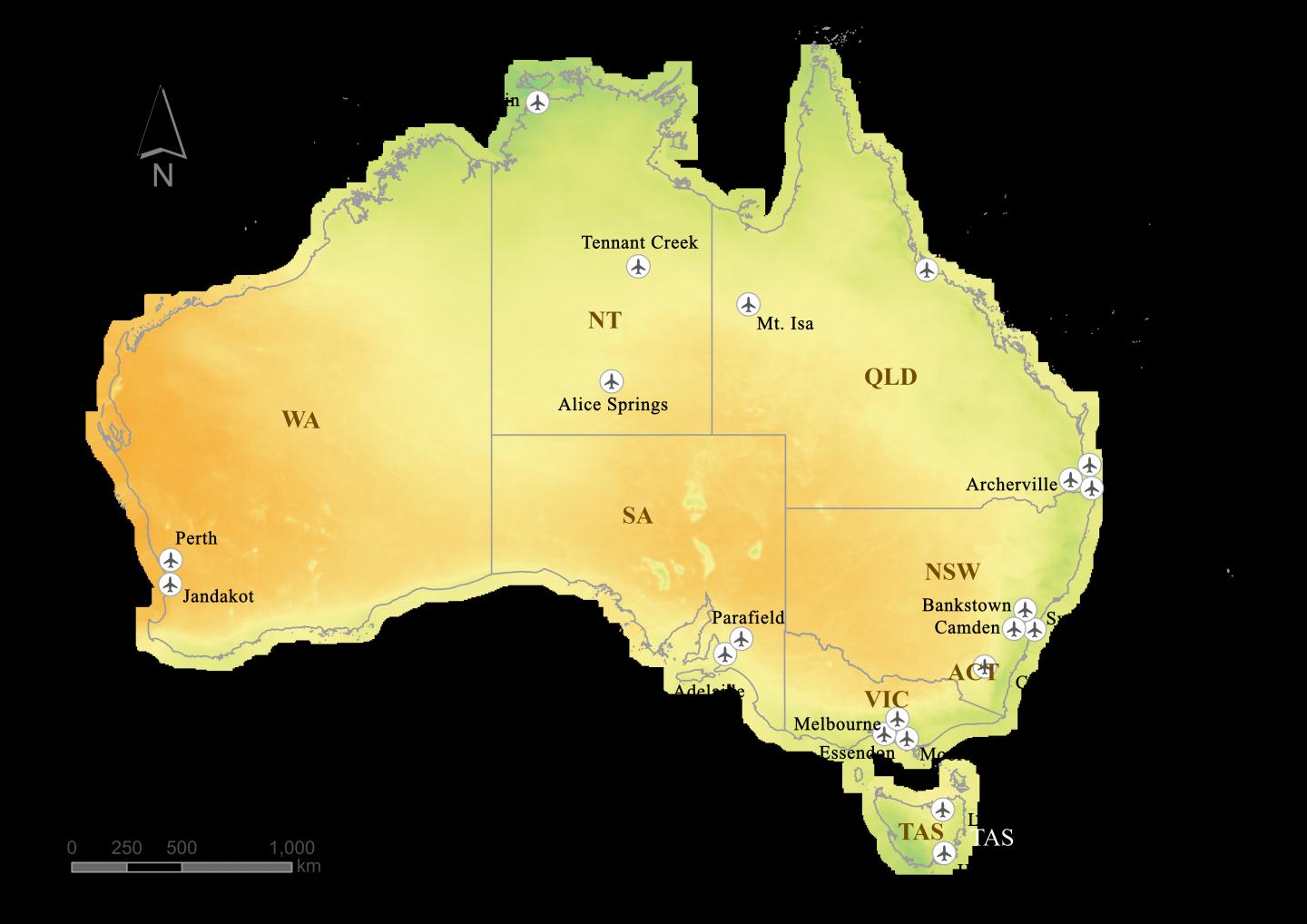
A new study has found Australia’s government-owned airports could produce enough electricity to power 136,000 homes, if they had large-scale rooftop solar systems installed.
Researchers at RMIT University compared electricity generated by residential solar panels in a regional Australian city to the potential green energy production of 21 leased federal airports.
They found if large-scale solar panels were installed at the airports, they would generate 10 times more electricity than the city’s 17,000 residential panels, while offsetting 151.6 kilotons of greenhouse gasses annually.
Researcher Dr Chayn Sun said the analysis showed the value of focusing renewable energy efforts on large, centralised rooftop solar systems.
“We can’t rely on small residential solar panels to get us to a zero-emission economy but installing large panels at locations like airports would get us a lot closer,” she said.
“We hope our results will help guide energy policy, while informing future research in solar deployment for large buildings.
“There’s so much potential to facilitate national economic development while contributing towards greenhouse gas emission reduction targets.”
Sun, a geospatial scientist in RMIT’s School of Science, said airports were ideal for solar panels but were not currently being used to their full potential – many Australian airports are without adequate solar systems.
“Airports get good sun exposure because they’re not shaded by tall buildings or trees, making them a perfect spot to harness the sun’s energy,” she said.
“Australia is facing an energy crisis, yet our solar energy resources – such as airport rooftops – are being wasted.
“Harnessing this power source would avoid 63 kilotons of coal being burned in Australia each year, an important step towards a zero-carbon future.”
For the study, published in the Journal of Building Engineering, geospatial researchers estimated the solar electricity generated from 17,000 residential solar panels in Bendigo, Victoria, over one year.
Lead author Athenee Teofilo, a Master of Geospatial Science student, then mapped the buildings in every leased federal airport – excluding unsuitable structures like dome and blister-type hangars – and identified 2.61km2 of usable rooftop space.
Researchers determined the optimum tilt angle for the solar arrays for each airport, to maximise efficiency.
Perth Airport had most energy-generating potential; placing solar panels there could produce almost twice the solar output of Bendigo, equal to the combined production from Adelaide, Sydney, Moorabbin and Townsville airports.
Even Melbourne Airport alone would outperform Bendigo’s annual solar electricity production by almost 12 gigawatt hours a year.
Airport buildings less suited to solar panels could still be useful for ground-mounted solar systems, the study found.
Sun said the research underlined the necessity for energy policies to include a plan for installing solar panels at airports.
“Based on our solar radiation analysis, we know airports with decent solar systems could not only be self-sufficient but would generate enough electricity to send the excess back into the grid,” she said.
“We mapped airports owned by the federal government, but Australia has more than 150 privately-owned airfields, which could also have panels installed.
“Australia receives so much solar radiation, so every airport in the country would benefit from having the right type of solar panels installed.
“The same could be said for many airports and large buildings located around the world.”
Sun said reflections from the panels would not be a problem, as modern solar arrays absorb rather than reflect sunlight.
Previous studies have deemed airports as great solar generators but the RMIT research goes further by precisely modelling the use of large-scale systems.
The findings could also be extended to assess the solar potential of other sites, such as large commercial buildings, warehouses or distribution centres.
###
‘Investigating potential rooftop solar energy generated by Leased Federal Airports in Australia: Framework and implications’, with Athenee Teofilo, Dr Chayn Sun, Nenad Radosevic, Yaguang Tao, Jerome Iringan and Chengyang Liu, is published in the Journal of Building Engineering (DOI: 10.1016/j.jobe.2021.102390).
Media Contact
Aeden Ratcliffe
[email protected]
Original Source
https:/
Related Journal Article
http://dx.