Credit: Frances Trail
We’ve all heard the news stories of how what you eat can affect your microbiome. Changing your diet can shift your unique microbial fingerprint. This shift can cause a dramatic effect on your health. But what about the microbiome of the plants you eat? Scientists are beginning to see how shifts in plant microbiomes also impact plant health. Unlocking the factors in plant microbial assemblage can lead to innovative and sustainable solutions to increase yield and protect our crops.
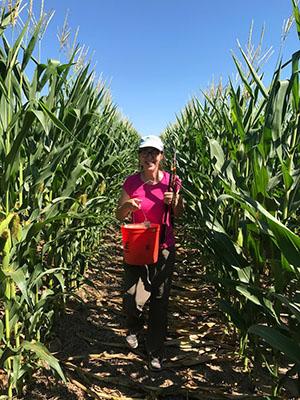
In a new study published in the Phytobiomes Journal, “Influence of plant host and organ, management strategy, and spore traits on microbiome composition,” Dr. Frances Trail and her research group are interested in three factors that might attribute to microbial assemblage: the age of the plant, the organ or tissue type, and the management strategy. They followed a 3-year crop rotation that included corn, wheat, and soybean planted in a single field. They looked at a total of 24 plots under 4 different management strategies (6 plots/strategy): till, no-till, reduced chemicals, and organic.
Many factors drive crop microbial assemblage. Many researchers have looked at organic management strategies and how they might provide more diversity compared to conventional ones. Scientists believe that plant genetics also play a role in assemblage as each plant has a unique microbial fingerprint. Researchers have also shown microbes have adapted to a particular niche within the plant. Stems and leaves have a different nutrient niche than belowground compartments. The microbial profile of a leaf is often less diverse and different than the soil. What makes Trail’s research unique is it’s one of the first studies to look at all these factors (management strategy, host genetics, and tissue type) in one study.
The lead author on the paper, Dr. Kristi Gdanetz, was surprised by what she found to be the most important factor for microbial assemblage. She said, “the influence of management practices was not as strong an effect as I expected. It appears host genetics and plant location are more important indicators of community composition.” Their research found that growth stages and tissue all had distinct microbial communities, particularly with bacterial communities.
The soil is the major reservoir for bacterial inhabitants of the plant with a few bacteria being carried by insects. Several studies, including Trail’s, have shown bacterial profiles are most diverse and abundant within the soil. Above-ground organs, like the stem and leaf, are less diverse and harbor fewer microbes. Many bacterial inhabitants can be traced back to the soil, which suggests that the plant grants some microbes access to its tissues or the microbes may trick the plant to let them in.
The fungal route to the plant is more complicated. The roots and soil do not appear to be a major source of plant-associated fungi. Dr. Trail’s research found that the alpha diversity of fungal communities did not decline from below- to above-ground tissues. Many fungal species form spores that wind, insects, and even humans can transport from one plant to the next. One major finding is that the shape, size, and other traits of the spore influence the host’s fungal community. Specific sport traits may drive fungal assemblage to a specific niche (stem, leaf roots) within the plant.
Trail says, “When I realized that I could tie spore traits with the microbiome data, I was very excited, because this adds important information for how fungal microbiomes assemble, and the assembly of bacterial microbiomes as well.” This unique finding became a focus of their research.
As this research unfolds there are many directions for future applications in sustainable agriculture, food production, and microbiology. Already we know several roles microbes play in crop health, such as enhancing immunity and nutrient cycling. Interacting and competing microbes might mask these roles. Dr. Trail is the first to show spore phenotypes influence the plant microbiome. With this knowledge, researchers can better understand microbial assemblage and use this information to increase yield. The researchers hope this knowledge will help develop new products to enhance crop sustainability.
###
Dr. Frances Trail is an established professor at Michigan State University and has mentored several aspiring scientists within her lab. Dr. Kristi Gdanetz is a postdoctoral scholar at Michigan State University who aspires to be a USDA scientist.
Author Bio: Tess Deyett, Ph.D. is a current postdoc under the guidance of Dr. Philippe Rolshausen at the University of California Riverside. She serves as an assistant feature editor for the Phytobiomes Journal. A passionate and driven science communicator, Tess also hosts her own website microbigals.com and podcast The Microbe Moment. She aspires to share how microbes are a constant force of good to every person and that everyone has many unique microbe moments!
Media Contact
Tess Deyett
[email protected]
Related Journal Article
http://dx.