• HOME
  • NEWS
  • EXPLORE
    • CAREER
      • Companies
      • Jobs
    • EVENTS
    • iGEM
      • News
      • Team
    • PHOTOS
    • VIDEO
    • WIKI
  • BLOG
  • COMMUNITY
    • FACEBOOK
    • INSTAGRAM
    • TWITTER
Saturday, March 28, 2026
BIOENGINEER.ORG
No Result
View All Result
  • Login
  • HOME
  • NEWS
  • EXPLORE
    • CAREER
      • Companies
      • Jobs
        • Lecturer
        • PhD Studentship
        • Postdoc
        • Research Assistant
    • EVENTS
    • iGEM
      • News
      • Team
    • PHOTOS
    • VIDEO
    • WIKI
  • BLOG
  • COMMUNITY
    • FACEBOOK
    • INSTAGRAM
    • TWITTER
  • HOME
  • NEWS
  • EXPLORE
    • CAREER
      • Companies
      • Jobs
        • Lecturer
        • PhD Studentship
        • Postdoc
        • Research Assistant
    • EVENTS
    • iGEM
      • News
      • Team
    • PHOTOS
    • VIDEO
    • WIKI
  • BLOG
  • COMMUNITY
    • FACEBOOK
    • INSTAGRAM
    • TWITTER
No Result
View All Result
Bioengineer.org
No Result
View All Result
Home NEWS Science News Chemistry

Stone skipping techniques can improve reentry of space vehicles

Bioengineer by Bioengineer
April 20, 2021
in Chemistry
Reading Time: 3 mins read
0
IMAGE
Share on FacebookShare on TwitterShare on LinkedinShare on RedditShare on Telegram

Experimental investigation, combined with theory, reveals key factors affecting the way a stone skips on water and how spaceflight vehicles make water landings
IMAGE

Credit: Kun Zhao

WASHINGTON, April 20, 2021 — Skipping stones on a body of water is an age-old game, but developing a better understanding of the physics involved is crucial for more serious matters, such as water landings upon reentry of spaceflight vehicles or aircrafts.

In Physics of Fluids, by AIP Publishing, scientists from several universities in China reveal several key factors that influence the number of bounces a skipping stone or landing aircraft will undergo when hitting the water.

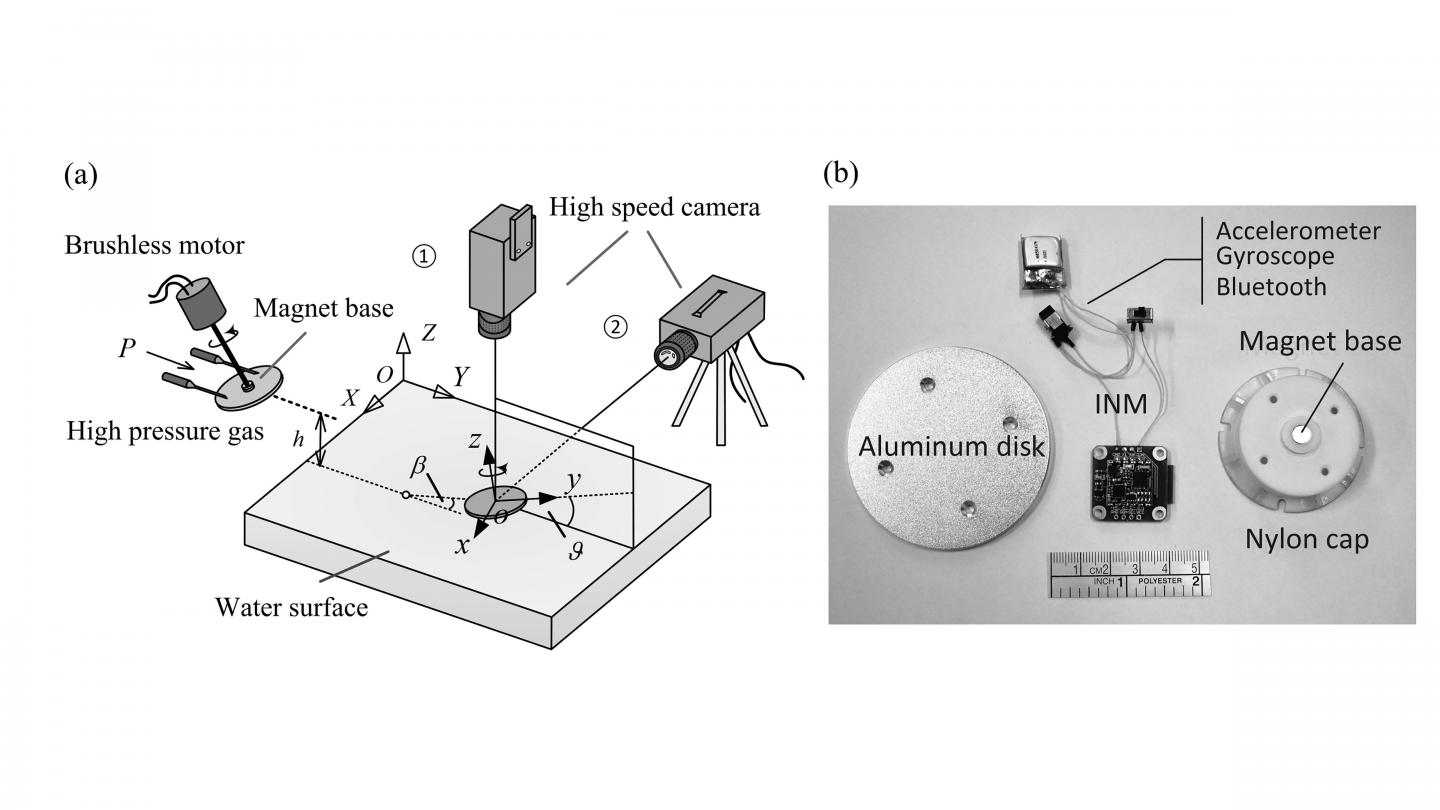
The study involved theoretical modeling and a simple experimental setup using a model stone to gather data in real time. The investigators used an aluminum disk as a stand-in for the stone and designed a launching mechanism that utilized a puff of air from a compressor to control the speed at which the disk traveled toward the water.

Previous studies had already determined that spinning the stone is key in getting it to skip or bounce, so the experimental setup allowed a motor to apply a controlled spin to the disk prior to launch. In addition, the disk had a nylon cap containing an inertial navigation module to measure data in flight and transmit it to a computer via a Bluetooth connection.

The investigators observed two types of motions after the disk collided with the water surface: bouncing and surfing. In the latter, the disk skims along the surface of the water without bouncing at all.

A key quantity in determining whether the disk can bounce is the vertical acceleration. When this acceleration exceeds four times the acceleration due to gravity, g, the disk bounces. When it is slightly smaller, 3.8 g, surfing was observed.

“We consider the surfing phenomenon to be a critical form of bouncing, with 3.8 g as the critical bounce boundary,” said author Kun Zhao. The minimum value at which the stone has the potential to skip was found to be 3.05 g.

The scientists also found the direction at which the disk or stone is spun affects its trajectory and the attitude or pitch, which is the angle between the water surface and the direction of flight.

“Our results show that the main effect of spinning is to stabilize the attitude during the collision by the gyro effect,” said Zhao.

Spinning also deflected the trajectory of the disk in flight. A clockwise rotation bent the trajectory toward the right, whereas a counterclockwise spin deflected it toward the left.

“Our results provide a new perspective to advance future studies in aerospace and marine engineering,” said Zhao.

###

The article “Trajectory and altitude study of a skipping stone” is authored by Jie Tang, Kun Zhao, Huatao Chen, and Dengqing Cao. The article will appear in Physics of Fluids on April 20, 2021 (DOI: 10.1063/5.0040158). After that date, it can be accessed at https://aip.scitation.org/doi/10.1063/5.0040158.

ABOUT THE JOURNAL

Physics of Fluids is devoted to the publication of original theoretical, computational, and experimental contributions to the dynamics of gases, liquids, and complex fluids. See https://aip.scitation.org/journal/phf.

Media Contact
Larry Frum
[email protected]

Related Journal Article

http://dx.doi.org/10.1063/5.0040158

Tags: Chemistry/Physics/Materials SciencesTechnology/Engineering/Computer Science
Share12Tweet8Share2ShareShareShare2

Related Posts

blank

Physicists Identify Electronic Drivers Behind Flat Band Quantum Materials

March 21, 2026
Würzburg Chemistry Professor Claudia Höbartner Receives Prestigious Honor

Würzburg Chemistry Professor Claudia Höbartner Receives Prestigious Honor

March 20, 2026

Scientists Reveal How Magnets Control Metamaterial Behavior

March 20, 2026

Gallium-Based Liquid Metals: Pioneering Cybernetic Bridges for Human-Machine Integration

March 20, 2026
Please login to join discussion

POPULAR NEWS

  • blank

    Revolutionary AI Model Enhances Precision in Detecting Food Contamination

    96 shares
    Share 38 Tweet 24
  • Imagine a Social Media Feed That Challenges Your Views Instead of Reinforcing Them

    1004 shares
    Share 397 Tweet 248
  • Uncovering Functions of Cavernous Malformation Proteins in Organoids

    54 shares
    Share 22 Tweet 14
  • Promising Outcomes from First Clinical Trials of Gene Regulation in Epilepsy

    51 shares
    Share 20 Tweet 13

About

We bring you the latest biotechnology news from best research centers and universities around the world. Check our website.

Follow us

Recent News

In-Sensor Cryptography Links Physical Process to Digital Identity

Can Psychosocial Factors Influence Cancer Risk?

Depression Factors in Elderly: Pre vs. Post-COVID Analysis

Subscribe to Blog via Email

Enter your email address to subscribe to this blog and receive notifications of new posts by email.

Join 78 other subscribers
  • Contact Us

Bioengineer.org © Copyright 2023 All Rights Reserved.

Welcome Back!

Login to your account below

Forgotten Password?

Retrieve your password

Please enter your username or email address to reset your password.

Log In
No Result
View All Result
  • Homepages
    • Home Page 1
    • Home Page 2
  • News
  • National
  • Business
  • Health
  • Lifestyle
  • Science

Bioengineer.org © Copyright 2023 All Rights Reserved.