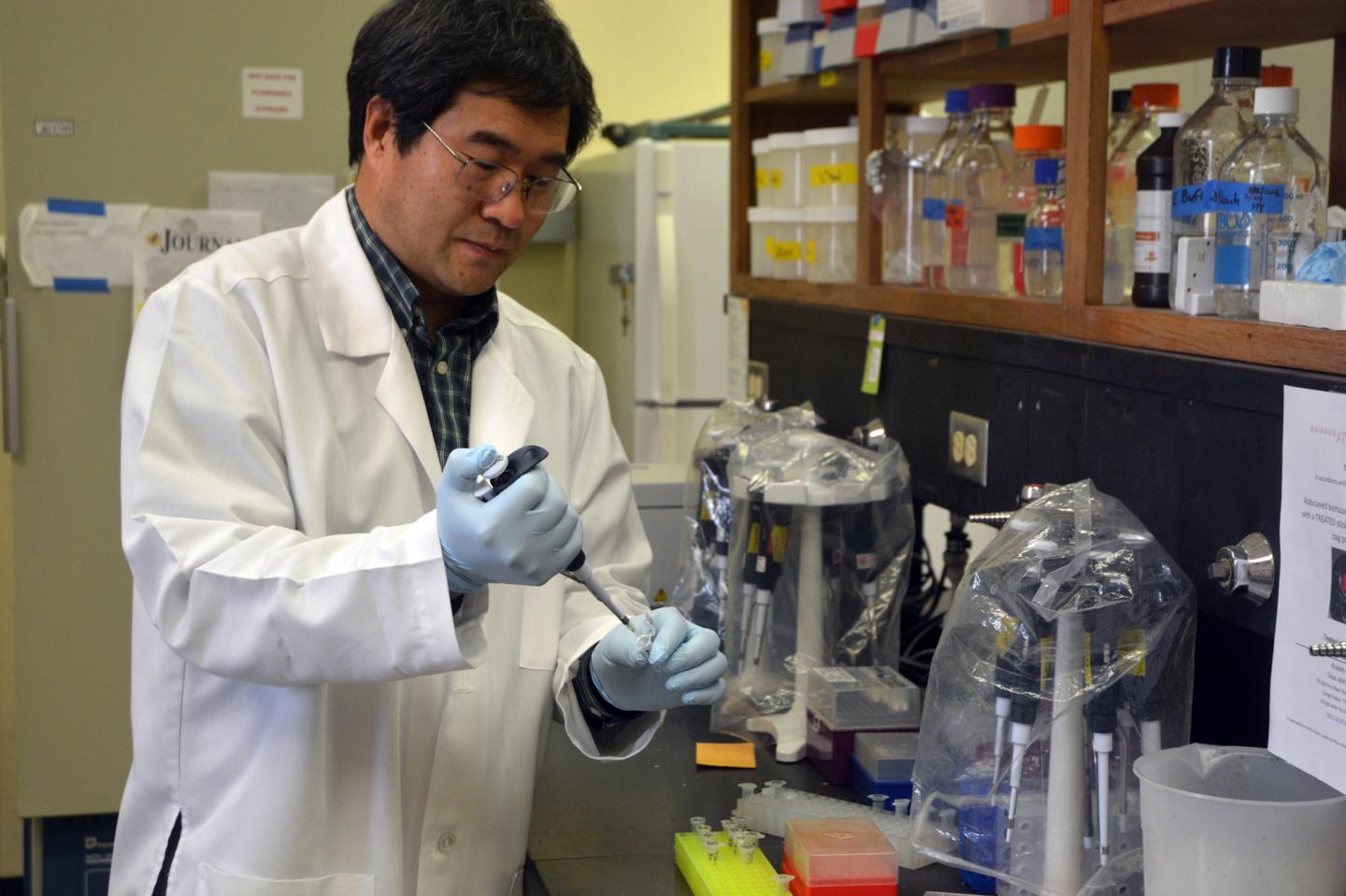
Credit: (Texas A&M AgriLife photo by Kay Ledbetter)
AMARILLO – Texas A&M AgriLife Research's wheat genetic and breeding programs will have genes in play when a multi-state, multi-agency project establishes a nationally coordinated consortium to advance wheat yields.
The Wheat Coordinated Agricultural Project, titled "Validation, characterization and deployment of QTL for grain yield components in wheat," is a five-year project jointly funded by U.S. Department of Agriculture's National Institute of Food and Agriculture and International Wheat Yield Partnership.
The first year of funding, $1,696,000, has been released with the following years of funding subject to release based upon continued progress in the grant research.
The primary focus of this consortium of public wheat breeders, molecular geneticists, high-throughput genotyping laboratories, database experts and educators will be on increasing wheat yields.
Developers of the project said surveys of state wheat-grower associations have repeatedly shown grain yield is the main priority for producers and the main determinant of their profits. Increases in kernel weight will also benefit grain millers, because this trait is highly correlated with increases in flour yield.
The project will be led by the University of California-Davis and include most university-based and USDA-Agricultural Research Service public wheat breeding programs.
Contributing to the major effort to improve wheat yields dramatically over the next decade from AgriLife Research will be wheat geneticist Dr. Shuyu Liu, Amarillo, and wheat breeders Dr. Amir Ibrahim, College Station, and Dr. Jackie Rudd, Amarillo.
"AgriLife Research's TAM 111 is currently the most planted hard red winter wheat cultivar in the U.S., and its derivatives have been used in many wheat breeding programs," Liu said.
The project will allow the TAM wheat breeding team to hire a doctoral student to follow through on genetic testing of TAM 111, he said. The student will deploy a variety of techniques to identify and study the functionality of candidate genes for the major quantitative trait loci, or QTL, identified in TAM 111 for higher yield.
"Since TAM 111 and its derivatives have been used in many wheat breeding programs as parents, the knowledge will be very helpful for wheat breeders," Liu said.
The project was developed because increases in the global wheat production required to feed a growing population is currently hampered by limited knowledge of the genes controlling wheat yield. Identification of these genes is a necessary first step to understand how they interact and shape the pathways that regulate yield.
Genetic variations of grain yield and its components can be used to identify candidate genes, such as those in TAM 111, and the use of new genomic tools will provide a unique opportunity to clone the underlying genes, Liu said.
The U.S. scientists will partner with International Wheat and Maize Improvement Center, or CIMMYT, researchers to transfer these underlying genes into wheat lines from CIMMYT in Mexico to be used to improve varieties worldwide, he said. The group also identified a long-term constraint to future increases in wheat production in the U.S. as the limited number of trained plant breeders. This project will train 15 doctoral students in plant breeding, integrating field, laboratory and bioinformatics skills, including the one with AgriLife Research.
According to the project outline, public breeding programs within the universities are essential to providing plant breeding students with integrated training, including field and laboratory experiences. Centralized workshops will allow doctoral students to benefit from the collective group expertise.
###
Additional expected research outcomes include finding perfect markers for genes regulating grain yield components and develop genotypic and phenotypic information for a large number of breeding lines organized in a database to serve wheat breeders worldwide.
Media Contact
Dr. Shuyu Liu
[email protected]
806-677-5600
@texasagwriter
http://today.agrilife.org
############
Story Source: Materials provided by Scienmag