Korea Institute of Materials Science/Samsung Medical Center, Rapid and sensitive multiplex molecular diagnosis of respiratory pathogens using plasmonic isothermal RPA array chip
Credit: Korea Institute of Materials Science (KIMS)
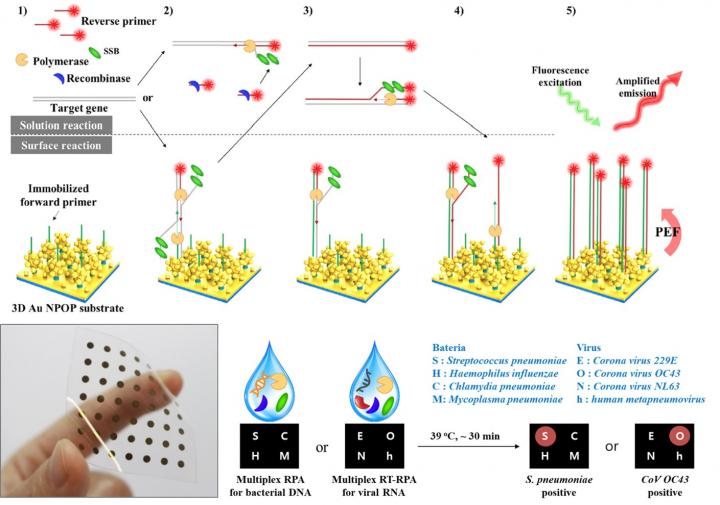
Researchers in South Korea developed a plasmonic isothermal recombinase polymerase amplification (RPA) array chip, the world’s first plasmoinc isothermal PCR technology which can detect 8 types of pathogens (4 bacteria and 4 viruses) that cause acute respiratory infectious diseases in 30 minutes, led by Dr. Sung-Gyu Park and Dr. Ho Sang Jung of the Korea Institute of Materials Science (KIMS, President Jung-Hwan Lee) and by Dr. Min-Young Lee and Dr. Ayoung Woo of Samsung Medical Center. KIMS is a government-funded research institute under the Ministry of Science and ICT.
* PCR(Polymerase Chain Reaction): A test method to amplify and detect nucleic acids target
The current detection technology for COVID-19 is impossible to analyze on-site as it takes about 4 hours or more to be confirmed after specimen collection, making it difficult to isolate the infectee as soon as possible.
To solve this problem, the researchers combined isothermal PCR technology with 3D Au nanostructured substrate which can amplify the fluorescence signal of RPA products with DNA amplicons and sucessfully detected bacterial DNA and viral RNA within 30 minutes.
In addition, the research team also developed a 3D plasmonic array chip for multiplex molecular detections: a chip that can simultaneously analyze 8 pathogens(4 bacteria and 4 viruses).
* 4 bacteria: Streptococcus pneumoniae, Haemophilus influenzae, Chlamydia pneumoniae, Mycoplasma pneumoniae
* 4 viruses: Coronavirus 229E, OC42, NL63(Coronavirus 229E, OC43, NL63), Human metapneumovirus
The “multiplex diagnosis technology for acute respiratory infections” was also confirmed to be valid for clinical specimens collected by nasopharyngeal swabs. The team is planning to perform the reliability test of medical devices through large-scale clinical trials on COVID-19 infectees and applying for approval from the Ministry of Food and Drug Safety.
The “3D plasmonic nanomaterials technology for enhancing optical signal” of KIMS has already been patented in Korea, the US, and China, and the “on-site rapid pathogen detection technology” has been applied for a domestic patent jointly with Samsung Medical Center.
“We developed a medical device that can detect pathogens in half an hour on-site, by developing core plasmonic nanomaterials which enable ultra-sensitive pathogene diagnosis of more than 10 types of respiratory viral pathogens. The on-site molecular diagnostic devices can be prevalent rapidly as we actively research with Samsung Medical Center and domestic diagnostic device companies.” said Dr. Sung-Gyu Park, a principal research scientist of KIMS.
Jung-hwan Lee, the president of KIMS said, “KIMS consistently supports to commercialize the on-site molecular diagnosis technology for respiratory infectious disease and ultrasensitive drug detection sensor technology which are based on the 3D highly sensitive plasmonic nanomaterials. We will do our utmost so that our research outcomes contribute to the quality of life and safe society.”
###
This research was supported by the Fundamental Research Program of the Korea Institute of Materials Science (KIMS) and funded by Nano Plasmonic In Vitro Diagnostic Research Center of the Ministry of Science and ICT, and the alchemist project of the Ministry of Trade, Industry and Energy.
Also, the technology was published in Biosensors and Bioelectronics (IF:10.257), the principal international journal in the field of analytical chemistry.
* Research paper title: Rapid and sensitive multiplex molecular diagnosis of respiratory pathogens using plasmonic isothermal RPA array chip
The research team was selected as a national R&D excellence in 2020 by developing an ultra-sensitive detection sensor for sepsis through a 3D nano-biosensor chip.
About Korea Institute of Materials Science (KIMS)
KIMS is a non-profit government-funded research institute under the Ministry of Science and ICT (MSIT) of the Republic of Korea. As the only institute specializing in comprehensive materials technologies in Korea, KIMS has contributed to Korean industry by carrying out a wide range of activities related to materials science including R&D, inspection, testing&evaluation, and technology support.
Media Contact
LEE, Donggee
[email protected]
Related Journal Article
http://dx.