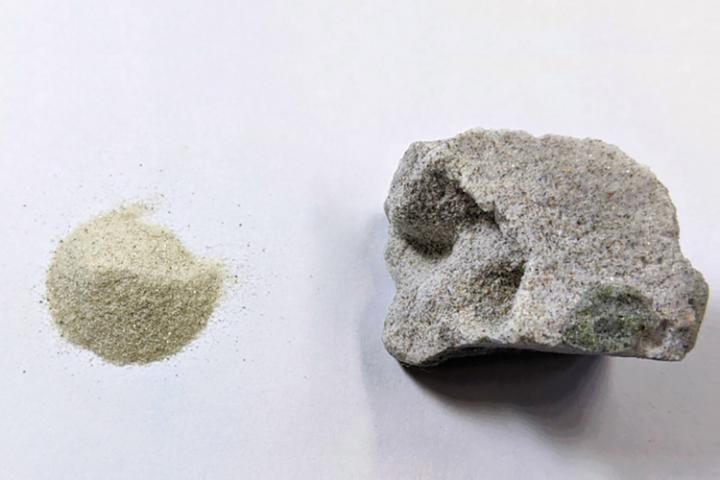
Credit: Institute of Industrial Science, the University of Tokyo
Tokyo, Japan – Researchers at the Institute of Industrial Science, a part of The University of Tokyo, have developed a new method of producing concrete without cement. They have directly bonded sand particles via a simple reaction in alcohol with a catalyst. This may help both to slash carbon emissions and to construct buildings and structures in desert regions, even on the Moon or Mars.
Concrete consists of two parts: the aggregate (typically made of sand and gravel) and cement (responsible for 8% of total global CO2 emissions). Despite there being a huge amount of sand in the world, the availability of sand for concrete production is fairly limited because sand particles must have a specific size distribution to provide flowability to concrete.
“In concrete, cement is used to bond sand and gravel. Some researchers are investigating how more cement can be replaced with other materials, such as fly ash and blast furnace slag, to reduce CO2 emissions, but this approach is unsustainable because the supply of these materials is decreasing owing to reduced use of thermal power systems and increased use of electrical furnace steel,” explains Yuya Sakai, lead author. Therefore, a new approach is required to produce concrete from inexhaustible materials with less environmental load. “Researchers can produce tetraalkoxysilane from sand through a reaction with alcohol and a catalyst by removing water, which is a byproduct of the reaction. Our idea was to leave the water to shift the reaction back and forth from sand to tetraalkoxysilane, to bond the sand particles with each other.”
The researchers placed a cup made of copper foil in a reaction vessel with sand and materials, and systematically varied the reaction conditions, such as the amounts of sand, alcohol, catalyst, and dehydration agent; the heating temperature; and the reaction time. Finding the right proportion of sand and chemicals was critical to obtain a product with sufficient strength.
“We obtained sufficiently strong products with, for example, silica sand, glass beads, desert sand, and simulated moon sand,” says second author Ahmad Farahani. “These findings can promote a move toward a greener and more economical construction industry everywhere on Earth. Our technique does not require specific sand particles used in conventional construction. This will also help address the issues of climate change and space development.”
Additionally, the product is likely to have better durability than that of conventional concrete because cement paste, which is relatively weak against chemical attack and exhibits large volume changes due to temperature and humidity, is not included in the product.
###
The work will be published in Seisan Kenkyu, Vol. 75, 2021 as “Production of Hardened Body by Direct Bonding of Sand Particles.”
About Institute of Industrial Science (IIS), the University of Tokyo
Institute of Industrial Science (IIS), the University of Tokyo is one of the largest university-attached research institutes in Japan.
More than 120 research laboratories, each headed by a faculty member, comprise IIS, with more than 1,000 members including approximately 300 staff and 700 students actively engaged in education and research. Our activities cover almost all the areas of engineering disciplines. Since its foundation in 1949, IIS has worked to bridge the huge gaps that exist between academic disciplines and realworld applications.
Media Contact
Yuya Sakai
[email protected]
Original Source
https:/