• HOME
  • NEWS
  • EXPLORE
    • CAREER
      • Companies
      • Jobs
    • EVENTS
    • iGEM
      • News
      • Team
    • PHOTOS
    • VIDEO
    • WIKI
  • BLOG
  • COMMUNITY
    • FACEBOOK
    • INSTAGRAM
    • TWITTER
Saturday, February 7, 2026
BIOENGINEER.ORG
No Result
View All Result
  • Login
  • HOME
  • NEWS
  • EXPLORE
    • CAREER
      • Companies
      • Jobs
        • Lecturer
        • PhD Studentship
        • Postdoc
        • Research Assistant
    • EVENTS
    • iGEM
      • News
      • Team
    • PHOTOS
    • VIDEO
    • WIKI
  • BLOG
  • COMMUNITY
    • FACEBOOK
    • INSTAGRAM
    • TWITTER
  • HOME
  • NEWS
  • EXPLORE
    • CAREER
      • Companies
      • Jobs
        • Lecturer
        • PhD Studentship
        • Postdoc
        • Research Assistant
    • EVENTS
    • iGEM
      • News
      • Team
    • PHOTOS
    • VIDEO
    • WIKI
  • BLOG
  • COMMUNITY
    • FACEBOOK
    • INSTAGRAM
    • TWITTER
No Result
View All Result
Bioengineer.org
No Result
View All Result
Home NEWS Science News

A new material enables the usage of ‘calcium’ for batteries

Bioengineer by Bioengineer
April 6, 2021
in Science News
Reading Time: 2 mins read
0
IMAGE
Share on FacebookShare on TwitterShare on LinkedinShare on RedditShare on Telegram

IMAGE

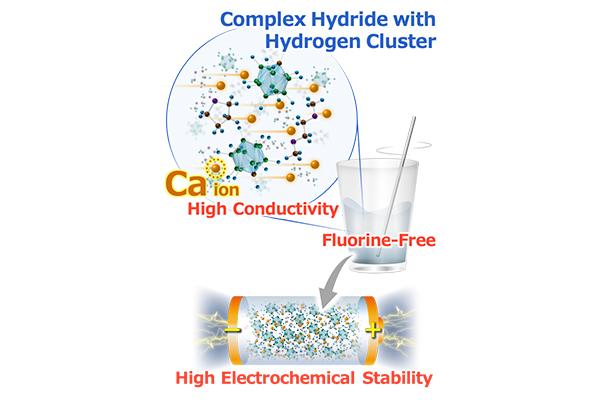
Credit: Kazuaki Kisu and Shin-ichi Orimo

Scientists from Tohoku University have developed a new fluorine-free calcium (Ca) electrolyte based on a hydrogen (monocarborane) cluster that could potentially realize rechargeable Ca batteries.

The researchers say the new material, achieved by designing the coordination structure of Ca cation with a weakly coordinating anion and mixed solvents, shows markedly improved electrochemical performances such as high conductivity and high electrochemical stabilities.

Current lithium-ion (Li-ion) batteries have some drawbacks. They are approaching their demand limits of theoretical energy density and cost, and lithium is not naturally plentiful.

Calcium, however, is the fifth most abundant element in Earth’s crust and its metal anode has low reduction potential (-2.87 V vs. standard hydrogen electrode (SHE)) and volumetric capacities of 2072 mAh cm-3, giving it comparable cell voltage and energy density to those of Li. Calcium batteries are therefore cost effective and possess high battery performance, making them a suitable substitute for Li-batteries.

Still, many challenges remain before Ca batteries can be realized due to a lack of suitable electrolytes which possess reductive/oxidative stabilities and high ionic conductivities. Moreover, realizing a fluorine-free system is desirable for practical Ca electrolytes because a fluorine-containing electrolyte intrinsically induces CaF2 formation on the electrode, which hinders Ca diffusion as well as the Ca plating and stripping processes.

The Tohoku University research team, which was led by Kazuaki Kisu and Shin-ichi Orimo from the Advanced Institute for Materials Research (AIMR), utilized the hydrogen cluster anion because of its high reductive and oxidative stability, which allows for a wide potential window and demonstrates excellent stability against metal anodes such as Li, Na, and Mg.

“A design that incorporates a hydrogen cluster into a Ca electrolyte had not been proposed yet,” said Kisu. “We were pleased that this turned out suitable for a Ca battery.”

The team, which also included Kim Sangryun from the Institute of Materials Research and Kun Zhao and Andreas Züttel from École Polytechnique Fédérale de Lausanne (EPFL) as part of Tohoku University’s Core Research Cluster for Materials Science, envisions this new Ca electrolyte with robust electrochemical performances to be a breakthrough for Ca batteries.

“We expect the development of a promising electrolyte candidate based on complex hydrides compatible with Ca batteries will create future opportunities for exploring other related complex hydride compounds such as multivalent electrolytes,” added Kisu.

###

Media Contact
Shin-ichi Orimo
[email protected]

Original Source

https://www.tohoku.ac.jp/en/press/new_material_calcium_batteries.html

Related Journal Article

http://dx.doi.org/10.1038/s41598-021-86938-0

Tags: Technology/Engineering/Computer Science
Share12Tweet8Share2ShareShareShare2

Related Posts

Phage-Antibiotic Combo Beats Resistant Peritoneal Infection

February 7, 2026

Boosting Remote Healthcare: Stepped-Wedge Trial Insights

February 7, 2026

Barriers and Boosters of Seniors’ Physical Activity in Karachi

February 7, 2026

Evaluating Pediatric Emergency Care Quality in Ethiopia

February 7, 2026
Please login to join discussion

POPULAR NEWS

  • Robotic Ureteral Reconstruction: A Novel Approach

    Robotic Ureteral Reconstruction: A Novel Approach

    82 shares
    Share 33 Tweet 21
  • Digital Privacy: Health Data Control in Incarceration

    63 shares
    Share 25 Tweet 16
  • Study Reveals Lipid Accumulation in ME/CFS Cells

    57 shares
    Share 23 Tweet 14
  • Breakthrough in RNA Research Accelerates Medical Innovations Timeline

    53 shares
    Share 21 Tweet 13

About

We bring you the latest biotechnology news from best research centers and universities around the world. Check our website.

Follow us

Recent News

Phage-Antibiotic Combo Beats Resistant Peritoneal Infection

Boosting Remote Healthcare: Stepped-Wedge Trial Insights

Barriers and Boosters of Seniors’ Physical Activity in Karachi

Subscribe to Blog via Email

Enter your email address to subscribe to this blog and receive notifications of new posts by email.

Join 73 other subscribers
  • Contact Us

Bioengineer.org © Copyright 2023 All Rights Reserved.

Welcome Back!

Login to your account below

Forgotten Password?

Retrieve your password

Please enter your username or email address to reset your password.

Log In
No Result
View All Result
  • Homepages
    • Home Page 1
    • Home Page 2
  • News
  • National
  • Business
  • Health
  • Lifestyle
  • Science

Bioengineer.org © Copyright 2023 All Rights Reserved.