Some natural surfaces, like insect wings, have evolved to develop bactericidal features, which researchers hope to translate into health care materials
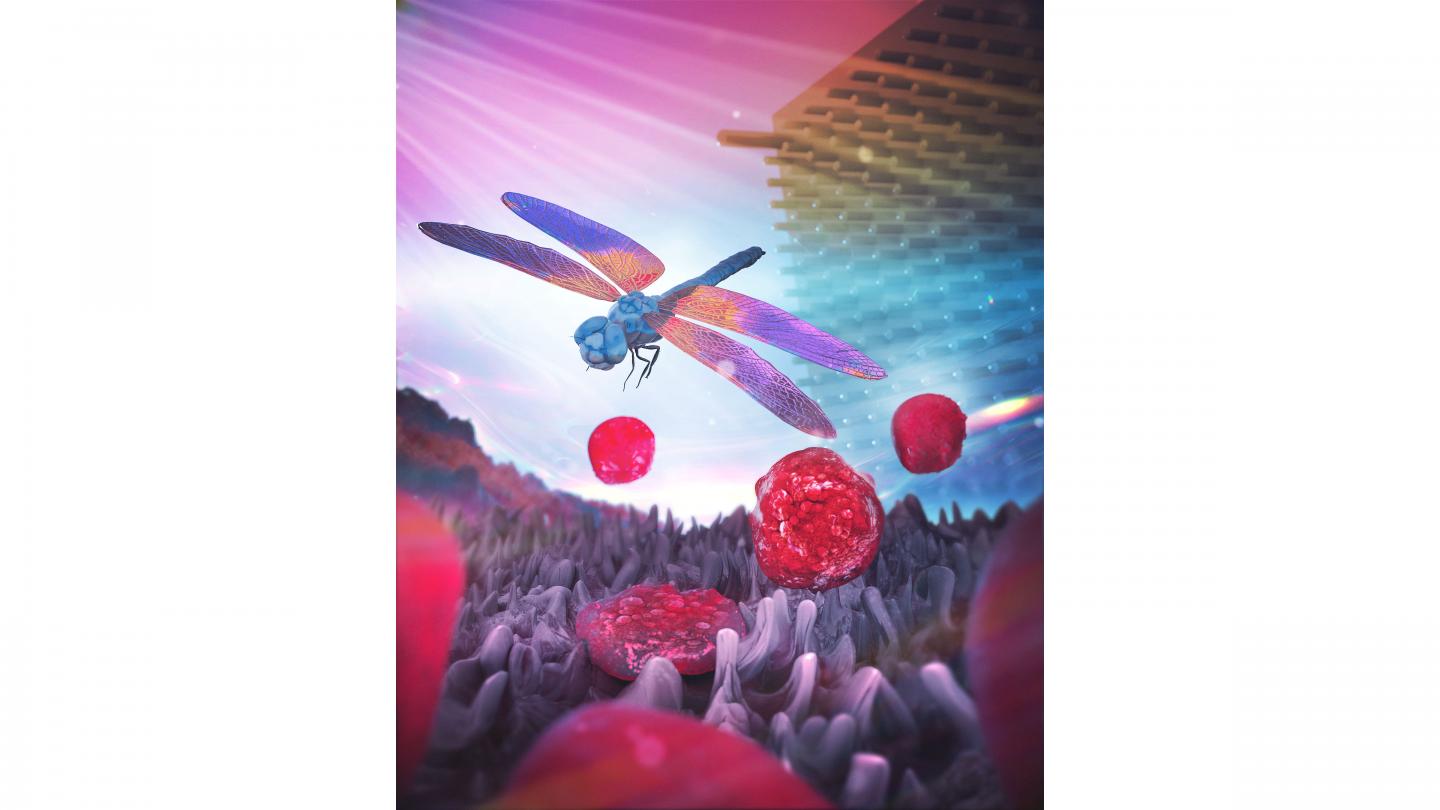
Credit: Saurav Goel, Alaitz Zabala
WASHINGTON, April 6, 2021 — Dragonfly wings, lotus leaves, cicada wings — thanks to millennia of evolution, nature has optimized the ways these surfaces and others behave to offer antibacterial functionality.
An international, interdisciplinary team of researchers is trying to find the best way to translate these features to create nature-inspired bactericidal surfaces for use in medical implants. They discuss the surface structures and chemical compositions for an ideal implant material in the journal Applied Physics Reviews, from AIP Publishing.
“Objects in nature have such unique features, like spikes sharper than a bacterium, which give them the power of disturbing and killing a bacterium, making them antibacterial,” said Saurav Goel, an author from London South Bank University. “We can make these features with our ultraprecision engineering instruments.”
Despite many studies on the mechanisms by which natural surfaces kill bacteria — whether it is due to chemical reactions, the roughness of the surface, the ability of bacteria to rest on the surface, or something else — commercial exploitation has been virtually nonexistent. The authors said this is partially due to the lack of suitable manufacturing techniques that can produce these nature-inspired features with controlled accuracy on a large scale, which Goel describes as one of the major puzzles faced by 21st-century applied physics.
Goel and his team are working on developing a new laser-based technique that can modify the surface properties of a material by manufacturing the desired features in a freeform manner, based on 3D computer models they generated. Once the method is fully developed, they plan to create a demonstrative prototype of an implant, which will be tested to monitor its bacterial activity.
“The end goal is a prosthesis that I can implant with clinical evidence that it kills bacteria and reduces the infection rate,” said Oliver Pearce, an author from Milton Keynes University Hospital in Buckinghamshire, England.
Though the percentage of infections caused by implants is quite low, with so many prosthetics in use around the world, the sheer number of infections is large, presenting a huge cost to health care systems. However, the vast majority of these are caused by staphylococci and streptococci, so eradicating their effect would reduce infections by up to 90%. The technology is versatile and would be applicable to prosthetics in all parts of the body.
“It’s simplistic to have an advanced surface that kills bacteria and to say that the infection problem is eradicated,” Pearce said. “It won’t eliminate all infections, but in my mind, it will make the rate significantly lower.”
###
The article “Bactericidal surfaces: An emerging 21st century ultra-precision manufacturing and materials puzzle” is authored by Mikel Larrañaga-Altuna, Alaitz Zabala, Inigo Llavori, Oliver Pearce, Dinh T. Nguyen, Jaume Caro, Holger Mescheder, Jose L. Endrino, Gaurav Goel, Wayne Nishio Ayre, Rajkumar Kottayasamy Seenivasagam, Debendra K. Tripathy, Joe Armstrong, and Saurav Goel. The article will appear in Applied Physics Reviews on April 6, 2021 (DOI: 10.1063/5.0028844). After that date, it can be accessed at https:/
ABOUT THE JOURNAL
Applied Physics Reviews features articles on significant and current topics in experimental or theoretical research in applied physics, or in applications of physics to other branches of science and engineering. The journal publishes both original research on pioneering studies of broad interest to the applied physics community, and reviews on established or emerging areas of applied physics. See https:/
Media Contact
Larry Frum
[email protected]
Related Journal Article
http://dx.