• HOME
  • NEWS
  • EXPLORE
    • CAREER
      • Companies
      • Jobs
    • EVENTS
    • iGEM
      • News
      • Team
    • PHOTOS
    • VIDEO
    • WIKI
  • BLOG
  • COMMUNITY
    • FACEBOOK
    • INSTAGRAM
    • TWITTER
Sunday, May 10, 2026
BIOENGINEER.ORG
No Result
View All Result
  • Login
  • HOME
  • NEWS
  • EXPLORE
    • CAREER
      • Companies
      • Jobs
        • Lecturer
        • PhD Studentship
        • Postdoc
        • Research Assistant
    • EVENTS
    • iGEM
      • News
      • Team
    • PHOTOS
    • VIDEO
    • WIKI
  • BLOG
  • COMMUNITY
    • FACEBOOK
    • INSTAGRAM
    • TWITTER
  • HOME
  • NEWS
  • EXPLORE
    • CAREER
      • Companies
      • Jobs
        • Lecturer
        • PhD Studentship
        • Postdoc
        • Research Assistant
    • EVENTS
    • iGEM
      • News
      • Team
    • PHOTOS
    • VIDEO
    • WIKI
  • BLOG
  • COMMUNITY
    • FACEBOOK
    • INSTAGRAM
    • TWITTER
No Result
View All Result
Bioengineer.org
No Result
View All Result
Home NEWS Science News Chemistry

Exploring comet thermal history: Burnt-out comet covered with talcum powder

Bioengineer by Bioengineer
April 6, 2021
in Chemistry
Reading Time: 3 mins read
0
IMAGE
Share on FacebookShare on TwitterShare on LinkedinShare on RedditShare on Telegram

IMAGE

Credit: Kyoto Sangyo University

The world’s first ground-based observations of the bare nucleus of a comet nearing the end of its active life revealed that the nucleus has a diameter of 800 meters and is covered with large grains of phyllosilicate; on Earth large grains of phyllosilicate are commonly available as talcum powder. This discovery provides clues to piece together the history of how this comet evolved into its current burnt-out state.

Comet nuclei are difficult to observe because when they enter the inner Solar System, where they are easy to observe from Earth, they heat up and release gas and dust which form a coma obscuring the nuclei. When Comet P/2016 BA14 (PANSTARRS) was discovered in January 2016 it was first mistaken for an asteroid, but subsequent observations revealed weak cometary activity. It is believed that after many trips through the inner Solar System, this comet has burnt off almost all of its ice and is now nearing the end of its cometary life.

On March 22, 2016, this comet passed within 3.6 million kilometers of Earth, only 9 times farther than the Moon. A team of astronomers from the National Astronomical Observatory of Japan (NAOJ) and Koyama Astronomical Observatory of Kyoto Sangyo University used this unique opportunity to observe the comet with the Subaru Telescope about 30 hours before its closest approach to Earth. They successfully observed the nucleus with minimal interference from dust grains in the coma. Previously, the surface composition of a cometary nucleus has only been observed by a few “in-situ” observations by space missions.

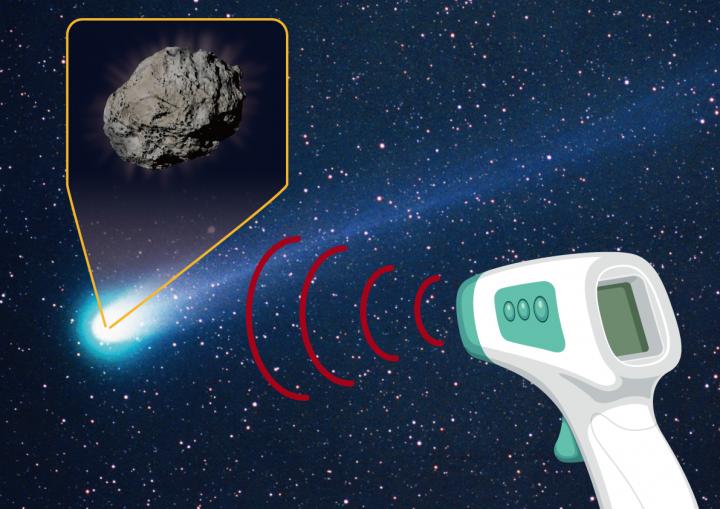
Because the team observed thermal infrared radiation, the same region of the infrared used by contactless thermometers, they were able to find evidence that the nucleus is 800 meters in diameter and covered with organic molecules and large grains of phyllosilicate. This is the first time hydrous silicate minerals such as talc have been found in a comet. Comparison with laboratory measurements of various minerals revealed that the hydrous silicate minerals on the surface of P/2016 BA14 have been heated to more than about 330 degrees Celsius in the past. Since the surface temperature of P/2016 BA14 cannot reach higher than about 130 degrees Celsius in its current orbit, the comet may have been in an orbit closer to the Sun in the past.

The next question is whether comets are covered with talcum powder from the start or if it develops over time as they burn out. “This result provides us a precious clue to study the evolution of comets.” comments Dr. Takafumi Ootsubo, the lead author of this research, “We believe that further observations of the comet nuclei will enable us to learn more about the evolution of comets.”

###

The target of this research, P/2016 BA14, is a potential backup target for the Comet Interceptor mission, a comet exploration mission being carried out by the ESA and JAXA.

Media Contact
Dr. Miki Ishii
[email protected]

Original Source

https://www.nao.ac.jp/en/news/science/2021/20210406-subaru.html

Related Journal Article

http://dx.doi.org/10.1016/j.icarus.2021.114425

Tags: AstronomyAstrophysicsComets/AsteroidsSpace/Planetary Science
Share12Tweet8Share2ShareShareShare2

Related Posts

Miniature Sensor Uses Light to Detect Touch — Chemistry

Miniature Sensor Uses Light to Detect Touch

May 8, 2026
Iron Minerals Determine Whether Dissolved Organic Matter Fuels Microbes or Becomes Long-Term Carbon Storage — Chemistry

Iron Minerals Determine Whether Dissolved Organic Matter Fuels Microbes or Becomes Long-Term Carbon Storage

May 8, 2026

Kate Evans Appointed Associate Lab Director for Biological and Environmental Systems Science at ORNL

May 8, 2026

Advancing Multiscale Modeling and Overcoming Operational Challenges in Autothermal COâ‚‚-to-Methanol Reactors

May 8, 2026
Please login to join discussion

POPULAR NEWS

  • Research Indicates Potential Connection Between Prenatal Medication Exposure and Elevated Autism Risk

    840 shares
    Share 336 Tweet 210
  • New Study Reveals Plants Can Detect the Sound of Rain

    727 shares
    Share 290 Tweet 181
  • Scientists Investigate Possible Connection Between COVID-19 and Increased Lung Cancer Risk

    68 shares
    Share 27 Tweet 17
  • Salmonella Haem Blocks Macrophages, Boosts Infection

    61 shares
    Share 24 Tweet 15

About

We bring you the latest biotechnology news from best research centers and universities around the world. Check our website.

Follow us

Recent News

Evaluating Digoxin Use in Patients with Symptomatic Rheumatic Heart Disease

Evaluating the Effectiveness and Safety of Digitalis Glycosides in Treating Heart Failure

Urdu Fall Risk Questionnaire Adapted for Elderly

Subscribe to Blog via Email

Enter your email address to subscribe to this blog and receive notifications of new posts by email.

Join 82 other subscribers
  • Contact Us

Bioengineer.org © Copyright 2023 All Rights Reserved.

Welcome Back!

Login to your account below

Forgotten Password?

Retrieve your password

Please enter your username or email address to reset your password.

Log In
No Result
View All Result
  • Homepages
    • Home Page 1
    • Home Page 2
  • News
  • National
  • Business
  • Health
  • Lifestyle
  • Science

Bioengineer.org © Copyright 2023 All Rights Reserved.