Credit: Keiji Murayama
Nagoya University scientists in Japan have demonstrated how DNA-like molecules could have come together as a precursor to the origins of life. The findings, published in the journal Nature Communications, not only suggest how life might have begun, but also have implications for the development of artificial life and biotechnology applications.
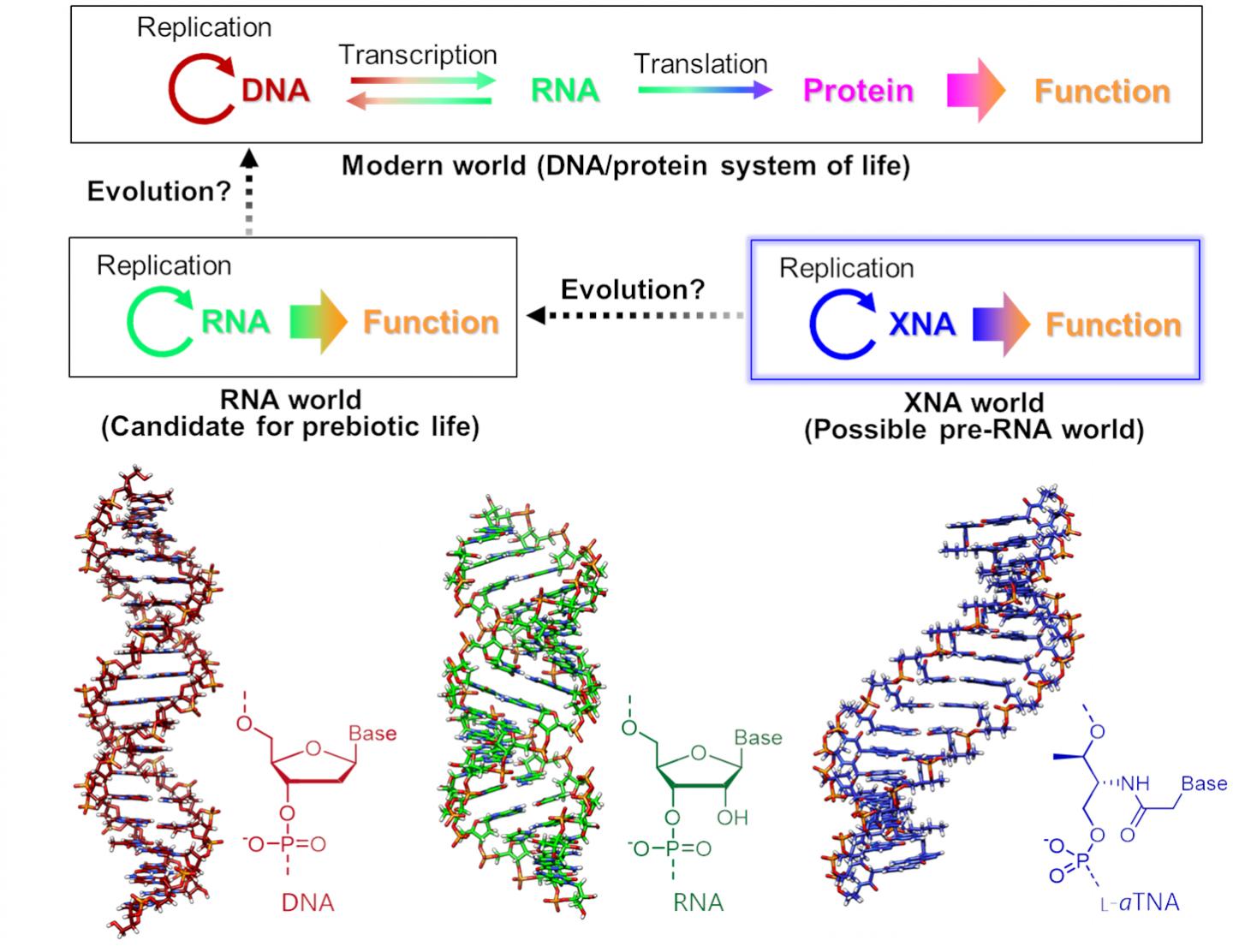
“The RNA world is widely thought to be a stage in the origin of life,” says Nagoya University biomolecular engineer Keiji Murayama. “Before this stage, the pre-RNA world may have been based on molecules called xeno nucleic acids (XNAs). Unlike RNA, however, XNA replication probably didn’t require enzymes. We were able to synthesize an XNA without enzymes, strongly supporting the hypothesis that an XNA world might have existed before the RNA world.”
XNAs are formed of chains of linked nucleotides, similar to DNA and RNA but with a different sugar backbone. XNAs can carry genetic code very stably because the human body can’t break them down. Some researchers have reported that XNAs containing specific sequences can act as enzymes and bind to proteins. This makes XNAs exciting in the field of synthetic genetics, with potential biotechnology and molecular medicine applications.
Murayama, Hiroyuki Asanuma and colleagues wanted to find out if conditions likely present on early Earth could have led to XNA chain formation. They synthesized fragments of acyclic (non-circular) L-threoninol nucleic acid (L-aTNA), a molecule that is thought to have existed before RNA came to be. They also made a longer L-aTNA with a nucleobase sequence that complemented the sequences of the fragments, similar to how DNA strands match up.
When placed together in a test tube under controlled temperature, the shorter L-aTNA fragments came together and linked up with each other on the longer L-aTNA template. Critically, this happened in the presence of a compound, called N-cyanoimidazole, and a metal ion, like manganese, both of which were possibly present in early Earth. The fragments interlinked when a phosphate at the end of one chemically attached to a hydroxyl group at the end of its neighbour, without the help of an enzyme.
“To the best of our knowledge, this is the first demonstration of template-driven, enzyme-free extension of acyclic XNA from a random fragment pool, generating phosphodiester bonding,” says Murayama.
The team also demonstrated that L-aTNA fragments could interlink on DNA and RNA templates. This suggests that genetic code could be transferred from DNA and RNA onto L-aTNA and vice versa.
“Our strategy is an attractive system for experimenting with the construction of artificial life and the development of highly functional biological tools composed of acyclic XNA,” says Murayama. “The data also indicate that L-aTNA could have been an RNA precursor.”
The team plans to continue their investigations to clarify whether L-aTNA could have been synthesized in early Earth ‘pre-life’ conditions and to examine their potential for developing advanced biological tools.
###
The paper, “Nonenzymatic polymerase-like template-directed synthesis of acyclic L-threoninol nucleic acid,” was published online in the journal Nature Communications on February 5, 2021 at DOI: 10.1038s41467-021-21128-0.
Authors:
Keiji Murayama, Hikari Okita, Takumi Kuriki, and Hiroyuki Asanuma
About Nagoya University, Japan
Nagoya University has a history of about 150 years, with its roots in a temporary medical school and hospital established in 1871, and was formally instituted as the last Imperial University of Japan in 1939. Although modest in size compared to the largest universities in Japan, Nagoya University has been pursuing excellence since its founding. Six of the 18 Japanese Nobel Prize-winners since 2000 did all or part of their Nobel Prize-winning work at Nagoya University: four in Physics – Toshihide Maskawa and Makoto Kobayashi in 2008, and Isamu Akasaki and Hiroshi Amano in 2014; and two in Chemistry – Ryoji Noyori in 2001 and Osamu Shimomura in 2008. In mathematics, Shigefumi Mori did his Fields Medal-winning work at the University. A number of other important discoveries have also been made at the University, including the Okazaki DNA Fragments by Reiji and Tsuneko Okazaki in the 1960s; and depletion forces by Sho Asakura and Fumio Oosawa in 1954.
Website: http://en.
Media Contact
Keiji Murayama
[email protected]
Original Source
https:/
Related Journal Article
http://dx.