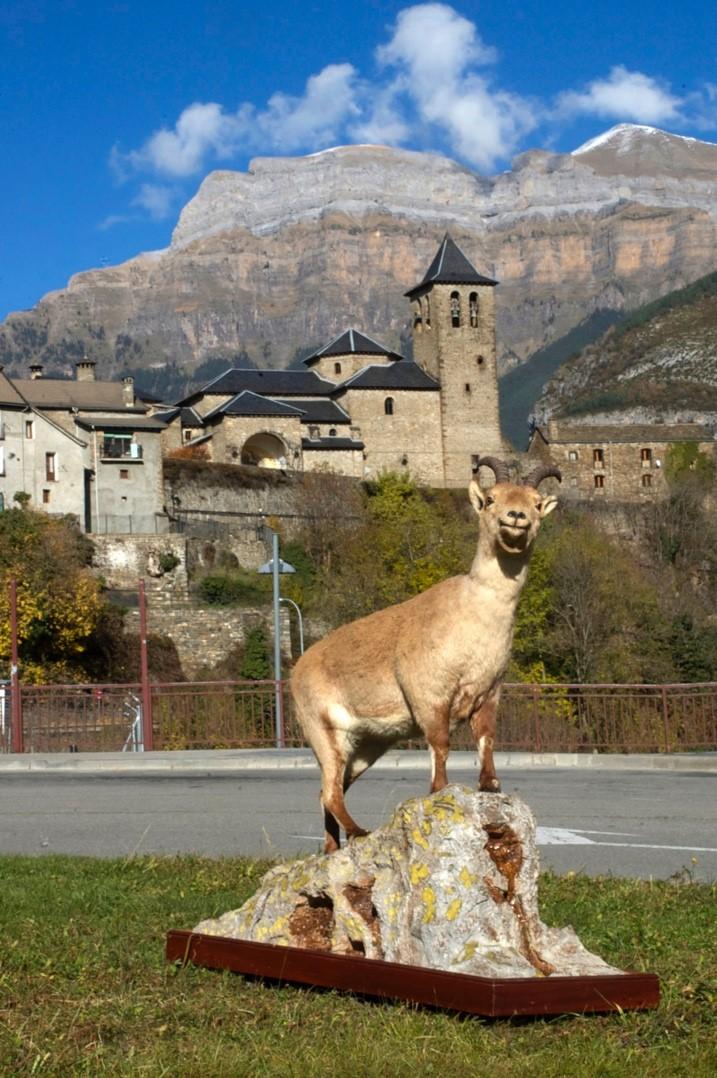
Credit: Manolo Grasa
Likely the first extinction event of the 2000s in Europe, the sad history of the Pyrenean Ibex (Capra pyrenaica pyrenaica) is a powerful example of the ever-increasing species loss worldwide due to causes related to human activity. It can, however, give us valuable information on what should be done (or avoided) to halt this extinction vortex.
The distribution of this subspecies of Iberian Ibex was limited to the French and Spanish Pyrenees. Its first mention in an official written document, dating back to 1767, already refers to it as extremely rare. Like many other mountain goats, it was almost hunted to extinction before its killing became prohibited in 1913. Neither the institution of a national park (Ordesa & Monte Perdido), nor a conservation project with European LIFE program funding could stop the extinction of the Pyrenean Ibex eventually officialised on January 6, 2000. But the story of this charismatic animal did not end there – a controversial cloning program was started instantly with no scientific agreement, nor support from regional environmental NGOs, claiming that de-extinction was possible even in the absence of further DNA studies.
To find out more about the drivers of its extinction, an international team composed of 7 nationalities built a database of all known museum specimens and reconstructed the demographic history of the Pyrenean Ibex based on DNA evidence. Their research is published in the open-access, peer-reviewed journal Zoosystematics and Evolution.
The research found that after a population expansion between 14,000 and 29,000 years ago (which is quite recent from a genetic point of view), a significant loss of genetic diversity followed between approximately 15,000 and 7,500 years BP, and continued until present. By that time, the Pyrenean Ibex also lived outside the Pyrenean mountain chain, but, gradually, its distribution was reduced to only one valley in the Ordesa National Park in the Spanish Pyrenees.
Written sources confirm hunting of the Pyrenean Ibex from as early as the 14th century, and during the 19th and 20th century it became a common target for trophy hunters. Undoubtedly, hunting played an important role in reducing its population numbers and distribution area, but it is not possible – with the information currently available – to pinpoint it as the straw that broke the camel’s back. Infectious diseases that originate from livestock (for instance, those caused by the bluetongue virus, BTV, and sarcopses) are capable of decimating other subspecies of Iberian Ibex in extremely short periods of time.
While the relative contribution of various factors remains largely unknown, it seems that hunting and diseases transmitted from other animals have been effective in drastically reducing the number of Pyrenean ibexes over the last two centuries, because they were acting on an already genetically weakened population. This low genetic diversity, combined with inbreeding depression and reduced fertility, brought the population beyond the minimum viable size – from that point onwards, extinction was inevitable.
This case study shows the importance of historical biological collections for genetic analyses of extinct species. A privately owned 140-year-old trophy preserved in Pau, France, was genotyped as part of this research, showing that private individuals may possess material of high value. As there is little knowledge of such resources, the authors call for the creation of an online public database of private collections hosting biological material for the benefit of biodiversity studies.
###
Original source:
Forcina G, Woutersen K, Sánchez-Ramírez S, Angelone S, Crampe JP, Pérez JM, Fandos P, Granados JE, Jowers MJ (2021) Demography reveals populational expansion of a recently extinct Iberian ungulate. Zoosystematics and Evolution 97(1): 211-221. https:/
Media Contact
Michael J. Jowers
[email protected]
Related Journal Article
http://dx.