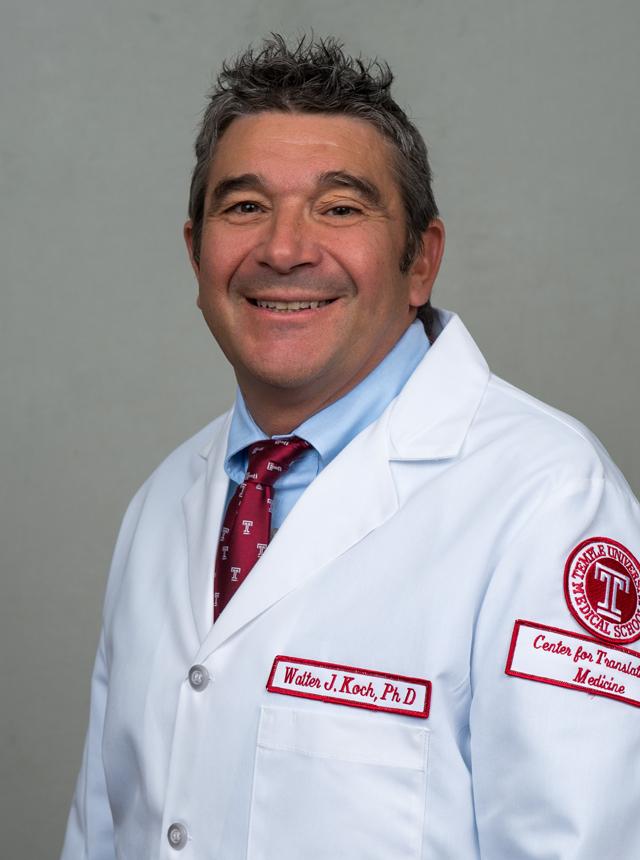
Credit: Lewis Katz School of Medicine at Temple University
Like a bad water pump that fails to circulate coolant in a car engine, a failing heart struggles to pump blood through the body, causing symptoms of fatigue, shortness of breath, and swelling in the legs and feet. As heart failure progresses, the heart itself becomes increasingly unable to contract effectively, owing to changes in the molecules that control the heart, particularly a small gaseous molecule called nitric oxide.
Nitric oxide is carried by red blood cells and acts as a signal to relax arteries and increase blood flow to heart tissue. It is also produced within heart cells, where it chemically combines with proteins in a process known as S-nitrosylation. More than 20,000 known S-nitrosylation events turn proteins “on” or “off,” including proteins that make up the heart’s beta-adrenergic receptor (βAR) system – the system that regulates the “fight-or-flight” response that allows physical activity. In heart failure, both S-nitrosylation and βAR activity are altered, with significant impacts on cardiac function.
Moreover, βAR is a key member of a class of receptors known as G protein-coupled receptors (GPCRs), which are the targets of ~50% of all drugs, and how changes in nitric oxide levels and S-nitrosylation affect GPCRs involved in disease remains unclear. But now, scientists at the Lewis Katz School of Medicine at Temple University (LKSOM), in collaboration with scientists at the Case Western Reserve University School of Medicine and University Hospitals in Cleveland, have an opportunity to explore these basic mechanisms, thanks to a new $3 million grant from the National Institutes of Health National Heart Lung and Blood Institute. The insights gained from the collaboration could break new ground in the development of heart failure therapies.
“Signaling through βARs and GPCRs in the heart is complex,” explained Walter J. Koch, PhD, W.W. Smith Endowed Chair in Cardiovascular Medicine, Professor and Chair of the Department of Pharmacology, Director of the Center for Translational Medicine at LKSOM, and a senior co-investigator on the new grant. “We want to know more about the details behind these signaling mechanisms and especially whether S-nitrosylation can be modulated or manipulated to prevent heart failure.”
“We see this leading to new therapeutic approaches,” said co-investigator Jonathan S. Stamler, MD, Robert S. and Sylvia K. Reitman Family Foundation Distinguished Chair of Cardiovascular Innovation, Professor of Medicine and Biochemistry, and Director of the Institute for Transformative Molecular Medicine at Case Western Reserve University School of Medicine and co-founder and President of the Harrington Discovery Institute at University Hospitals Cleveland Medical Center. Dr. Koch and Dr. Stamler have worked together for more than two decades to better understand mechanisms underlying heart failure.
“We know that increased heart damage is linked to altered βAR activity; what we’ve discovered is a new role for nitric oxide in controlling the βAR system,” Dr. Stamler said.
Dr. Stamler discovered protein S-nitrosylation and has helped demonstrate its ubiquitous role in the control of protein function. His work led to the realization that aberrant S-nitrosylation is a causal factor in many diseases, including heart failure– among the most common causes of death in the developed world.
Dr. Koch’s laboratory, meanwhile, has made major advances in understanding how GPCRs and proteins known as GPCR kinases (GRKs) contribute to heart function and heart disease. Of particular importance in heart failure is GRK2 activity, which increases in the injured heart.
“We know from studies in animals that GRK2 is S-nitrosylated and that S-nitrosylation is necessary for normal heart function,” Dr. Koch said. “But we need to figure out how exactly S-nitrosylation goes awry and leads to increases in the amount of heart damage.
“Dysregulated S-nitrosylation of the βAR system is now being linked to the progression of congestive heart failure, a huge medical problem,” Dr. Koch added. “We think new approaches to treatment are on the horizon.”
###
Media Contact
Jeremy Walter
[email protected]
Original Source
https:/