• HOME
  • NEWS
  • EXPLORE
    • CAREER
      • Companies
      • Jobs
    • EVENTS
    • iGEM
      • News
      • Team
    • PHOTOS
    • VIDEO
    • WIKI
  • BLOG
  • COMMUNITY
    • FACEBOOK
    • INSTAGRAM
    • TWITTER
Monday, July 6, 2026
BIOENGINEER.ORG
No Result
View All Result
  • Login
  • HOME
  • NEWS
  • EXPLORE
    • CAREER
      • Companies
      • Jobs
        • Lecturer
        • PhD Studentship
        • Postdoc
        • Research Assistant
    • EVENTS
    • iGEM
      • News
      • Team
    • PHOTOS
    • VIDEO
    • WIKI
  • BLOG
  • COMMUNITY
    • FACEBOOK
    • INSTAGRAM
    • TWITTER
  • HOME
  • NEWS
  • EXPLORE
    • CAREER
      • Companies
      • Jobs
        • Lecturer
        • PhD Studentship
        • Postdoc
        • Research Assistant
    • EVENTS
    • iGEM
      • News
      • Team
    • PHOTOS
    • VIDEO
    • WIKI
  • BLOG
  • COMMUNITY
    • FACEBOOK
    • INSTAGRAM
    • TWITTER
No Result
View All Result
Bioengineer.org
No Result
View All Result
Home NEWS Science News Biology

Unravelling the secret of a critical immune cell for cancer immunity

Bioengineer by Bioengineer
April 2, 2021
in Biology
Reading Time: 3 mins read
0
IMAGE
Share on FacebookShare on TwitterShare on LinkedinShare on RedditShare on Telegram

IMAGE

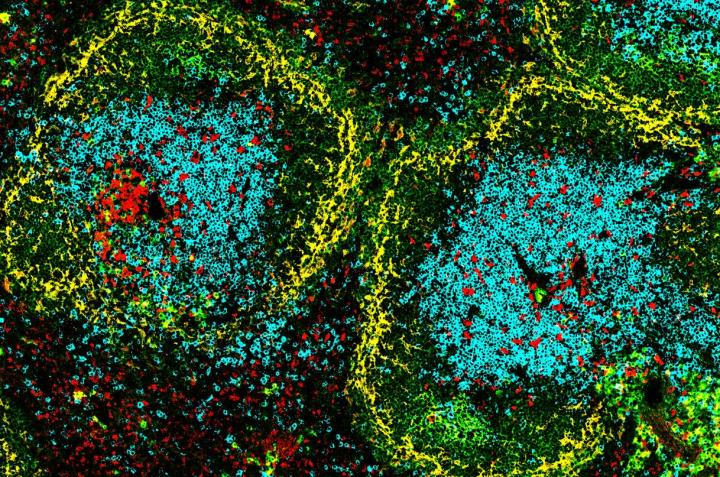
Credit: Shengbo Zhang and Wang Cao, WEHI

WEHI researchers have discovered a key differentiation process that provides an essential immune function in helping to control cancer and infectious diseases.

The research, published in Science Immunology, is the first to show a new factor – DC-SCRIPT – is required for the function a particular type of dendritic cell – called cDC1 – that is essential in controlling the immune response to infection.

Led by WEHI Professor Stephen Nutt, Dr Michael Chopin and Mr Shengbo Zhang, it defines the role for a new regulatory protein – DC-SCRIPT – in producing dendritic cells.

At a glance

  • WEHI researchers have uncovered a key step in the formation of a particular type of dendritic cell – called cDC1 – in controlling the immune response to infection.
  • The research highlights the importance of DC-SCRIPT in the production of effective dendritic cells.
  • Through gaining a better understanding of how dendritic cells are produced, researchers hope to be able to determine a way of directing the body to produce large numbers of dendritic cells, to enable it to better fight off cancer and infections.

DC-SCRIPT essential in the production of cancer-fighting cells

Dendritic cells are immune cells that activate ‘killer’ T cells, which are vital for clearing viral infections and for triggering a response to cancer tumours.

Through gaining a better understanding of how this process works, researchers hope to be able to determine a way of directing the body to produce large numbers of dendritic cells, to enable it to better fight off cancer and infections.

Professor Nutt said the research paper highlighted the importance of DC-SCRIPT in the production of effective dendritic cells.

“What we found, is that without this new factor, the cells develop poorly, and their capacity to fight infection and cancer, or to clear a parasite, is diminished,” he said.

“The next stage of our research is to try and work out how we can get the body to produce these particular dendritic cells, cDC1s, in large volumes in order to boost the body’s natural tumour response.”

Harnessing the body’s natural response to infection

Dr Chopin said he was confident cDC1s held the clues to improving immunity to viruses and tumours.

“This paper clearly shows DC-SCRIPT is one of the regulators of dendritic cell production. As a result of this study, we’re now focussed on ways we could harness this to increase dendritic cell production,” he said.

“We now have a biomarker to follow when we expand this elusive cell type, which we will continue to test in pre-clinical models.”

This research lays the foundation for future studies into dendritic cell production and their clinical applications in response to tumours.

“We have generated new tools, allowing us to trace these cells within the tumour and observe how they behave in the tumour environment,” Dr Chopin said.
This work was made possible with funding from the National Health and Medical Research Council and the Victorian Government.

###

Media Contact
Samantha Robin
[email protected]

Original Source

http://immunology.sciencemag.org/lookup/doi/10.1126/sciimmunol.abf4432

Related Journal Article

http://dx.doi.org/10.1126/sciimmunol.abf4432

Tags: Cell BiologyMedicine/Health
Share12Tweet8Share2ShareShareShare2

Related Posts

Here are a few rewritten headlines for a science magazine post, each with a slightly different tone: Intriguing & poetic: How do organs sculpt themselves? Sea stars hold the secret Direct & research-focused: Sea stars reveal the hidden rules of organ formation Metaphorical & inviting: Tiny architects beneath the waves: What sea stars teach us about building organs Short & punchy: Star-shaped clues to how our organs take shape Question-led: Could a sea star show us how organs form? Elegant & feature-style: The body’s blueprint, glimpsed in a sea star’s arm

July 6, 2026
Bacteria evolve faster with unconventional gene copies — Biology

Bacteria evolve faster with unconventional gene copies

July 6, 2026

Neighbours rewire soil feedback via root microbiome shifts

July 6, 2026

Evolution-Inspired Biosensors Revolutionize Lipid Tracking in Real Time

July 2, 2026
Please login to join discussion

POPULAR NEWS

  • Detection of EDCs in Breast Milk and Infant Urine Up to Six Months Highlights Early Exposure Risks

    77 shares
    Share 31 Tweet 19
  • New Drug Candidate Developed at McMaster Shows Potential for Treating Brain Cancer

    58 shares
    Share 23 Tweet 15
  • Saying Goodbye to PGY-6: Pediatric Fellowship Realities

    103 shares
    Share 41 Tweet 26
  • KTU Researchers Explore Ultrasound’s Role in Enhancing Blood Flow Beyond Diagnostics

    53 shares
    Share 21 Tweet 13

About

We bring you the latest biotechnology news from best research centers and universities around the world. Check our website.

Follow us

Recent News

Flame retardant BDE-209 targets molecularly linked to ulcerative colitis

Ultra-high frequency particle impacts mimic rockbursts to shatter hard rock

Kidney transplant outcomes in older adults studied by German researchers

Subscribe to Blog via Email

Enter your email address to subscribe to this blog and receive notifications of new posts by email.

Join 83 other subscribers
  • Contact Us

Bioengineer.org © Copyright 2023 All Rights Reserved.

Welcome Back!

Login to your account below

Forgotten Password?

Retrieve your password

Please enter your username or email address to reset your password.

Log In
No Result
View All Result
  • Homepages
    • Home Page 1
    • Home Page 2
  • News
  • National
  • Business
  • Health
  • Lifestyle
  • Science

Bioengineer.org © Copyright 2023 All Rights Reserved.