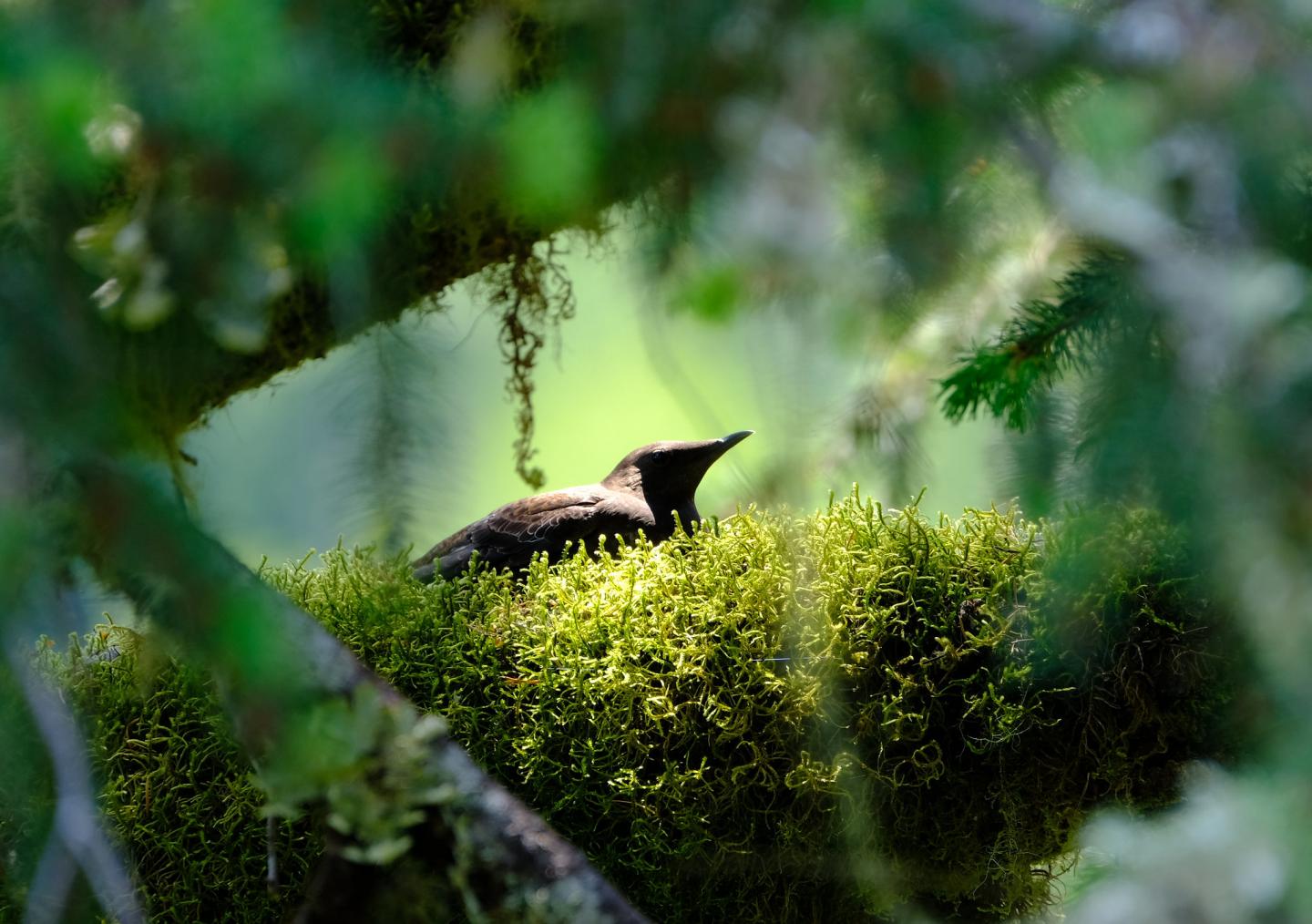
Credit: Brett Lovelace, Oregon State University
CORVALLIS, Ore. – Oregon State University researchers broadcast marbled murrelet calls in mature forests and found that the threatened seabirds’ choice of breeding locations is strongly influenced by whether they hear other murrelets in the area.
The research by scientists in the OSU College of Forestry and College of Agricultural Sciences is important because the elusive seabird’s populations are in decline and recovery may be hindered by there being too few birds around to provide information to each other about where to nest.
Findings were published in Ornithology, the the flagship journal of the American Ornithologists Union.
“The odds that marbled murrelets would consider nesting at sites where we broadcast murrelet calls were many times greater than at sites where we didn’t,” said lead author Jonathon Valente, a postdoctoral researcher with the College of Forestry’s Oregon Marbled Murrelet Project.
Marbled murrelets are closely related to puffins and murres but unlike those birds, murrelets raise their young as far as 60 miles inland in mature and old-growth forests.
“There aren’t many species like it,” said study co-author Jim Rivers, also a faculty member in the College of Forestry. “In fact, there’s no other bird that feeds in the ocean and commutes such long distances to inland nest sites. This behavior is really unusual and it makes this species especially challenging to study.”
In 2016, Valente, Rivers and three collaborators at Oregon State simulated the presence of murrelets at 14 randomly selected potential breeding sites by broadcasting the bird’s calls during breeding season. Between the rounds of simulations, they recorded wild murrelet calls at the sites and compared call rates with rates at 14 control sites where no recorded were broadcast.
In the year of the broadcast experiment, simulated murrelet calls increased the odds of recording wild murrelet calls by as much as 15 times. The scientists hypothesized that these were young “prospecting” birds, on the lookout for new nesting sites.
To the researchers’ surprise, these prospectors appeared to have remembered the locations of experimental areas the following breeding season, nearly a year after broadcasts of murrelet calls had ceased. The odds of a site being occupied during the 2017 breeding season were 10 times greater at the experimental sites than the control sites.
“That means it would likely be a good idea for conservation managers to consider broadcasting vocalizations to encourage murrelets to nest in unused, high-quality habitat,” said co-author Matt Betts of the College of Forestry. “And because murrelets are attracted to other murrelets, protecting areas adjacent to known nesting sites may also be an effective conservation approach.”
The dove-sized marbled murrelet spends most of its time in coastal waters eating krill, other invertebrates and forage fish such as herring, anchovies, smelt and capelin. Murrelets can only produce one offspring per year, if the nest is successful, and their young require forage fish for proper growth and development.
The secretive birds typically lay their single egg high in a tree on a horizontal limb at least 4 inches in diameter. Steller’s jays, crows and ravens are the main predators of murrelet nests.
Along the West Coast, marbled murrelets are found regularly from Santa Cruz, California, north to the Aleutian Islands. The species is listed as threatened under the U.S. Endangered Species Act in Washington, Oregon and California.
###
Also collaborating on the vocalization study were Kim Nelson and Dan Roby of the OSU College of Agricultural Sciences. The College of Forestry and the USDA National Institute of Food and Agriculture supported this research.
Media Contact
Matt Betts
[email protected]
Original Source
https:/
Related Journal Article
http://dx.