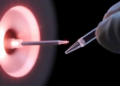

Credit: Stanford University
Diamond Blackfan Anemia (DBA) is a condition that is characterized by a failure of the bone marrow to produce red blood cells, congenital abnormalities, and a predisposition to cancer. Current treatment options, including steroid treatments and chronic transfusions, can lead to significant morbidity. Therefore, investigation into molecular mechanisms that drive DBA is critical to saving the lives of patients suffering from this disease.
DBA is caused by a deficiency of some ribosomal proteins to properly process pre-ribosomal ribonucleic acid (RNA), which is ultimately important for the translation of the genome into functional proteins. While it is known that p53, an important DNA repair protein, mediates many facets of DBA, its mechanism has not, until now, been well understood. With support from a Bone Marrow Failure Research Program FY12 Idea Award, Dr. Kathleen Sakamoto and her team at Stanford University has identified that a deficiency in RPS19, the most commonly mutated ribosomal protein in DBA patients, leads to the upregulation and activation of the p53 pathway. Furthermore, they have identified that a target of p53, microRNA34A, is responsible for decreased red blood cell formation.
In a recently published article in Disease Models & Mechanisms, Dr. Sakamoto's team used a zebrafish model of DBA with RPS19 and RPL11 insufficiency to further characterize the link between defects in ribosome biogenesis, nucleotide metabolism, and the p53 pathway in DBA. The RPS19-deficient zebrafish showed a decrease in proliferation, enhanced activation of the ATR/ATM-CHK1/CHK2/p53 DNA damage pathway, an imbalanced pool of nucleotides, ATP depletion, and AMPK activation. These findings are all hallmarks of cellular energy crisis,DNA replication stress, and thus enhanced DNA repair. When treating zebrafish with exogenous nucleosides, a decrease in the activation of p53 and AMPK was observed. As blood cells are highly dependent on salvage pathways for the production of nucleotides and are therefore vulnerable to a stressed metabolism, red blood cells in DBA patients may benefit from exogenous nucleosides. Nucleoside supplements are known to be very safe and are even included in many infant formulas. This form of supplementation may be beneficial, not only in patients with DBA, but also for other conditions that involve the activation of the DNA damage response, such as radiation exposure. Furthermore, treatment of the RP-deficient zebrafish with inhibitors of various cell cycle checkpoint kinases decreased p53 upregulation and apoptosis while resulting in an improvement of hematopoiesis. Therefore drugs that work to decrease DNA damage or help increase DNA repair could be effective for the treatment of DBA.
The results from this research have shed light on a previously undiscovered link between the well-studied p53 pathway and the lesser known pathways associated with ribosome biogenesis and nucleotide metabolism in DBA. Uncovering this link may provide several avenues for new treatment options for patients suffering from DBA and its current treatment regimens.
###
Media Contact
Gail Whitehead
[email protected]
301-619-7783
http://cdmrp.army.mil
############
Story Source: Materials provided by Scienmag