• HOME
  • NEWS
  • EXPLORE
    • CAREER
      • Companies
      • Jobs
    • EVENTS
    • iGEM
      • News
      • Team
    • PHOTOS
    • VIDEO
    • WIKI
  • BLOG
  • COMMUNITY
    • FACEBOOK
    • INSTAGRAM
    • TWITTER
Monday, November 9, 2026
BIOENGINEER.ORG
No Result
View All Result
  • Login
  • HOME
  • NEWS
  • EXPLORE
    • CAREER
      • Companies
      • Jobs
        • Lecturer
        • PhD Studentship
        • Postdoc
        • Research Assistant
    • EVENTS
    • iGEM
      • News
      • Team
    • PHOTOS
    • VIDEO
    • WIKI
  • BLOG
  • COMMUNITY
    • FACEBOOK
    • INSTAGRAM
    • TWITTER
No Result
View All Result
Bioengineer.org
No Result
View All Result
Home NEWS Science News Chemistry

Mixed reality gets a machine learning upgrade

Bioengineer by Bioengineer
March 24, 2021
in Chemistry
Reading Time: 3 mins read
0
IMAGE
Share on FacebookShare on TwitterShare on LinkedinShare on RedditShare on Telegram

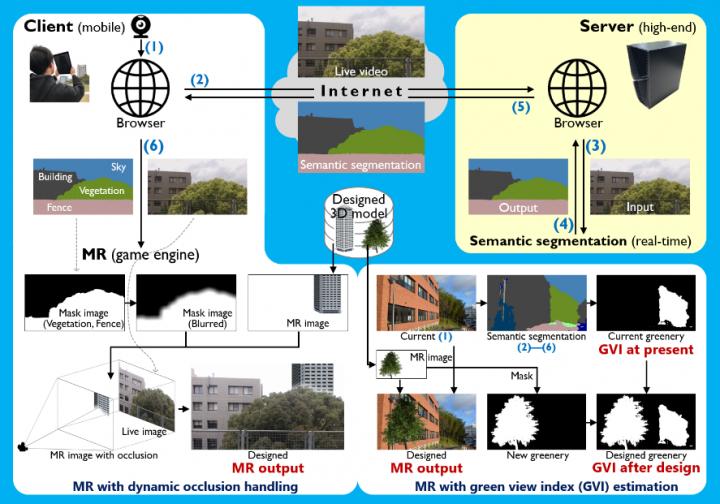
Researchers at Osaka University use machine learning to enhance the ability of a mixed-reality mobile viewer to digitally remove obstructions and add greenery, which may improve sustainable architecture and urban planning
IMAGE

Credit: Osaka University

Osaka, Japan – Scientists from the Division of Sustainable Energy and Environmental Engineering at Osaka University employed deep learning artificial intelligence to improve mobile mixed reality generation. They found that occluding objects recognized by the algorithm could be dynamically removed using a video game engine. This work may lead to a revolution in green architecture and city revitalization.

Mixed reality (MR) is a type of visual augmentation in which real-time images of existing objects or landscapes can be digitally altered. As anyone who has played Pokémon Go! or similar games knows, looking at a smartphone screen can feel almost like magic when characters appear alongside real landmarks. This approach can be applied for more serious undertakings as well, such as visualizing what a new building will look like once the existing structure is removed and trees added. However, this kind of digital erasure was thought to be too computationally intensive to generate in real time on a mobile device.

Now, researchers at Osaka University have demonstrated a new system that can construct a MR landscape visualization faster with the help of deep learning. The key is to train the algorithm with thousands of labeled images so that it can more quickly identify occlusions, like walls and fences. This allows for the automatic “semantic segmentation” of the view into elements to be kept and others to be masked. The program also quantitatively measured the Green View Index (GVI), which is the fraction of greenery areas including plants and trees in a person’s visual field, in either the current or proposed layout. “We were able to implement both dynamic occlusion and Green View Index estimation in our mixed reality viewer,” corresponding author Tomohiro Fukuda says.

Live video is sent to a semantic segmentation server, and the result is used to render the final view with a game engine on the mobile device. Proposed structures and greenery can be shown even when the viewing angle is changed. “Internet speed and latency were evaluated to ensure real-time MR rendering,” first author Daiki Kido explains. The team hopes this research will help stakeholders understand the importance of GVI on urban planning.

###

The article, “Assessing future landscapes using enhanced mixed reality with semantic segmentation by deep learning,” was published in Advanced Engineering Informatics at DOI: https://doi.org/10.1016/j.aei.2021.101281

About Osaka University

Osaka University was founded in 1931 as one of the seven imperial universities of Japan and is now one of Japan’s leading comprehensive universities with a broad disciplinary spectrum. This strength is coupled with a singular drive for innovation that extends throughout the scientific process, from fundamental research to the creation of applied technology with positive economic impacts. Its commitment to innovation has been recognized in Japan and around the world, being named Japan’s most innovative university in 2015 (Reuters 2015 Top 100) and one of the most innovative institutions in the world in 2017 (Innovative Universities and the Nature Index Innovation 2017). Now, Osaka University is leveraging its role as a Designated National University Corporation selected by the Ministry of Education, Culture, Sports, Science and Technology to contribute to innovation for human welfare, sustainable development of society, and social transformation.

Website: https://resou.osaka-u.ac.jp/en

Media Contact
Saori Obayashi
gi-strategy@cgin.osaka-u.ac.jp

Original Source

https://resou.osaka-u.ac.jp/en

Related Journal Article

http://dx.doi.org/10.1016/j.aei.2021.101281

Tags: Civil EngineeringIndustrial Engineering/ChemistryMultimedia/Networking/Interface DesignResearch/DevelopmentRobotry/Artificial IntelligenceSoftware EngineeringTechnology/Engineering/Computer ScienceUrbanization
Share12Tweet8Share2ShareShareShare2

Related Posts

New Electrochemiluminescence Immunosensor Enables Ultrasensitive Detection of Nectin-4

New Electrochemiluminescence Immunosensor Enables Ultrasensitive Detection of Nectin-4

November 9, 2026
Dried Pomegranate Snack Maintains Sensory and Biochemical Stability for Sixty Days

Dried Pomegranate Snack Maintains Sensory and Biochemical Stability for Sixty Days

November 9, 2026

Nanocomposite Polymer Coating Shields Carbon Steel From Saline Corrosion

November 9, 2026

Levelers Enable Defect-Free Copper Filling in Advanced Electronics

November 9, 2026
Please login to join discussion

POPULAR NEWS

  • Perceptually Guided Optimization Cuts Computational Costs for Personalized Spatial Audio Models

    Perceptually Guided Optimization Cuts Computational Costs for Personalized Spatial Audio Models

    29 shares
    Share 12 Tweet 7
  • Combined Aerobic and Strength Exercise Reduces Geriatric Depression in Controlled Trial

    29 shares
    Share 12 Tweet 7
  • Miniature Pig Kidney Atlas Reveals Developmental Dynamics and Key Regulator

    29 shares
    Share 12 Tweet 7
  • Genetic study reveals multiple invasion paths for invasive snail in Brazil

    29 shares
    Share 12 Tweet 7

About

We bring you the latest biotechnology news from best research centers and universities around the world. Check our website.

Follow us

Recent News

Ethiopian Study Identifies Tailored Mobile Health Strategies to Boost Maternal Care

Targeted Social Disruptions Reshape Dominance Patterns in Parakeet Groups

Young Adults With Insomnia Show Early Cardiac Dysfunction in Case-Control Study

Subscribe to Blog via Email

Enter your email address to subscribe to this blog and receive notifications of new posts by email.

Join 87 other subscribers
  • Contact Us

Bioengineer.org © Copyright 2023 All Rights Reserved.

Welcome Back!

Login to your account below

Forgotten Password?

Retrieve your password

Please enter your username or email address to reset your password.

Log In
No Result
View All Result
  • Homepages
    • Home Page 1
    • Home Page 2
  • News
  • National
  • Business
  • Health
  • Lifestyle
  • Science

Bioengineer.org © Copyright 2023 All Rights Reserved.