• HOME
  • NEWS
  • EXPLORE
    • CAREER
      • Companies
      • Jobs
    • EVENTS
    • iGEM
      • News
      • Team
    • PHOTOS
    • VIDEO
    • WIKI
  • BLOG
  • COMMUNITY
    • FACEBOOK
    • INSTAGRAM
    • TWITTER
Thursday, May 21, 2026
BIOENGINEER.ORG
No Result
View All Result
  • Login
  • HOME
  • NEWS
  • EXPLORE
    • CAREER
      • Companies
      • Jobs
        • Lecturer
        • PhD Studentship
        • Postdoc
        • Research Assistant
    • EVENTS
    • iGEM
      • News
      • Team
    • PHOTOS
    • VIDEO
    • WIKI
  • BLOG
  • COMMUNITY
    • FACEBOOK
    • INSTAGRAM
    • TWITTER
  • HOME
  • NEWS
  • EXPLORE
    • CAREER
      • Companies
      • Jobs
        • Lecturer
        • PhD Studentship
        • Postdoc
        • Research Assistant
    • EVENTS
    • iGEM
      • News
      • Team
    • PHOTOS
    • VIDEO
    • WIKI
  • BLOG
  • COMMUNITY
    • FACEBOOK
    • INSTAGRAM
    • TWITTER
No Result
View All Result
Bioengineer.org
No Result
View All Result
Home NEWS Science News Chemistry

Recurrent neural network advances 3D fluorescence imaging

Bioengineer by Bioengineer
March 23, 2021
in Chemistry
Reading Time: 2 mins read
0
IMAGE
Share on FacebookShare on TwitterShare on LinkedinShare on RedditShare on Telegram

IMAGE

Credit: by Ozcan Lab, UCLA

Rapid 3D microscopic imaging of fluorescent samples has gained increasing importance in numerous applications in physical and biomedical sciences. Given the limited axial range that a single 2D image can provide, 3D fluorescence imaging often requires time-consuming mechanical scanning of samples using a dense sampling grid. In addition to being slow and tedious, this approach also introduces additional light exposure on the sample, which might be toxic and cause unwanted damage, such as photo-bleaching.

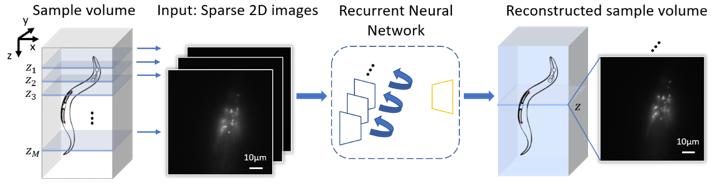
By devising a new recurrent neural network, UCLA researchers have demonstrated a deep learning-enabled volumetric microscopy framework for 3D imaging of fluorescent samples. This new method only requires a few 2D images of the sample to be acquired for reconstructing its 3D image, providing ~30-fold reduction in the number of scans required to image a fluorescent volume. The convolutional recurrent neural network that is at the heart of this 3D fluorescence imaging method intuitively mimics the human brain in processing information and storing memories, by consolidating frequently appearing and important object information and features, while forgetting or ignoring some of the redundant information. Using this recurrent neural network scheme, UCLA researchers successfully incorporated spatial features from multiple 2D images of a sample to rapidly reconstruct its 3D fluorescence image.

Published in Light: Science and Applications, the UCLA team demonstrated the success of this volumetric imaging framework using fluorescent C. Elegans samples, which are widely used as a model organism in biology and bioengineering. Compared with standard wide-field volumetric imaging that involves densely scanning of samples, this recurrent neural network-based image reconstruction approach provides a significant reduction in the number of required image scans, which also lowers the total light exposure on the sample. These advances offer much higher imaging speed for observing 3D specimen, while also mitigating photo-bleaching and phototoxicity related challenges that are frequently observed in 3D fluorescence imaging experiments of live samples.

###

This research is led by Professor Aydogan Ozcan, an associate director of the UCLA California NanoSystems Institute (CNSI) and the Volgenau Chair for Engineering Innovation at the electrical and computer engineering department at UCLA. The other authors include graduate students Luzhe Huang, Hanlong Chen, Yilin Luo and Professor Yair Rivenson, all from electrical and computer engineering department at UCLA. Ozcan also has UCLA faculty appointments in bioengineering and surgery, and is an HHMI professor.

Media Contact
Aydogan Ozcan
[email protected]

Related Journal Article

http://dx.doi.org/10.1038/s41377-021-00506-9

Tags: Chemistry/Physics/Materials SciencesOptics
Share13Tweet8Share2ShareShareShare2

Related Posts

Scientists Achieve Breakthrough in Molecular ‘Sandwich’ Assembly — Chemistry

Scientists Achieve Breakthrough in Molecular ‘Sandwich’ Assembly

May 21, 2026
Advancing In Vivo and In Situ Monitoring: Science Bulletin Highlights Host-Based Antifouling Gold Nanotube Sensor for Selective Detection of Mechanically Sensitive Serotonin Release in Intestinal Mucosa — Chemistry

Advancing In Vivo and In Situ Monitoring: Science Bulletin Highlights Host-Based Antifouling Gold Nanotube Sensor for Selective Detection of Mechanically Sensitive Serotonin Release in Intestinal Mucosa

May 20, 2026

How Magnetic Orientation Could Influence the Building Blocks of Life

May 20, 2026

Breaking a 200-Year-Old Belief: Novel Surface Design Achieves Two Distinct Wetting States on One Substrate

May 20, 2026
Please login to join discussion

POPULAR NEWS

  • blank

    New Study Reveals Plants Can Detect the Sound of Rain

    733 shares
    Share 292 Tweet 183
  • ESMO 2025: mRNA COVID Vaccines Enhance Efficacy of Cancer Immunotherapy

    304 shares
    Share 122 Tweet 76
  • Research Indicates Potential Connection Between Prenatal Medication Exposure and Elevated Autism Risk

    846 shares
    Share 338 Tweet 212
  • Breastmilk Balances E. coli and Beneficial Bacteria in Infant Gut Microbiomes

    58 shares
    Share 23 Tweet 15

About

We bring you the latest biotechnology news from best research centers and universities around the world. Check our website.

Follow us

Recent News

Innovative Reusable Brick Walls Revolutionize Construction Industry

Nonlinear Atomic Tunneling Enhanced by Bright Squeezed Vacuum

Label-Free Super-Resolution Imaging of Live Cells

Subscribe to Blog via Email

Enter your email address to subscribe to this blog and receive notifications of new posts by email.

Join 82 other subscribers
  • Contact Us

Bioengineer.org © Copyright 2023 All Rights Reserved.

Welcome Back!

Login to your account below

Forgotten Password?

Retrieve your password

Please enter your username or email address to reset your password.

Log In
No Result
View All Result
  • Homepages
    • Home Page 1
    • Home Page 2
  • News
  • National
  • Business
  • Health
  • Lifestyle
  • Science

Bioengineer.org © Copyright 2023 All Rights Reserved.