• HOME
  • NEWS
  • EXPLORE
    • CAREER
      • Companies
      • Jobs
    • EVENTS
    • iGEM
      • News
      • Team
    • PHOTOS
    • VIDEO
    • WIKI
  • BLOG
  • COMMUNITY
    • FACEBOOK
    • INSTAGRAM
    • TWITTER
Thursday, December 18, 2025
BIOENGINEER.ORG
No Result
View All Result
  • Login
  • HOME
  • NEWS
  • EXPLORE
    • CAREER
      • Companies
      • Jobs
        • Lecturer
        • PhD Studentship
        • Postdoc
        • Research Assistant
    • EVENTS
    • iGEM
      • News
      • Team
    • PHOTOS
    • VIDEO
    • WIKI
  • BLOG
  • COMMUNITY
    • FACEBOOK
    • INSTAGRAM
    • TWITTER
  • HOME
  • NEWS
  • EXPLORE
    • CAREER
      • Companies
      • Jobs
        • Lecturer
        • PhD Studentship
        • Postdoc
        • Research Assistant
    • EVENTS
    • iGEM
      • News
      • Team
    • PHOTOS
    • VIDEO
    • WIKI
  • BLOG
  • COMMUNITY
    • FACEBOOK
    • INSTAGRAM
    • TWITTER
No Result
View All Result
Bioengineer.org
No Result
View All Result
Home NEWS Science News Biology

Phytol may be promising for eco-friendly agrochemicals to control root-knot nematodes

Bioengineer by Bioengineer
March 22, 2021
in Biology
Reading Time: 2 mins read
0
IMAGE
Share on FacebookShare on TwitterShare on LinkedinShare on RedditShare on Telegram

IMAGE

Credit: Taketo Fujimoto, Hiroshi Abe, Takayuki Mizukubo, and Shigemi Seo

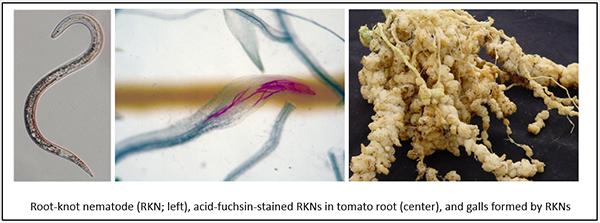
Root-knot nematodes (RKNs, Meloidogyne spp.) infect a broad range of plants, including several agriculturally important species such as cotton, soybean and corn, as well as various vegetables and ornamentals. These parasites cause roots to develop galls that result in severe plant damage and, ultimately, important crop losses. Growers currently use synthetic nematicides to manage RKNs; however, these compounds are detrimental to the microbial diversity of soil and harmful for the environment. Thus, it is necessary to develop alternative sustainable control methods.

“We have been seeking natural compounds that activate plant defense systems and do not have direct nematicidal activity using the combination of RKNs and their host plants,” explained Shigemi Seo, researcher at the National Institute of Agrobiological Sciences of Japan. “We were most excited to discover that phytol, a chlorophyll constituent, has an inhibitory effect on the root invasion by a certain harmful plant nematode without killing it. We did not expect this molecule to be involved in RKN resistance.”

“We noticed that plant leaves discolored yellow or pale green when their roots were parasitized by RKNs and confirmed a decrease in chlorophyll content in such leaves. We hypothesized that chloroplast-related compounds would accumulate in RKN-parasitized roots and induce the host defense against RKNs. We analyzed root metabolites and found accumulation of phytol, a constituent of chlorophyll. When phytol was applied to plant roots, RKN invasion of the roots was inhibited. This inhibition was not due to the direct nematicidal activity of phytol, since this compound did not kill RKNs,” added Seo.

Even though phytol has been known for several years as a constituent of chlorophyll and is a ubiquitous compound present in almost all photosynthetic organisms, its role as a plant defense-signaling molecule remained unexplored. “Phytol may be a promising material for eco-friendly agrochemicals for the control of RKNs. We are currently investigating its effects on not only other plant parasitic nematodes but also other pathogenic microorganisms.”
For more information about this study, read “Phytol, a Constituent of Chlorophyll, Induces Root-Knot Nematode Resistance in Arabidopsis via the Ethylene Signaling Pathway” in the MPMI journal.

###

Media Contact
Juan S. Ramirez-Prado
[email protected]

Related Journal Article

http://dx.doi.org/10.1094/MPMI-07-20-0186-R

Tags: Agricultural Production/EconomicsAgricultureBiologyBiotechnologyFertilizers/Pest ManagementFood/Food ScienceMicrobiologyMolecular BiologyPlant Sciences
Share12Tweet8Share2ShareShareShare2

Related Posts

blank

Lanthipeptides Linked to Genetic Exchange in Prokaryotes

December 18, 2025
blank

Comparing LEGU-1 and LGMN Interactions with Proton Pump Inhibitors

December 18, 2025

Two-Decade Shift in Parasite Communities of Paralonchurus Brasiliensis

December 18, 2025

Synovial Parasitosis, Biomarkers, and Osteoarthritis Links Explored

December 18, 2025
Please login to join discussion

POPULAR NEWS

  • Nurses’ Views on Online Learning: Effects on Performance

    Nurses’ Views on Online Learning: Effects on Performance

    70 shares
    Share 28 Tweet 18
  • NSF funds machine-learning research at UNO and UNL to study energy requirements of walking in older adults

    70 shares
    Share 28 Tweet 18
  • MoCK2 Kinase Shapes Mitochondrial Dynamics in Rice Fungal Pathogen

    72 shares
    Share 29 Tweet 18
  • Unraveling Levofloxacin’s Impact on Brain Function

    53 shares
    Share 21 Tweet 13
/div>

About

We bring you the latest biotechnology news from best research centers and universities around the world. Check our website.

Follow us

Recent News

Initial Head Posture Influences Neck Responses in Impacts

Single-Cell Transcriptomics Unravels Carotid Artery Diversity

Revolutionizing Smart Manufacturing with AI and IoT

Subscribe to Blog via Email

Enter your email address to subscribe to this blog and receive notifications of new posts by email.

Join 70 other subscribers
  • Contact Us

Bioengineer.org © Copyright 2023 All Rights Reserved.

Welcome Back!

Login to your account below

Forgotten Password?

Retrieve your password

Please enter your username or email address to reset your password.

Log In
No Result
View All Result
  • Homepages
    • Home Page 1
    • Home Page 2
  • News
  • National
  • Business
  • Health
  • Lifestyle
  • Science

Bioengineer.org © Copyright 2023 All Rights Reserved.