

• HOME
  • NEWS
  • EXPLORE
    • CAREER
      • Companies
      • Jobs
    • EVENTS
    • iGEM
      • News
      • Team
    • PHOTOS
    • VIDEO
    • WIKI
  • BLOG
  • COMMUNITY
    • FACEBOOK
    • INSTAGRAM
    • TWITTER
Saturday, February 7, 2026
BIOENGINEER.ORG
No Result
View All Result
  • Login
  • HOME
  • NEWS
  • EXPLORE
    • CAREER
      • Companies
      • Jobs
        • Lecturer
        • PhD Studentship
        • Postdoc
        • Research Assistant
    • EVENTS
    • iGEM
      • News
      • Team
    • PHOTOS
    • VIDEO
    • WIKI
  • BLOG
  • COMMUNITY
    • FACEBOOK
    • INSTAGRAM
    • TWITTER
  • HOME
  • NEWS
  • EXPLORE
    • CAREER
      • Companies
      • Jobs
        • Lecturer
        • PhD Studentship
        • Postdoc
        • Research Assistant
    • EVENTS
    • iGEM
      • News
      • Team
    • PHOTOS
    • VIDEO
    • WIKI
  • BLOG
  • COMMUNITY
    • FACEBOOK
    • INSTAGRAM
    • TWITTER
No Result
View All Result
Bioengineer.org
No Result
View All Result
Home NEWS Science News

New software improves accuracy of factories’ mass-produced 3D-printed parts

Bioengineer by Bioengineer
March 17, 2021
in Science News
Reading Time: 2 mins read
0
IMAGE
Share on FacebookShare on TwitterShare on LinkedinShare on RedditShare on Telegram

IMAGE

Credit: University of Illinois Urbana-Champaign

Researchers at University of Illinois Urbana-Champaign developed software to improve the accuracy of 3D-printed parts, seeking to reduce costs and waste for companies using additive manufacturing to mass produce parts in factories.

“Additive manufacturing is incredibly exciting and offers tremendous benefits, but consistency and accuracy on mass-produced 3D-printed parts can be an issue. As with any production technology, parts built should be as close to identical as possible, whether it is 10 parts or 10 million,” said Professor Bill King, Andersen Chair in the Department of Mechanical Science and Engineering and leader of the project.

The team’s software allows for the rapid and automatic measurement of additively manufactured parts – a processes that is typically time consuming and costly. It also allows for increased accuracy.

“Factories that rely on 3D printing are being built rapidly all over the world. Our software helps ensure production is consistent, accurate, and cost-effective,” King said.

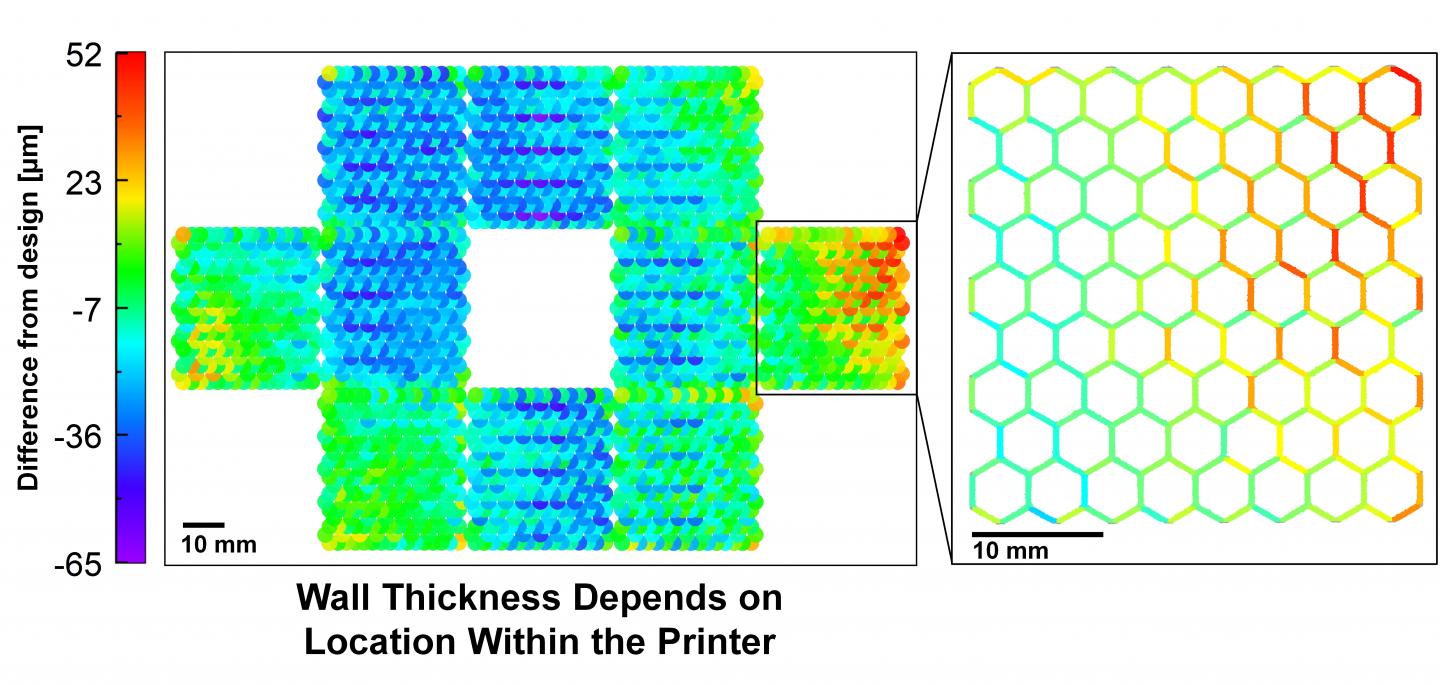
The software tracks how the accuracy of an additively manufactured part depends on which printer made the part and where the part was located in the printer. This process works by measuring parts using optical scanning technology and analysis of the scan data. This analysis allows a user to determine which parts are accurate and identifies which printers, and settings, produce the most accurate parts.

###

The University of Illinois researchers collaborated with engineers at Fast Radius Inc., a Chicago-based company with one of the world’s largest additive manufacturing factories. In 2018, the World Economic Forum identified Fast Radius as one of the world’s most advanced digital factories. King is one of the company’s co-founders and serves as its chief scientist.

The research was published this month in Additive Manufacturing, in an article titled: “Analyzing part accuracy and sources of variability for additively manufactured lattice parts made on multiple printers.” Authors on the study are Davis J. McGregor, Sameh Tawfick, and Chenhui Shao, and William King from University of Illinois, and Samuel Rylowicz, Aaron Brenzel, Daniel Baker, Charles Wood, David Pick, and Hallee Deutchman from Fast Radius.

Media Contact
Bill Bell
[email protected]

Related Journal Article

http://dx.doi.org/10.1016/j.addma.2021.101924

Tags: Business/EconomicsIndustrial Engineering/ChemistryResearch/DevelopmentTechnology TransferTechnology/Engineering/Computer Science
Share13Tweet8Share2ShareShareShare2

Related Posts

Barriers and Boosters of Seniors’ Physical Activity in Karachi

February 7, 2026

Evaluating Pediatric Emergency Care Quality in Ethiopia

February 7, 2026

TPMT Expression Predictions Linked to Azathioprine Side Effects

February 7, 2026

Improving Dementia Care with Enhanced Activity Kits

February 7, 2026
Please login to join discussion

POPULAR NEWS

  • Robotic Ureteral Reconstruction: A Novel Approach

    Robotic Ureteral Reconstruction: A Novel Approach

    82 shares
    Share 33 Tweet 21
  • Digital Privacy: Health Data Control in Incarceration

    63 shares
    Share 25 Tweet 16
  • Study Reveals Lipid Accumulation in ME/CFS Cells

    57 shares
    Share 23 Tweet 14
  • Breakthrough in RNA Research Accelerates Medical Innovations Timeline

    53 shares
    Share 21 Tweet 13

About

We bring you the latest biotechnology news from best research centers and universities around the world. Check our website.

Follow us

Recent News

Barriers and Boosters of Seniors’ Physical Activity in Karachi

Evaluating Pediatric Emergency Care Quality in Ethiopia

TPMT Expression Predictions Linked to Azathioprine Side Effects

Subscribe to Blog via Email

Enter your email address to subscribe to this blog and receive notifications of new posts by email.

Join 73 other subscribers
  • Contact Us

Bioengineer.org © Copyright 2023 All Rights Reserved.

Welcome Back!

Login to your account below

Forgotten Password?

Retrieve your password

Please enter your username or email address to reset your password.

Log In
No Result
View All Result
  • Homepages
    • Home Page 1
    • Home Page 2
  • News
  • National
  • Business
  • Health
  • Lifestyle
  • Science

Bioengineer.org © Copyright 2023 All Rights Reserved.

