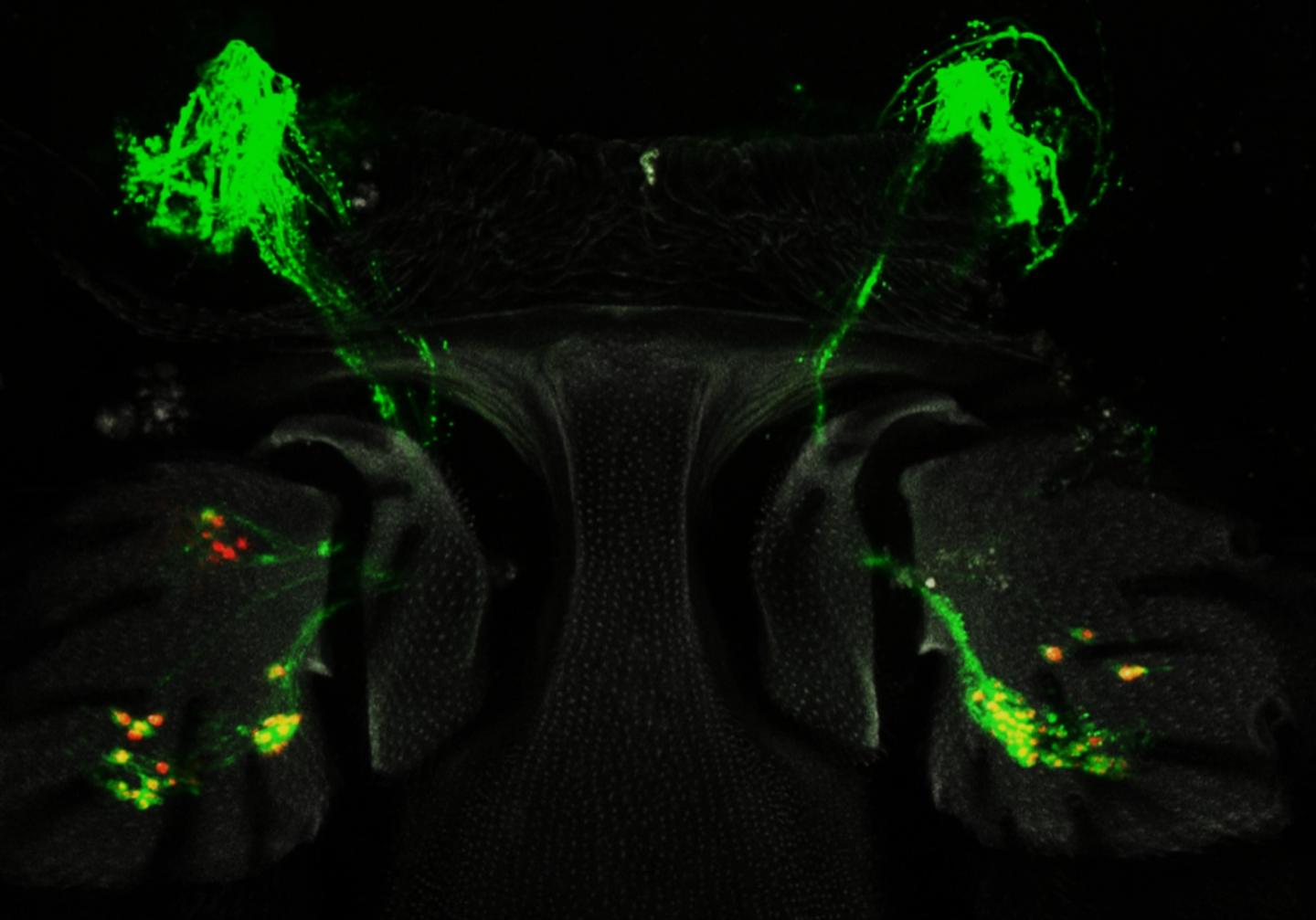
Credit: Image by Ismael Fernández-Hernández/Bonaguidi Lab
Even though a fruit fly doesn’t have ears, it can hear with its antennae. In a new study published in the journal Development, USC Stem Cell scientists describe how adult flies can regenerate sensory hearing cells in their antennae, and how studying flies can provide a new way to understand and develop treatments for the hundreds of millions of patients worldwide who live with hearing and balance disorders.
“Flies provide a powerful way to study the biology of hearing and balance at cellular, circuitry and behavioral levels. We can quickly and inexpensively perform sophisticated experiments on large swarms of flies, and we already possess a detailed map of their genomes and neural circuitry,” said postdoctoral fellow Ismael Fernández-Hernández, who led the study, along with co-author Evan Marsh and corresponding author Michael Bonaguidi.
In the fly, the sensory hearing cells are neurons located in a segment of their antennae known as the Johnston’s Organ, or JO. Despite differences in form, the genetic programs and function of these neurons are extremely similar in flies and mammals. The scientists were able to label, trace and view newborn JO neurons in live flies under microscopes.
In healthy flies, JO neurons were naturally turning over. The scientists set out to discover a distinct “cell type of origin.” Instead, they observed JO neurons proliferate and produce more of themselves–although this doesn’t rule out the potential for other types of cells to also produce JO neurons.
In flies given the chemotherapy drug cisplatin, which is known to kill sensory hearing cells, JO neurons compensated for the damage by proliferating even more. In flies given a different drug, known to enhance the generation of neurons in the brain, JO neurons similarly increased their proliferation.
The scientists also observed the JO neurons developing hair-like extensions known as cilia, and extending long nerve fibers called axons into hearing- and balance-related circuits in the brain. These features indicate that new JO neurons mature and may functionally remodel existing circuitry.
“Flies have the potential to provide many insights into how to promote the regeneration of sensory hearing cells,” said Bonaguidi, who is an assistant professor of stem cell biology and regenerative medicine at the Keck School of Medicine of USC. “This is such an important area of research, given that one in three people can expect to develop a hearing or balance disorder by the age of 80. Our results establish a new in vivo platform to expedite the search for compounds promoting their recovery.”
###
Twenty-five percent of this research was funded by federal grants from the National Institutes of Health (R00NS089013, R56AG064077). The remaining support came from a USC-CONACYT (Consejo Nacional de Ciencia y Tecnologia) Postdoctoral Scholars Program Fellowship, a USC Provost’s Postdoctoral Scholar Research Grant, a USC Provost Undergraduate Research Fellowship, the L.K. Whittier Foundation, the Donald E. and Delia B. Baxter Foundation, and The Eli and Edythe Broad Foundation.
Media Contact
Tana Watanabe
[email protected]
Original Source
https:/
Related Journal Article
http://dx.