


Federally funded study says drug delivery for certain common eye diseases could be improved
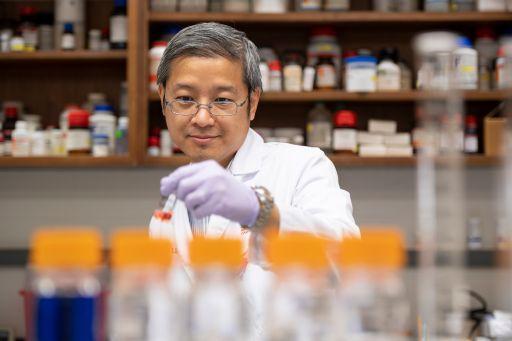
Credit: University of Cincinnati
Getting poked in the eye with a sharp object is a cringeworthy thought. However, many patients with posterior eye diseases — back of the eye diseases such as macular degeneration or diabetic retinopathy — undergo eye injections through the wall of the eye as a medical treatment on a regular basis.
“Direct injections of medications into the eye are not only an unpleasant experience but repeated injections can lead to severe adverse effects to the eye, which can be sight-threatening,” says Kevin Li, a University of Cincinnati pharmaceutical scientist who is leading a new research study of an alternative treatment for posterior eye diseases.
Li and colleagues in UC’s Department of Chemistry and Department of Ophthalmology, in collaboration with researchers at Cincinnati Children’s Hospital Medical Center and the Ohio State University, recently received a four-year, $1.6 million grant from the National Institutes of Health/National Eye Institute to develop a drug delivery system that is more efficient and longer lasting than conventional eye injections.
The researchers are working to develop an ocular drug delivery system based on RNA nanotechnology to deliver therapeutics into the eye that do not require an eye puncture but are instead injected under one of the layers called conjunctiva around the eye. This method will create a reservoir for the medications to treat the disease over time.
RNA is a messenger that carries genetic information to the cell machinery responsible for protein synthesis. RNA-based technology has been increasingly used for the development of therapeutics and vaccines. Success of this strategy also requires the development of improved analytical methodology for effective monitoring of the drug status.
“It will be a great benefit to the public if an effective drug delivery system can replace repeated intravitreal injections and allow effective nucleotide-based drug delivery for the treatments of these diseases,” says Li, a professor in UC’s James L. Winkle College of Pharmacy.
According to the National Eye Institute, posterior eye diseases such as macular degeneration and diabetic retinopathy affect millions of people in the United States each year.
“This technique would likely find an application in children as well, as they would have difficulty cooperating with a direct injection while awake, and it is desirable to avoid frequent anesthesias for repeated injections,” says Michael Yang, an ophthalmologist at Cincinnati Children’s.
Currently, the only effective treatments for these eye diseases are direct eye injections of medications. The injections, in addition to the unpleasant experience and adverse effects, Li says, “are also time-consuming and increase health care costs because the treatment must be delivered by a specialist, who is doing a minor surgery.” Therefore, he says, a more effective method of drug delivery and therapy is advantageous in the treatments of these sight-threatening diseases.
###
Collaborators include UC researchers Balasubrahmanyam Addepalli, PhD, Department of Chemistry, and Winston Kao, PhD, Department of Ophthalmology; Michael Yang, MD, Cincinnati Children’s Hospital Medical Center; and Peixuan Guo, PhD, College of Pharmacy at the Ohio State University.
Media Contact
Angela Koenig
[email protected]
Original Source
https:/


