• HOME
  • NEWS
  • EXPLORE
    • CAREER
      • Companies
      • Jobs
    • EVENTS
    • iGEM
      • News
      • Team
    • PHOTOS
    • VIDEO
    • WIKI
  • BLOG
  • COMMUNITY
    • FACEBOOK
    • INSTAGRAM
    • TWITTER
Sunday, May 10, 2026
BIOENGINEER.ORG
No Result
View All Result
  • Login
  • HOME
  • NEWS
  • EXPLORE
    • CAREER
      • Companies
      • Jobs
        • Lecturer
        • PhD Studentship
        • Postdoc
        • Research Assistant
    • EVENTS
    • iGEM
      • News
      • Team
    • PHOTOS
    • VIDEO
    • WIKI
  • BLOG
  • COMMUNITY
    • FACEBOOK
    • INSTAGRAM
    • TWITTER
  • HOME
  • NEWS
  • EXPLORE
    • CAREER
      • Companies
      • Jobs
        • Lecturer
        • PhD Studentship
        • Postdoc
        • Research Assistant
    • EVENTS
    • iGEM
      • News
      • Team
    • PHOTOS
    • VIDEO
    • WIKI
  • BLOG
  • COMMUNITY
    • FACEBOOK
    • INSTAGRAM
    • TWITTER
No Result
View All Result
Bioengineer.org
No Result
View All Result
Home NEWS Science News Chemistry

SwRI researcher theorizes worlds with underground oceans support, conceal life

Bioengineer by Bioengineer
March 16, 2021
in Chemistry
Reading Time: 3 mins read
0
IMAGE
Share on FacebookShare on TwitterShare on LinkedinShare on RedditShare on Telegram

Layers of ice and rock obviate the need for “habitable zone” and shield life against threats
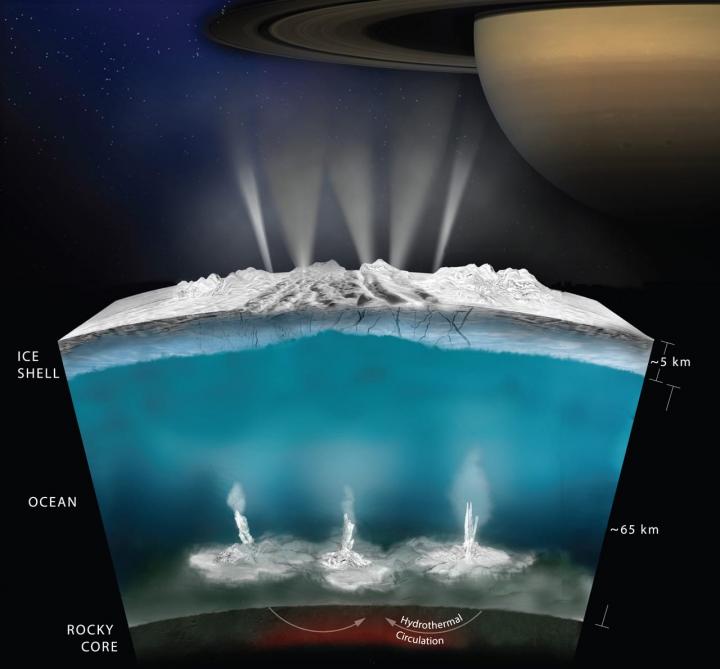
IMAGE

Credit: NASA/JPL-Caltech/Southwest Research Institute

SAN ANTONIO — March 16, 2021 — One of the most profound discoveries in planetary science over the past 25 years is that worlds with oceans beneath layers of rock and ice are common in our solar system. Such worlds include the icy satellites of the giant planets, like Europa, Titan and Enceladus, and distant planets like Pluto.

In a report presented at the 52nd annual Lunar and Planetary Science Conference (LPSC 52) this week, Southwest Research Institute planetary scientist S. Alan Stern writes that the prevalence of interior water ocean worlds (IWOWs) in our solar system suggests they may be prevalent in other star systems as well, vastly expanding the conditions for planetary habitability and biological survival over time.

It has been known for many years that worlds like Earth, with oceans that lie on their surface, must reside within a narrow range of distances from their stars to maintain the temperatures that preserve those oceans. However, IWOWs are found over a much wider range of distances from their stars. This greatly expands the number of habitable worlds likely to exist across the galaxy.

Worlds like Earth, with oceans on their exterior, are also subject to many kinds of threats to life, ranging from asteroid and comet impacts, to stellar flares with dangerous radiation, to nearby supernova explosions and more. Stern’s paper points out that IWOWs are impervious to such threats because their oceans are protected by a roof of ice and rock, typically several to many tens of kilometers thick, that overlie their oceans.

“Interior water ocean worlds are better suited to provide many kinds of environmental stability, and are less likely to suffer threats to life from their own atmosphere, their star, their solar system, and the galaxy, than are worlds like Earth, which have their oceans on the outside,” said Stern.

He also points out that the same layer of rock and ice that protects the oceans on IWOWs also conceals life from being detected by virtually all astronomical techniques. If such worlds are the predominant abodes of life in the galaxy and if intelligent life arises in them — both big “ifs,” Stern emphasizes — then IWOWs may also help crack the so-called Fermi Paradox. Posed by Nobel Laureate Enrico Fermi in the early 1960s, the Fermi Paradox questions why we don’t see obvious evidence of life if it’s prevalent across the universe.

“The same protective layer of ice and rock that creates stable environments for life also sequesters that life from easy detection,” said Stern.

###

In 2015, NASA created the Ocean Worlds Exploration Program, which seeks to explore an ocean world to determine habitability and seek life. Moons that harbor oceans under a shell of ice, such as Europa and Titan, are already the targets of NASA missions to study the habitability of these worlds.

The paper, “Some Implications for Both Life and Civilizations Regarding Interior Water Ocean Worlds” at LPSC 52 is available at https://www.hou.usra.edu/meetings/lpsc2021/pdf/1180.pdf.

To learn more about ocean worlds, watch https://youtu.be/_9AYw2EQm8s and https://youtu.be/086N-X1Bd2o.

For more information, visit https://www.swri.org/planetary-science.

Media Contact
Maria Stothoff
[email protected]

Original Source

https://www.swri.org/press-release/swri-researcher-theorizes-worlds-underground-oceans ?utm_source=EurekAlert!&utm_medium=Distribution&utm_campaign=Fermi_Peridox-PR

Tags: AstronomyAstrophysicsPlanets/MoonsSpace/Planetary ScienceStars/The Sun
Share12Tweet8Share2ShareShareShare2

Related Posts

Miniature Sensor Uses Light to Detect Touch — Chemistry

Miniature Sensor Uses Light to Detect Touch

May 8, 2026
Iron Minerals Determine Whether Dissolved Organic Matter Fuels Microbes or Becomes Long-Term Carbon Storage — Chemistry

Iron Minerals Determine Whether Dissolved Organic Matter Fuels Microbes or Becomes Long-Term Carbon Storage

May 8, 2026

Kate Evans Appointed Associate Lab Director for Biological and Environmental Systems Science at ORNL

May 8, 2026

Advancing Multiscale Modeling and Overcoming Operational Challenges in Autothermal COâ‚‚-to-Methanol Reactors

May 8, 2026
Please login to join discussion

POPULAR NEWS

  • Research Indicates Potential Connection Between Prenatal Medication Exposure and Elevated Autism Risk

    840 shares
    Share 336 Tweet 210
  • New Study Reveals Plants Can Detect the Sound of Rain

    727 shares
    Share 290 Tweet 181
  • Scientists Investigate Possible Connection Between COVID-19 and Increased Lung Cancer Risk

    68 shares
    Share 27 Tweet 17
  • Salmonella Haem Blocks Macrophages, Boosts Infection

    61 shares
    Share 24 Tweet 15

About

We bring you the latest biotechnology news from best research centers and universities around the world. Check our website.

Follow us

Recent News

Evaluating Digoxin Use in Patients with Symptomatic Rheumatic Heart Disease

Evaluating the Effectiveness and Safety of Digitalis Glycosides in Treating Heart Failure

Urdu Fall Risk Questionnaire Adapted for Elderly

Subscribe to Blog via Email

Enter your email address to subscribe to this blog and receive notifications of new posts by email.

Join 82 other subscribers
  • Contact Us

Bioengineer.org © Copyright 2023 All Rights Reserved.

Welcome Back!

Login to your account below

Forgotten Password?

Retrieve your password

Please enter your username or email address to reset your password.

Log In
No Result
View All Result
  • Homepages
    • Home Page 1
    • Home Page 2
  • News
  • National
  • Business
  • Health
  • Lifestyle
  • Science

Bioengineer.org © Copyright 2023 All Rights Reserved.