• HOME
  • NEWS
  • EXPLORE
    • CAREER
      • Companies
      • Jobs
    • EVENTS
    • iGEM
      • News
      • Team
    • PHOTOS
    • VIDEO
    • WIKI
  • BLOG
  • COMMUNITY
    • FACEBOOK
    • INSTAGRAM
    • TWITTER
Thursday, June 25, 2026
BIOENGINEER.ORG
No Result
View All Result
  • Login
  • HOME
  • NEWS
  • EXPLORE
    • CAREER
      • Companies
      • Jobs
        • Lecturer
        • PhD Studentship
        • Postdoc
        • Research Assistant
    • EVENTS
    • iGEM
      • News
      • Team
    • PHOTOS
    • VIDEO
    • WIKI
  • BLOG
  • COMMUNITY
    • FACEBOOK
    • INSTAGRAM
    • TWITTER
  • HOME
  • NEWS
  • EXPLORE
    • CAREER
      • Companies
      • Jobs
        • Lecturer
        • PhD Studentship
        • Postdoc
        • Research Assistant
    • EVENTS
    • iGEM
      • News
      • Team
    • PHOTOS
    • VIDEO
    • WIKI
  • BLOG
  • COMMUNITY
    • FACEBOOK
    • INSTAGRAM
    • TWITTER
No Result
View All Result
Bioengineer.org
No Result
View All Result
Home NEWS Science News Health

Fear of COVID-19 :

Bioengineer by Bioengineer
March 15, 2021
in Health
Reading Time: 2 mins read
0
IMAGE
Share on FacebookShare on TwitterShare on LinkedinShare on RedditShare on Telegram

Psychological, not environmental factors are important
IMAGE

Credit: (© Stephanie Eder)

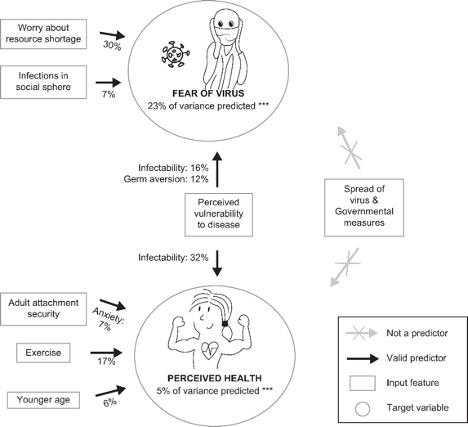
During pandemics, protective behaviors need to be motivated by effective communication. A critical factor in understanding a population’s response to such a threat is the fear it elicits, since fear both contributes to motivating protective responses, but can also lead to panic-driven behaviors. Furthermore, lockdown measures affect well-being, making it important to identify protective factors that help to maintain high perceived levels of health during restrictions. An international team of researchers led by scientists from the University of Vienna has now identified psychological predictors of fear and health during the lockdowns. The result of the study, published in PLOS ONE: Individual psychological variables have a much better predictive power than environmental variables.

The current publication aims to identify predictors of fear and perceived health during stay-at-home orders in response to the COVID-19 pandemic. “This way we can predict how different people and populations will react to external threats and restrictions,” explains Stephanie Eder from the Faculty of Psychology.

Researchers from the University of Vienna in collaboration with scientists from the University of Wroclaw (PL), University of Barcelona (ESP), Charles University and Jan Evangelista Purkyne University (CZ) have investigated 533 participants during the ‘first wave’ of the COVID-19 pandemic in Europe.

Utilizing machine-learning models, they identified psychological predictors of fear and health during the lockdowns. Fear can be predicted very well when worries about shortages in supply, perceived infectability to diseases in general, germ aversion, and infections in the immediate social sphere are taken into account. Predictors of perceived health include higher perceived infectability to diseases in general, attachment security, physical activity and younger age; suggesting that older populations with high perceived infectability and insecure attachment may be most vulnerable during these uncertain times.

Interestingly, environmental variables such as the local severity of lockdown restrictions and mortality had no predictive value for either of the target variables.
“We could show the value of ‘micro-level’, psychological factors over macro-scale environmental conditions when predicting a population’s response to a crisis and when designing behavioral interventions for specific target groups.”, says Eder.

###

Other aspects of this pandemic have been investigated as part of the same project and can be accessed over the Open Science Framework:
https://osf.io/db4px/

Publication in PlosOne:

Eder, S. J., Steyrl, D., Stefanczyk, M., M., Pieniak, M., Molina, J. M., Pešout, O., … Nicholson, A. (2021). Predicting fear and perceived health during the COVID-19 pandemic using machine learning: A cross-national longitudinal study. PLOS ONE. DOI: 10.1371/journal.pone.0247997

Media Contact
MSc. Stephanie Eder
[email protected]

Related Journal Article

http://dx.doi.org/10.1371/journal.pone.0247997

Tags: Coping/PhobiasMental HealthPublic HealthSocial/Behavioral ScienceStress/Anxiety
Share12Tweet8Share2ShareShareShare2

Related Posts

Tracking Lanthanide-Labeled Microplastics in Plants

June 25, 2026

Neural Design Enables Zero-Shot Drug-Binding Proteins

June 25, 2026

Genomic Insights into Human Skin Fungi Diversity

June 25, 2026

Chiral Laser Gyroscopes Surpass Lock-In Limit

June 25, 2026
Please login to join discussion

POPULAR NEWS

  • Saying Goodbye to PGY-6: Pediatric Fellowship Realities

    103 shares
    Share 41 Tweet 26
  • Multi-Hospital Study Reveals Long Covid Burden Is Twice as High as Current Estimates

    92 shares
    Share 36 Tweet 23
  • Detection of EDCs in Breast Milk and Infant Urine Up to Six Months Highlights Early Exposure Risks

    77 shares
    Share 31 Tweet 19
  • New Drug Candidate Developed at McMaster Shows Potential for Treating Brain Cancer

    58 shares
    Share 23 Tweet 15

About

We bring you the latest biotechnology news from best research centers and universities around the world. Check our website.

Follow us

Recent News

Tracking Lanthanide-Labeled Microplastics in Plants

POSTECH Researchers Slash Cost of Reconstituted Cell-Free Systems by 95%

AI and Physics Collaborate to Design Advanced Hydrogen Storage Materials

Subscribe to Blog via Email

Enter your email address to subscribe to this blog and receive notifications of new posts by email.

Join 82 other subscribers
  • Contact Us

Bioengineer.org © Copyright 2023 All Rights Reserved.

Welcome Back!

Login to your account below

Forgotten Password?

Retrieve your password

Please enter your username or email address to reset your password.

Log In
No Result
View All Result
  • Homepages
    • Home Page 1
    • Home Page 2
  • News
  • National
  • Business
  • Health
  • Lifestyle
  • Science

Bioengineer.org © Copyright 2023 All Rights Reserved.