Astronomers have detected a moving supermassive black hole
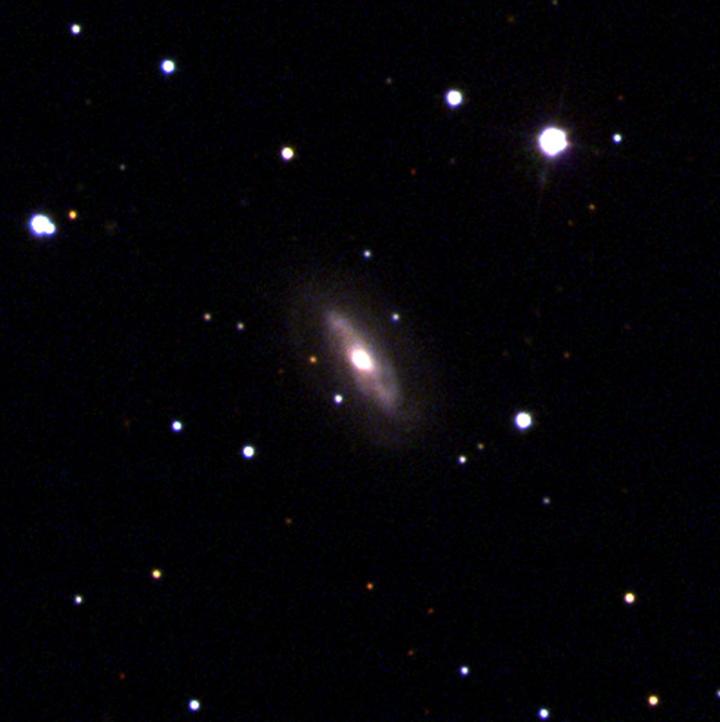
Credit: Sloan Digital Sky Survey (SDSS).
Scientists have long theorized that supermassive black holes can wander through space–but catching them in the act has proven difficult.
Now, researchers at the Center for Astrophysics | Harvard & Smithsonian have identified the clearest case to date of a supermassive black hole in motion. Their results are published today in the Astrophysical Journal.
“We don’t expect the majority of supermassive black holes to be moving; they’re usually content to just sit around,” says Dominic Pesce, an astronomer at the Center for Astrophysics who led the study. “They’re just so heavy that it’s tough to get them going. Consider how much more difficult it is to kick a bowling ball into motion than it is to kick a soccer ball — realizing that in this case, the ‘bowling ball’ is several million times the mass of our Sun. That’s going to require a pretty mighty kick.”
Pesce and his collaborators have been working to observe this rare occurrence for the last five years by comparing the velocities of supermassive black holes and galaxies.
“We asked: Are the velocities of the black holes the same as the velocities of the galaxies they reside in?” he explains. “We expect them to have the same velocity. If they don’t, that implies the black hole has been disturbed.”
For their search, the team initially surveyed 10 distant galaxies and the supermassive black holes at their cores. They specifically studied black holes that contained water within their accretion disks — the spiral structures that spin inward towards the black hole.
As the water orbits around the black hole, it produces a laser-like beam of radio light known as a maser. When studied with a combined network of radio antennas using a technique known as very long baseline interferometry (VLBI), masers can help measure a black hole’s velocity very precisely, Pesce says.
The technique helped the team determine that nine of the 10 supermassive black holes were at rest–but one stood out and seemed to be in motion.
Located 230 million light-years away from Earth, the black hole sits at the center of a galaxy named J0437+2456. Its mass is about three million times that of our Sun.
Using follow-up observations with the Arecibo and Gemini Observatories, the team has now confirmed their initial findings. The supermassive black hole is moving with a speed of about 110,000 miles per hour inside the galaxy J0437+2456.
But what’s causing the motion is not known. The team suspects there are two possibilities.
“We may be observing the aftermath of two supermassive black holes merging,” says Jim Condon, a radio astronomer at the National Radio Astronomy Observatory who was involved in the study. “The result of such a merger can cause the newborn black hole to recoil, and we may be watching it in the act of recoiling or as it settles down again.”
But there’s another, perhaps even more exciting possibility: the black hole may be part of a binary system.
“Despite every expectation that they really ought to be out there in some abundance, scientists have had a hard time identifying clear examples of binary supermassive black holes,” Pesce says. “What we could be seeing in the galaxy J0437+2456 is one of the black holes in such a pair, with the other remaining hidden to our radio observations because of its lack of maser emission.”
Further observations, however, will ultimately be needed to pin down the true cause of this supermassive black hole’s unusual motion.
###
Co-authors of the new study are Anil Seth of the University of Utah; Jenny Greene of Princeton University; Jim Braatz, Jim Condon, and Brian Kent of the National Radio Astronomy Observatory; and Davor Krajnovi? of the Leibniz Institute for Astrophysics in Potsdam, Germany.
About the Center for Astrophysics | Harvard & Smithsonian
The Center for Astrophysics | Harvard & Smithsonian is a collaboration between Harvard and the Smithsonian designed to ask–and ultimately answer–humanity’s greatest unresolved questions about the nature of the universe. The Center for Astrophysics is headquartered in Cambridge, MA, with research facilities across the U.S. and around the world.
Media Contact
Nadia Whitehead
[email protected]
Related Journal Article
http://dx.